ASL: Language & Community - Amy Andersen - Fifth Grade
6/5/2020 | 55m 26sVideo has Closed Captions
Students will learn the three dimensions of American Sign Language.
In this lesson, students will learn the three dimensions of American Sign Language, meet members of the Deaf community, and learn how ASL is part of a culture of people.
Problems playing video? | Closed Captioning Feedback
Problems playing video? | Closed Captioning Feedback
NJTV Learning Live is a local public television program presented by NJ PBS
ASL: Language & Community - Amy Andersen - Fifth Grade
6/5/2020 | 55m 26sVideo has Closed Captions
In this lesson, students will learn the three dimensions of American Sign Language, meet members of the Deaf community, and learn how ASL is part of a culture of people.
Problems playing video? | Closed Captioning Feedback
How to Watch NJTV Learning Live
NJTV Learning Live is available to stream on pbs.org and the free PBS App, available on iPhone, Apple TV, Android TV, Android smartphones, Amazon Fire TV, Amazon Fire Tablet, Roku, Samsung Smart TV, LG TV, and Vizio.
Providing Support for PBS.org
Learn Moreabout PBS online sponsorshipMore from This Collection
NJTV Learning Live is a class for fifth graders taught by NJ public school teachers.
Galloping through Art Movements - Jason DeMaria -Fifth Grade
Video has Closed Captions
Students will identify artworks from art movements throughout the 19th and 21st centuries. (56m 24s)

National Holidays: Why Celebrate? -Jason Glezman-Fifth Grade
Video has Closed Captions
Students will explore the national holidays that are celebrated in the United States. (58m 46s)
Spoken Word Poetry - Thais Jackson - Fifth Grade
Video has Closed Captions
Students will learn the craft of writing, listening, and performing Spoken Word Poetry. (57m 27s)
Coordinate Planes with Corey Plane -Lauren Proda-Fifth Grade
Video has Closed Captions
Students will learn how to graph points on the coordinate plane to create and read maps. (57m 1s)
Design a Creature - Maria Montroni-Currais - Fifth Grade
Video has Closed Captions
Students will analyze attributes of ecosystems and then create a brand-new creature. (53m 38s)
Decimal Dash! - Melissa Winters - Fifth Grade
Video has Closed Captions
Using a variety of sports statistics, students will compare, add, and subtract decimals. (56m 59s)
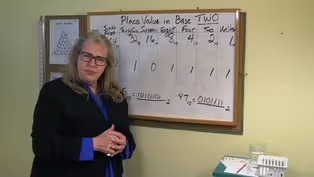
Exploring Place Value - Kristin Baker - Fifth Grade
Video has Closed Captions
Students will examine the structures of the Base Ten and Base Two place value systems. (56m 57s)
Close Reading - Tanya White - Fifth Grade
Video has Closed Captions
Students will explore how to closely analyze a text using the Close Reading method. (56m 2s)
Survival at Morristown - Christopher Kopitar - Fifth Grade
Video has Closed Captions
Students will learn about the Continental Army's survival during the American Revolution. (56m 37s)
The Elements of Drama - Maleesa Lamatina - Fifth Grade
Video has Closed Captions
The students will learn basic terms for the elements of drama. (55m 38s)
Descriptive Writing: Snacks - Christine Skalka - Fifth Grade
Video has Closed Captions
Students will learn how to write a descriptive paragraph, using their favorite snack food. (57m 57s)
The Sun: Living with a Star - Mary Lou DeCaprio -Fifth Grade
Video has Closed Captions
Students will learn how all that allows our planet to run can be due to the Sun's power. (56m 10s)
Providing Support for PBS.org
Learn Moreabout PBS online sponsorship- Hello there!
My name is Miss Anderson, and I teach American Sign Language, at Ocean City High School.
We are all the way at the very, very bottom of New Jersey.
And I am so excited to see all of you here today.
Well, sort of see you.
I know you're there.
(sighs) One of the hardest things about the quarantine and staying at home, has been that I miss my students so much.
So I'm really excited that all of you are here, and we can learn ASL together.
ASL.
America Sign Language.
And I know you've already had a couple lessons on ASL, so far since we've been home.
So I'm excited to teach you some more.
I'm gonna teach you three things about ASL.
Language, community and connection.
Language.
Okay, here's something I need you to think about.
What is the same, and what is different about ASL and English?
Are they just the same language?
Think about it, 'cause I'm gonna ask you in a little bit.
Community.
There is a huge, wonderful deaf community.
And one of the best parts for me about learning ASL, is all of the people who are part of deaf culture that I've gotten to meet.
It's amazing and a wonderful, wonderful way to learn to actually be within the culture of a community that uses a certain language.
And in this case, ASL is used by the deaf community.
I'm even gonna share with you, some of my friends later on, who are gonna tell you about their lives, and some things that they do.
And finally, connection.
This is gonna be really, really fun.
Connection, it relates to ASL, in how the deaf community and the hearing community can be brought together.
We're gonna learn about how music can connect the deaf and hearing community.
And it's one of the things that my high school students love the most about ASL.
So let's go!
Now, some of the things that you'll need today, for our lesson, are two or three pieces of paper.
It could be a piece of computer paper, lined paper, a scrap piece of paper.
And then, you'll need something to write with.
Definitely a pen or a pencil.
And if you wanna bring crayons or colored pencils or colored markers, you can do that as well.
Okay, so we're ready.
I just had to do my signing warmup exercises.
Shake out those fingers.
Okay, just kidding.
Remember, we talked about three different aspects of ASL, that we were gonna learn today.
The first one is language.
This is how you sign, language.
Language.
For the language portion of our lesson, I'm gonna teach you some signs that you'll need to be able to do an activity.
And we're also gonna learn how to put signs together, so they're in ASL grammar.
Grammar.
Okay, the grammar of a language is the system and the structure, the rules that make that language its own.
Are you ready?
Now I'm gonna ask you some questions.
Just yell at your TV.
Number one.
Is French a language?
Is Spanish a language?
Is German a language?
Is ASL a language?
I hope all of your answers were yes, because yes, French, Spanish, German, and ASL are all equal languages.
Do you think that you could speak in French and Spanish at the same time?
Of course not, right?
That would be crazy.
Alright, how about, could you write in German and speak English at the same time?
No way!
Maybe Superman.
But I know I couldn't.
Here's the last question.
Do you think you can speak in English and sign in ASL at the same time?
Now, the answer is no.
Why?
Because the grammatical structures are different.
The grammar of English, the order that you say the words, and the grammar of ASL, the system and the structure of the language are completely different.
So when I'm teaching you today, I'm gonna turn off my voice, 'cause I can only use one language at the same time.
And when you're signing back with me, I want you to do the same thing.
Turn off your voice.
(upbeat music) Are you ready?
Alright, turn off your voice.
Let's go.
So now, we're gonna learn.
This is how you sign, learn.
Put your hands into fists, and act like you're driving a car.
Now just hold on.
He is a dog.
See how I have three fingers, and it's like I'm snapping.
Dog.
Hey, you're a dog.
Are you a dog?
Dog.
I have one, nope, two dogs.
Two.
He's a dog.
Draw.
Draw.
So, I have an open palm, and an I. Not the index finger, it's your pinky.
Draw.
Paper.
Two hands, like this.
Twist your hand away from the other, paper.
See this?
Paper.
Now remember, draw.
So paper, with one hand.
And then draw, I just changed the other hand to an I. Green.
It's like I'm pinching somebody.
Please don't pinch anybody.
Green.
B, thumbs closed.
Blue.
Blue.
Cat.
Can you see sort of that picture of a cat?
So you can use two hands or one, cat.
You guys are doin' great.
What is that?
Tree.
Tree.
And this one down here, house.
It's like I'm making a roof and the two sides of the walls.
Alright, let's do them all again.
Do you remember, what?
What was this one?
Car.
How about this?
Dog.
This one, what was it?
Draw.
Alright, how do I sign paper?
Paper, great.
How 'bout this one?
Green.
What?
Blue.
What's that one?
Cat.
Great job, you guys are doin' good.
What's this?
Tree.
And, house.
You learned a lot!
Good job!
Now, we're gonna stop that kind of learning, and we're gonna play a game.
We're gonna play a game.
Now, do you have your paper?
What is this again, how do you sign it?
Do you remember?
Paper, paper.
So I want you to grab your paper, and you're gonna rip it into four pieces.
Two, three, four.
Four pieces of paper.
Now watch me.
I'm gonna fold it.
(fun music) Here we go, two and two, four.
Now, you are gonna grab your paper.
What's the sign again?
You're gonna grab a pen or a pencil.
Or you could use a colored marker.
Either one is fine.
Now you can pick any four signs.
First one I'm gonna do is cat.
And I'm gonna write the word cat on my paper.
Alright, now we have to do another one.
Get a second piece of paper.
Hm, which one should I pick?
Blue!
I'm gonna write the word blue on this piece of paper.
So on all four pieces, you're gonna write one word.
And you can pick any four words.
Are you done?
Alright, now we can play a game.
(upbeat music) Okay, so you've got your paper.
You've got four pieces, you're sitting on the floor.
And you're gonna put that paper out in front of you, just like we saw in that picture.
Make sure you can see all four words.
I'm gonna do a sign.
If you have the paper with the word that I sign, you're gonna take it out of the pile.
The object of the game, is to get rid of all of your papers, so that there's nothing.
Are you ready?
I'm gonna turn my voice off now.
So look and see, do you have that sign?
If you do, take the paper out.
If you don't, maybe next time.
Here's the next one.
Do you have it?
Yes?
Alright, take it out of the pile.
Here's the next sign.
How 'bout this one?
Do you have it?
Is it one of your four?
I forget what the words are.
Oh, here's another one.
Do any of you have all of your paper gone?
Is it empty?
Maybe you only have one left, maybe.
Alright, here's another one.
So that game, you could play with the people who live in your house.
Other adults or other children, that live in your house or your apartment.
You can teach them the signs, and then go ahead and play together.
I am really proud of all of you.
We've learned nine signs.
We played a game.
We've talked about how ASL and English are two different languages.
We've learned that you can't sign in ASL and speak in English at the same time, just like you can't write in German and speak in Spanish at the same time.
So now you're ready to put it all together, and try to form a sentence in ASL.
When we think about English, we call it a linear language.
Because the words are arranged in a line.
There's one word right after the other.
American Sign Language is a spatial language.
It's visual and it's spatial.
And by that, I mean we use our signing space to make what we're signing three dimensional.
So I'm gonna take you through a little exercise, and see how you do.
For this, you're gonna need another piece of paper.
So hopefully, that didn't go far.
And, a pen or a pencil.
You can get crayons or colored pencils, if you like, but you don't have to.
So I'll give you a couple minutes to do that, and then we'll meet back here.
(gentle music) (upbeat music) Suppose I wanted to sign the English sentence, my house is green, and your house is blue.
How would I sign that in ASL?
Now in English, we have, my house is green, we have one word right after the other.
But we know, in ASL, we're not gonna do that.
Well, let's take a break for a minute.
I want you to take your piece of paper, your pen or pencil or your crayon, colored pencil, and I want you to draw that sentence.
My house is green, your house is blue.
Now, when you're making this picture, when you're drawing, you're gonna label what you draw first, and what you draw second, third and fourth.
Okay, so again, you're gonna draw the picture, my house is green, your house is blue.
Go ahead and give it a try.
(exciting music) Did you draw one of the houses first?
That's exactly right.
We can't make a house green until the house is on the paper.
In ASL, we can't sign about a house, and describe it, until it's in our signing space.
So the first sign that I would do, and I would point to right where it is in my signing space.
Do you remember this sign?
My, your.
My, your.
And you've already learned house.
What would I draw next?
Did you draw the next house?
Exactly right.
So I've got.
So now, I can imagine I've got two houses in my signing space.
And on your paper, you should have two houses also.
Okay, what's the last part that I have to do to have my whole sentence represented on the page and represented with my hands?
My house is green, and your house is blue.
Did you color the house green?
And the other house blue?
Exactly right.
Now guess how we would sign it.
Wait!
Do you remember the signs for blue and green?
Okay, now watch and see if you follow.
Did you get it?
You wanna try to sign it along with me?
Let's sign it together.
And a look over in that direction.
Did you do it?
This is how we applaud in ASL.
Hands waving in the air.
Okay, let's try another one.
Now, I want you to think about the sentence, the dog is sitting on my car.
Go ahead, and try to draw that on a piece of paper.
Remember to label what you draw first, and what you draw second.
Did you draw the car first?
Exactly right.
And that's what we would sign first.
Remember the sign for car.
And I'm gonna use this hand shape to represent the car, and I'm gonna put it right here, in my signing space.
Okay, so I've got the car in my signing space, and you have the car on your paper.
What do I have to draw next, or what did you already draw next?
Did you draw the dog next?
Perfect!
So I couldn't put the dog on my car in my picture, until the car was there, right?
In ASL, I can't show the dog sitting on a car, until I've put the car in my signing space.
You wanna try it with me?
This hand shape, these two hand shapes, actually are called classifiers.
And it just means that they're hand shapes that represent a noun.
It can also show a preposition, like where something is in relation to something else.
It can show how something's moving, so it can act like an adverb.
All kinds of different things you can do with classifiers.
For us, right now, we're gonna just use them as a place holder in our signing space, as we're creating the sentence.
So the dog was sitting on my car.
You guys are awesome.
So now, you know nine new signs.
And you've learned how to set up your signs in your signing space, so that it really looks like ASL.
I'm so proud of you.
It's now time for the second part of our lesson, community.
I am so excited to be able to introduce you to some of my friends in the deaf community.
Whenever I talk about, or sign about ASL, I always include our deaf community, because they are the culture of people who use ASL.
And it is our honor to learn their language.
I am so grateful to all of the deaf teachers, colleagues and friends, who have been in my life, and continue to be in my life, helping me to learn ASL and about deaf culture.
So, I knew the best way to share some of that with you, would be to just share my friends with you.
The first friend I'm going to share with you, is Mr.
Channing Brown, Mr.
Brown.
He's a professional video editor.
And as soon as I asked him to be part of this lesson, he said yes, and has prepared a wonderful video for all of you.
So here he is, Mr.
Brown.
(upbeat music) - What's up?
My name's Channing.
That intro you just watched, prior to this, I actually shot all that on my iPhone.
The point I wanna make is that you don't need fancy, expensive cameras, like the ones that cost probably $1,000 to $25,000, just to make good films.
Nonsense.
You can use anything you have, cheap phones, laptops, tablets, anything.
What's really important, your ideas and your creativity, something that you just want to put out there for your audience to see and observe.
I grew up, always fascinated by technology, TV, and the film industry.
But back then, it was very tough trying to learn how to do something in that industry.
But nowadays, we have tons of resources available out there.
And it is all very accessible, as well.
Like I said before, you don't need expensive equipment, like a computer or expensive software or cameras.
You could use free software.
You could use cheap equipment, or your own phone.
You could use YouTube as a resource to learn how.
Guess what?
That's how I learned how to do a lot of stuff myself.
YouTube.
Don't feel held back by your own doubts.
I'm not ready.
I don't know how.
I don't feel good enough at it.
You have to knock down these barriers of self-doubt.
Go ahead, you can do it.
How else are you going to start?
Create whatever comes to mind, even if you do not think it's good.
You still deserve to make that first step.
Then you'll know how to take the second step after that.
I did that myself, and now I work with National Deaf News.
We cover a wide variety of topics for the deaf audience, for our app or websites, that viewers can catch up on news and events, happening all over, or important information.
If this is similar to your future goals, but you feel hesitant, because you think you have to finish high school, or wait until college first, that's okay.
Yes, your education is important, too.
But really, you could go ahead and take advantage by learning how to do a lot of stuff now.
We live in an impressive, technologically advanced world.
You don't need to feel like you have to sit and wait.
Go ahead, learn whatever you wanna learn, because that knowledge will greatly benefit you for your own future.
You've probably thought, "Aw, I have to go to Hollywood," or, "I have to go to NYC to learn how to do this stuff."
You could learn a lot by doing that, but a lot of local colleges have courses on how to work with TV and film, how to operate cameras, edit videos, everything.
But really, a lot of resources are already available on the internet, for you to take advantage of.
If you want to create content as a YouTube vlogger, or you want to become a Twitch streamer, or you want to make short films, or you prefer to express creatively through words, you could become a script writer.
If you feel more of an artistic person, you could work with art for movies, and help design different ideas for characters, for scenery, environments, stages.
If you are into photography, and you want to get into the film/video industry, you can!
They go hand in hand.
We have so many different opportunities for everyone.
You don't have to specialize in just film or TV.
You could get into the video game design, or create stories and plots for video games, or anything you'd want, really.
Go ahead, take advantage.
Don't ever doubt yourself.
Do it.
If you have an idea, show it to the world now.
If you have a story you wanna tell, go ahead and write it.
Show the world what you wanna tell them.
Make your story come alive.
- Wasn't Channing awesome?
Do you feel inspired?
Are you ready to go out and write that story?
Create that piece of art?
Get into the film business?
I hope so.
If that's your dream, as he said, "Go for it."
The next friend I wanna introduce you to, is Miss Tiffany Narciso.
And I have known Tiffany since she was three years old.
Can you imagine?
And I'm not telling you how long ago that was, 'cause then you'll be able to do some nifty math real quick, and figure out how old I am.
So, anyway.
Tiffany was in a preschool classroom, here in the Cape May County area.
And when I would come home from college, when I started learning American Sign Language, I would volunteer in that classroom.
And that's the first time I met Tiffany.
I saw her again recently, when she moved back to this area, after spending almost five years in the Marshall Islands, establishing their deaf education program, and their parent, infant outreach program.
So she works with deaf babies.
And she's gonna share with you, one of the videos that she created about Earth Day.
This video went to parents, who are now home, in the quarantine, and unable to have deaf mentors come and work with their deaf babies.
So this was a way for Tiffany to get that ASL exposure out to the babies that she works with.
And I think it's super cool.
Here it is.
(upbeat music) (reflective music) Okay, it's time for the last section, connection.
I'm already feeling kind of sad that we're gonna have to say good-bye soon.
But I'm glad you've been here this whole time, and this is going to be the most fun part yet.
So connection.
We learned about the language and how it's its own distinct language, ASL.
We learned about the deaf community.
You met a deaf video editor, professional video editor.
You met a deaf teacher of ASL, who works specifically with babies.
I don't know if you've noticed, but all of these pictures were all created, and the pictures on my wall, by deaf artists.
So when I buy artwork, that has to do with American Sign Language, or the deaf community, I always look for art that's been designed by a deaf artist.
Chuck Baird is the artist, who's done some of this work.
Nancy Rourke has done the artwork that's always in primary colors.
That's part of her style.
So it's red, blue and yellow.
And you can see those.
And then behind me, is Brittany Castle's work, which I just love.
And those are the signs for inspire, imagination and brave.
Hmm.
Brave.
That reminds me.
What's coming up next is gonna show you just how music connects the deaf and the hearing community.
Okay, next, we're going to watch a clip from a show, called "Little Big Shots," and a nine year old girl, named Savannah, who also happens to be deaf.
Let's watch her perform.
♪ You can be amazing ♪ ♪ You can turn a phrase into a weapon or a drug ♪ ♪ You can be the outcast or be the backlash ♪ ♪ Of somebody's lack of love ♪ ♪ Or you can start speakin' up ♪ ♪ Nothing's gonna hurt you the way that words do ♪ ♪ When they settle 'neath your skin ♪ ♪ Kept on the inside and no sunlight ♪ ♪ Sometimes a shadow wins ♪ ♪ But I wonder what would happen if you ♪ ♪ Say what you wanna say ♪ ♪ And let the words fall out ♪ ♪ Honestly, I wanna see you be brave ♪ ♪ With what you want to say ♪ ♪ And let the words fall out ♪ ♪ Honestly, I wanna see you be brave ♪ ♪ And since your history of silence ♪ ♪ Won't do you any good ♪ ♪ Did you think it would ♪ ♪ Let your words be anything but empty ♪ ♪ Why don't you tell them the truth ♪ ♪ Say what you wanna say ♪ ♪ And let the words fall out ♪ ♪ Honestly, I wanna see you be brave ♪ ♪ I just wanna see you ♪ ♪ Just wanna see you ♪ ♪ Just wanna see you ♪ (audience applauding) Was that the coolest thing you've ever seen?
That was Savannah.
She's nine years old.
She also happens to be deaf, and she was on the show, "Little Big Shots."
And for her talent, she signed the song, "Brave," by Sara Bareilles.
So, I thought it would be fun for us to learn part of that song, too, and sign along.
So, it would be a lot to learn the whole song.
We really couldn't do that in the amount of time we have left.
Do you see how I just looked at my wrist, and I don't even have a watch on?
But we can learn the chorus.
We can learn the chorus.
So, I'm gonna go through the signs with you.
Remember when we learn new signs, what do we do?
Ready?
Say.
You're gonna take your index finger on your chin, and it comes out, say.
What.
Want.
What, right, say.
With just learned that one.
Let.
So both hands are in that one.
Okay, words.
You know the sign for green, right?
G. So it's almost the same, but it goes right on your index finger.
Words fall out, or sign them, express them.
Alright, honesty.
We have these two hands shapes.
And that's the movement.
I. Want.
To see you.
Here's the picture with the sign.
Do you think you got it?
Let's go through it one more time, and then we'll try to sign it with the music.
As you're signing this, I want you to think about how brave you are, how brave you've been, how brave our healthcare workers and our first responders have been.
Rosie thinks she's been brave, too.
I don't know.
Alright, one more time before we do it with the music.
I think you got it.
Alright, one more time before we do it with the music.
I think you got it.
Here we go.
We're gonna watch Savannah sign the verses, and then we're gonna jump in for the chorus.
Get all stretched out and warmed up.
(audience applauding) (upbeat music) ♪ You can be amazing ♪ ♪ You can turn a phrase into a weapon or a drug ♪ ♪ You can be the outcast ♪ ♪ Or be the backlash of somebody's lack of love ♪ ♪ Or you can start speaking up ♪ ♪ Nothin's gonna hurt you the way that words do ♪ ♪ When they settle 'neath your skin ♪ ♪ Kept on the inside and no sunlight ♪ ♪ Sometimes a shadow wins ♪ ♪ But I wonder what would happen if you ♪ ♪ Say what you wanna say ♪ ♪ And let the words fall out ♪ ♪ Honestly, I wanna see you be brave ♪ ♪ With what you wanna say ♪ ♪ And let the words fall out ♪ ♪ Honestly, I wanna see you be brave ♪ (audience applauding) (upbeat music) ♪ You can be amazing ♪ ♪ You can turn a phrase into a weapon or a drug ♪ ♪ You can be the outcast ♪ ♪ Or be the backlash of somebody's lack of love ♪ ♪ Or you can start speaking up ♪ ♪ Nothin's gonna hurt you the way that words do ♪ ♪ When they settle 'neath your skin ♪ ♪ Kept on the inside and no sunlight ♪ ♪ Sometimes a shadow wins ♪ ♪ And I wonder what would happen if you ♪ ♪ Say what you wanna say ♪ ♪ And let the words fall out ♪ ♪ Honestly, I wanna see you be brave ♪ ♪ With what you wanna say ♪ ♪ And let the words fall out ♪ ♪ Honestly, I wanna see you be brave ♪ That was great!
You did it!
I'm so proud of you.
Thank you, so much, for being here with me today.
I had a great time with all of you, and I hope you learned a lot too.
Remember, American Sign Language has three components, language, community, connection.
Have a wonderful afternoon.
Bye!
Did you really think I was gone?
No way!
I have one more thing I wanna share with you.
Remember at the beginning, when I was talking about how music connects the deaf community and the hearing community?
And how my high school students absolutely love signing and songs and music.
Well, they made a very special video while we were on quarantine.
Many of them have friends or family who are first responders or healthcare workers or working in our grocery stores, doing all of the important jobs that are helping all of us get through this time.
So they wanted to make a special video just for the people who are heroes today, that we really wanna thank.
And I wanna share that with you as I say good-bye.
- Hi, my name's Marissa.
I'm a student at Ocean City High School, and a member of the ASL Club.
Today, my friends and I, from Ocean City High School's ASL Club, are here to present an American Sign Language translation of the song, "Rise Up," by Andra Day.
This is a tribute to all of the people that are working everyday to keep all of us safe.
The pictures that you see in this video, are of family and friends from ASL Club members.
We would like to say thank you for all that you have done and all that you are doing.
We will rise up.
♪ You're broken down and tired ♪ ♪ Of livin' life on the merry-go-round ♪ ♪ And you can't find a fighter ♪ ♪ But I see it in you so we gonna walk it out ♪ ♪ Move mountains ♪ ♪ We gonna walk it out ♪ ♪ And move mountains ♪ ♪ And I'll rise up ♪ ♪ I'll rise like the day ♪ ♪ I'll rise up ♪ ♪ I'll rise unafraid ♪ ♪ I'll rise up ♪ ♪ And I'll do it a thousand times again ♪ ♪ And I'll rise up ♪ ♪ High like the waves ♪ ♪ I'll rise up ♪ ♪ In spite of the ache ♪ ♪ I'll rise up ♪ ♪ And I'll do it a thousand times again ♪ ♪ For you ♪ ♪ For you ♪ ♪ For you ♪ ♪ For you ♪ ♪ When the silence isn't quiet ♪ ♪ And it feels like it's getting hard to breathe ♪ ♪ And I know you feel like dyin' ♪ ♪ But I promise we'll take the world to its feet ♪ ♪ Move mountains ♪ ♪ Bring it to its feet ♪ ♪ Move mountains ♪ ♪ And I'll rise up ♪ ♪ I'll rise like the day ♪ ♪ I'll rise up ♪ ♪ I'll rise unafraid ♪ ♪ I'll rise up ♪ ♪ And I'll do it a thousand times again ♪ ♪ For you ♪ ♪ For you ♪ ♪ For you ♪ ♪ For you ♪ ♪ All we need, all we need is hope ♪ ♪ And for that we have each other ♪ ♪ And for that we have each other ♪ ♪ And we will rise ♪ ♪ We will rise ♪ ♪ We'll rise up ♪ ♪ We'll rise ♪ ♪ Oh, we'll rise ♪ ♪ I'll rise up ♪ ♪ Rise like the day ♪ ♪ I'll rise up ♪ ♪ In spite of the ache ♪ ♪ I will rise a thousand times again ♪ ♪ And we'll rise up ♪ ♪ High like the waves ♪ ♪ We'll rise up ♪ ♪ In spite of the ache ♪ ♪ We'll rise up ♪ ♪ And we'll do it a thousand times again ♪ ♪ For you ♪ ♪ For you ♪ ♪ For you ♪ ♪ For you ♪ ♪ Ha-Ah ♪ ♪ Ha-Ah ♪ ♪ Ha-Ah ♪














Support for PBS provided by:
NJTV Learning Live is a local public television program presented by NJ PBS