
Report raises concerns about generic drug quality testing
Clip: 1/11/2026 | 5m 15sVideo has Closed Captions
Investigation raises concerns about lack of FDA quality testing for generic drugs
By some estimates, about 90% of prescriptions in the U.S. are filled with generic drugs. The Food and Drug Administration says that all agency-approved generic drugs “have the same high quality” as brand-name drugs, but a ProPublica investigation found that the FDA rarely tests the quality of generic drugs. John Yang speaks with investigative reporter Debbie Cenziper for more.
Problems playing video? | Closed Captioning Feedback
Problems playing video? | Closed Captioning Feedback
Major corporate funding for the PBS News Hour is provided by BDO, BNSF, Consumer Cellular, American Cruise Lines, and Raymond James. Funding for the PBS NewsHour Weekend is provided by...
Report raises concerns about generic drug quality testing
Clip: 1/11/2026 | 5m 15sVideo has Closed Captions
By some estimates, about 90% of prescriptions in the U.S. are filled with generic drugs. The Food and Drug Administration says that all agency-approved generic drugs “have the same high quality” as brand-name drugs, but a ProPublica investigation found that the FDA rarely tests the quality of generic drugs. John Yang speaks with investigative reporter Debbie Cenziper for more.
Problems playing video? | Closed Captioning Feedback
How to Watch PBS News Hour
PBS News Hour is available to stream on pbs.org and the free PBS App, available on iPhone, Apple TV, Android TV, Android smartphones, Amazon Fire TV, Amazon Fire Tablet, Roku, Samsung Smart TV, and Vizio.
Providing Support for PBS.org
Learn Moreabout PBS online sponsorshipBy some estimates, about 90 percent of all prescriptions in the United States are filled with generic drugs.
Insurance companies encourage their use over brand name medications to reduce health care costs.
The Food and Drug Administration says that all agency approved generic drugs have the same high quality, strength, purity and stability.
As brand name drugs.
But a ProPublic investigation found that the FDA rarely tests the quality of generic drugs, many of them manufactured overseas.
National reporter Debbie Cenziper of ProPublica was one of the authors of that investigation.
Debbie, the FDA doesn't test these drugs, but you independently tested some of the most widely used generic drugs.
What did you find?
DEBBIE CENZIPER, National Reporter, ProPublica: Yeah, we did because the FDA isn't regularly testing drugs.
And what we found in this testing is that there were certain versions of widely prescribed generic drugs that had concerning results because they didn't dissolve properly in the body.
JOHN YANG: Have patients or other people expressed concerns about this in the past?
DEBBIE CENZIPER: Absolutely, and it's one of the reasons we did the testing in the first place.
And that is because doctors, pharmacists, consumers, academic researchers, even the Department of Defense has raised concerns about the quality of some of our generic drugs.
And despite all of that, the FDA does not have a regular testing program.
The agency doesn't regularly test for quality and safety issues.
JOHN YANG: Do they do that with brand name medications?
DEBBIE CENZIPER: No.
I mean, the FDA publicly reports the names of the drugs that they test, including brand name drugs and over the counter drugs, but there's no regular testing program.
They say they test based on risk, but what we found is that they're not regularly testing drugs coming in from some of the most troubled factories overseas.
JOHN YANG: What's the FDA's rationale for this?
DEBBIE CENZIPER: The FDA just by just didn't think it would work right, because they would only be testing a sample, a small sample, a moment in time, and it wouldn't necessarily pick up on trends and wider concerns.
But the Department of Defense is now testing 40 or so drugs because they are concerned about contaminants and other things that can go wrong.
Not all generics are the same as brand name drugs, and doctors and patients have been saying that for years.
JOHN YANG: Talk about what patients are saying.
Have there been specific cases where people have said that the generic doesn't feel the same as the brand name or that they wonder about the effects?
DEBBIE CENZIPER: Absolutely.
And that's really what struck us as reporters, is how many people just turn to social media and say, something's not right with this drug.
One of the drugs we had tested was bupropion.
It's antidepressant.
And so many people for so many years have been saying when they switch from the brand Wellbutrin to a generic or from one version of a generic to another, they get all kinds of funny symptoms or worse, they just feel the drug is ineffective.
And doctors might say, well, meaning doctors who are busy might say, something's wrong with, it's just you, it's your body, or it's Mother Nature or it's God, or it's bad luck.
But it actually might be that drug, that version doesn't work the same as the brand.
And for too long, we haven't really been asking those questions.
JOHN YANG: In addition to testing these generics yourself or the ProPublica doing it, you've also created a tool where people can check what's in their medicine cabinets.
Tell us about that.
DEBBIE CENZIPER: We really at ProPublica wanted to empower consumers to take control of their own health care by creating a tool.
It's free, it's a lookup tool.
It's called RX Inspector, where you can actually take the information on the labels of your pill bottle, stick it in this tool, figure out where your drugs were made the factory that made it and whether that factory has ever been in trouble with the FDA for substandard manufacturing practices.
JOHN YANG: And where do people go to get this tool?
DEBBIE CENZIPER: Right on ProPublica's website, we're free.
It's called RX Inspector.
But I think it's important to note that even if you find something, a bad inspection for a factory that makes your drug, it doesn't necessarily mean that your generic is unsafe and that you should stop taking the drug.
Right.
I mean, you should always talk to your health care provider.
But we really felt like this was information that had never been made public before, not by the FDA and not by the drug makers themselves.
And so we spent many months putting this tool together for consumers.
JOHN YANG: Debbie Cenziper of ProPublica, thank you very much.
DEBBIE CENZIPER: Thank you for having me.
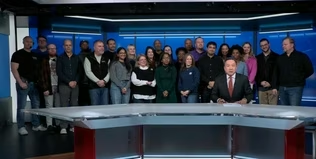
Highlights from PBS News Weekend as show goes off the air
Video has Closed Captions
Clip: 1/11/2026 | 6m 41s | Highlights from PBS News Weekend as show goes off the air (6m 41s)

How social media lures migrants into treacherous journeys
Video has Closed Captions
Clip: 1/11/2026 | 6m 31s | How social media lures migrants into undertaking treacherous journeys (6m 31s)

News Wrap: Iran warns U.S. against supporting protesters
Video has Closed Captions
Clip: 1/11/2026 | 1m 44s | News Wrap: Iran threatens retaliation if U.S. intervenes in protest crackdown (1m 44s)

Scientists use new tech to track monarch butterfly migration
Video has Closed Captions
Clip: 1/11/2026 | 4m 53s | Scientists use new technology to track individual monarch butterfly migrations (4m 53s)
Providing Support for PBS.org
Learn Moreabout PBS online sponsorship
- News and Public Affairs

FRONTLINE is investigative journalism that questions, explains and changes our world.

- News and Public Affairs

Amanpour and Company features conversations with leaders and decision makers.











Support for PBS provided by:
Major corporate funding for the PBS News Hour is provided by BDO, BNSF, Consumer Cellular, American Cruise Lines, and Raymond James. Funding for the PBS NewsHour Weekend is provided by...