
How bags of ice are helping save lives in Phoenix
Clip: 8/26/2026 | 3m 36sVideo has Closed Captions
In one of the nation's hottest cities, bags of ice are helping save lives
Extreme heat is the deadliest weather-related threat in the U.S. In Phoenix, heat kills more people than homicides each year. So the city is turning to an unlikely lifesaver: bags of ice. And the fire department is creating a new model in the battle against heatstroke. For our series, Tipping Point, Ben Tracy of Climate Central shows how this low-tech approach is saving lives.
Problems playing video? | Closed Captioning Feedback
Problems playing video? | Closed Captioning Feedback
Major corporate funding for the PBS News Hour is provided by BDO, BNSF, Consumer Cellular, American Cruise Lines, and Raymond James. Funding for the PBS NewsHour Weekend is provided by...
How bags of ice are helping save lives in Phoenix
Clip: 8/26/2026 | 3m 36sVideo has Closed Captions
Extreme heat is the deadliest weather-related threat in the U.S. In Phoenix, heat kills more people than homicides each year. So the city is turning to an unlikely lifesaver: bags of ice. And the fire department is creating a new model in the battle against heatstroke. For our series, Tipping Point, Ben Tracy of Climate Central shows how this low-tech approach is saving lives.
Problems playing video? | Closed Captioning Feedback
Where to Watch PBS News Hour
PBS News Hour is available to stream on pbs.org and the PBS app.
Providing Support for PBS.org
Learn Moreabout PBS online sponsorshipGEOFF BENNETT: Across the South, another punishing stretch of extreme heat is taking hold.
In Phoenix, temperatures were expected to reach 115 degrees today.
And the danger goes well beyond discomfort.
Extreme heat kills more Americans than any other weather-related hazard.
AMNA NAWAZ: In Phoenix, heat kills more people than homicides each year.
So the city is turning to an unlikely lifesaver, bags of ice.
And the fire department is creating a new model in the battle against heatstroke.
Special correspondent Ben Tracy of Climate Central shows how this low-tech approach is saving lives, part of our series Tipping Point.
BEN TRACY: Where what are we heading to right now?
COLIN KENNEDY, Phoenix, Arizona, Fire Department: So, right now, we're going to 50s female outside of a Dollar Store.
BEN TRACY: Phoenix Firefighter Colin Kennedy always knows one number.
COLIN KENNEDY: It's 105, 106 degrees.
The pavement is hot.
BEN TRACY: They find a woman having a stroke on a hot sidewalk.
If her temperature hit 104 degrees, they would put her inside one of these blue bags and fill it with ice water.
Firefighters demonstrated what is now their standard heatstroke protocol to quickly cool a person down on their way to the E.R.
CAPT.
DAVE KIRK, Phoenix, Arizona, Fire Department: We have a bag and we have ice and we're saving lives with it.
BEN TRACY: Captain Dave Kirk says cold water immersion began with the military.
With climate change driving longer, hotter heat waves, Phoenix faces 39 more hot summer days compared to 1970.
And Climate Central found that dangerous multiday heat streaks are increasing nationwide.
Old ways of treating heatstroke no longer cut it.
CAPT.
DAVE KIRK: Putting ice packs around the neck area, the groin area, and then giving cold I.V.
fluids.
BEN TRACY: How much more effective is this approach of putting somebody in this bag of ice?
CAPT.
DAVE KIRK: It's night and day.
BEN TRACY: It can cool patients up to three to five times faster, critical to avoiding brain damage and organ failure.
Here in America's hottest city, where firefighters train in the searing sun, every fire station now has something you would find at a gas station.
COLIN KENNEDY: We have got eight bags at seven pounds each inside essentially a large trash bag right now, and this bag is going to come out and it's going to come with us on the call.
So, right now, we have been dispatched to a person down at a bus stop, unconscious person.
BEN TRACY: Just this summer, they have used the rapid cooling bags more than 220 times.
They also stockpile ice at popular trailheads to cool overheated hikers like this one on the spot.
COLIN KENNEDY: We're seeing people go from 108, 109, 110 core body temperature to 101 or 100 degrees even by the time they arrive at the hospital.
BEN TRACY: At this Phoenix hospital, Dr.
Geoff Comp has been training his team on the protocol for a few years.
Why is putting somebody basically in ice water more effective?
DR.
GEOFF COMP, Valleywise Health Medical Center: Because it's fast.
The thermal conductivity of water is so much faster than air.
Zip him up.
BEN TRACY: He says cooling patients before the E.R.
is a game changer.
DR.
GEOFF COMP: If we're able to decrease the amount of time that the patient is impacted by that higher temperature, it's going to be better.
By doing this, we're decreasing mortality.
We're saving people's lives.
BEN TRACY: A new weapon in the cold war on heat.
For the "PBS News Hour," I'm Ben Tracy with Climate Central.

Custody fight erupts after surrogate refused to get abortion
Video has Closed Captions
Custody fight erupts after surrogate refuses abortion for baby with heart condition (4m 56s)
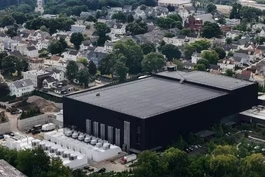
How data centers became a major issue in the midterms
Video has Closed Captions
How data centers became a major issue in the midterms (8m 2s)

Martina McBride shares her favorite Dolly Parton memories
Video has Closed Captions
Martina McBride shares her favorite Dolly Parton memories (5m 56s)
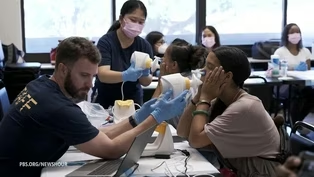
Maui residents face health struggles years after wildfires
Video has Closed Captions
Maui residents face health struggles 3 years after wildfires (8m 15s)

Meta case puts focus on youth mental health, Colo. AG says
Video has Closed Captions
$17B Meta settlement puts focus on youth mental health crisis, Colorado AG says (7m 14s)

News Wrap: States sue USPS over Trump’s mail-in voting order
Video has Closed Captions
News Wrap: States sue USPS, challenging Trump’s order on mail-in voting (4m 43s)
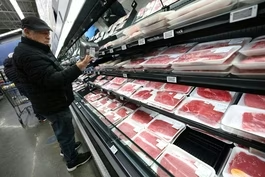
Trump faces backlash from ranchers over plan to import beef
Video has Closed Captions
Trump faces backlash from ranchers over plan to import beef (6m 55s)
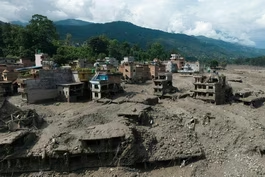
Wall of mud and debris floods communities in Nepal and Tibet
Video has Closed Captions
Wall of mud and debris floods communities in Nepal and Tibet (2m 35s)
Providing Support for PBS.org
Learn Moreabout PBS online sponsorship
- News and Public Affairs

FRONTLINE is investigative journalism that questions, explains and changes our world.
 New Episode
- News and Public Affairs

Today's top journalists discuss Washington's current political events and public affairs.

 New Episode
 New Episode
 New Episode
 New Episode
 New Episode
 New Episode

 New Episode
 New Episode
Support for PBS provided by:
Major corporate funding for the PBS News Hour is provided by BDO, BNSF, Consumer Cellular, American Cruise Lines, and Raymond James. Funding for the PBS NewsHour Weekend is provided by...