
Let's Get Moving! - Kelly Cerbone - Sixth Grade
4/7/2020 | 57m 44sVideo has Closed Captions
Lesson brings physics to the real world with demonstrations of Newton's 3 Laws of Motion.
Lesson brings physics to the real world with demonstrations of Newton's 3 Laws of Motion. Created by NJTV in partnership with the NJEA and the NJ Department of Education, NJTV Learning Live remote learning classes are for grades 3-6, taught by NJ public school teachers. One-hour lessons include math, science, English language arts, social studies, physical education and more.
Problems playing video? | Closed Captioning Feedback
Problems playing video? | Closed Captioning Feedback
NJTV Learning Live is a local public television program presented by NJ PBS
Let's Get Moving! - Kelly Cerbone - Sixth Grade
4/7/2020 | 57m 44sVideo has Closed Captions
Lesson brings physics to the real world with demonstrations of Newton's 3 Laws of Motion. Created by NJTV in partnership with the NJEA and the NJ Department of Education, NJTV Learning Live remote learning classes are for grades 3-6, taught by NJ public school teachers. One-hour lessons include math, science, English language arts, social studies, physical education and more.
Problems playing video? | Closed Captioning Feedback
How to Watch NJTV Learning Live
NJTV Learning Live is available to stream on pbs.org and the free PBS App, available on iPhone, Apple TV, Android TV, Android smartphones, Amazon Fire TV, Amazon Fire Tablet, Roku, Samsung Smart TV, LG TV, and Vizio.
Providing Support for PBS.org
Learn Moreabout PBS online sponsorshipMore from This Collection
NJTV Learning Live is a class for sixth graders taught by NJ public school teachers.
Food Makes You Move - Kyle Hering - Sixth Grade
Video has Closed Captions
We look at how nutrition and physical activity play a role in taking care of our bodies. (58m 44s)
DNA: Language of Life - Megan Graziano - Sixth Grade
Video has Closed Captions
Students will answer the questions: What is DNA? What does DNA look like? How is it made? (56m 49s)
Science is "Egg" Citing - Dr. Robin McLean
Video has Closed Captions
Students will learn about the cell membrane through demonstrations that use a chicken egg. (54m 36s)
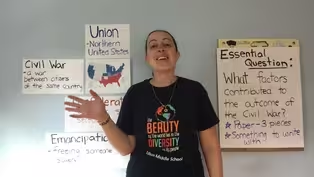
Civil War: Other Factors - Pam Romanchuk - Sixth Grade
Video has Closed Captions
Students will learn about the "other" factors of the Civil War. (57m 57s)
Try to See it My Way - Sally Booth - Sixth Grade
Video has Closed Captions
Students will learn about point of view and different perspectives in literature. (56m 11s)
Acquiring a 2nd Language - Sanchez & Others - Sixth Grade
Video has Closed Captions
In this lesson, students will learn the benefits of acquiring a second language. (55m 31s)

Three Branches of US Government - J & K Brotz - Sixth Grade
Video has Closed Captions
In this lesson, students will learn about the three branches of the American government. (46m 45s)
Crafting "I Survived" Stories - Vicki Sasso - Sixth Grade
Video has Closed Captions
Students will brainstorm, plan, and draft a story about surviving a historical event. (57m 16s)
Operating with Integers -Dr. Christopher Masullo-Sixth Grade
Video has Closed Captions
Students will learn how to add, subtract, multiply, divide, and simplify with integers. (56m 10s)

Intro to Public Speaking - Dr. Michael Gaskell - Sixth Grade
Video has Closed Captions
Students learn how to present in front of a group, whether in a classroom or remotely. (55m 19s)
Les Couleurs - Johadane Pierre-Davis - Sixth Grade
Video has Closed Captions
In this language lesson, students will learn all about the colorful world of French! (58m 55s)
Ecology and Water Conservation Tips - Dana Mason-Sixth Grade
Video has Closed Captions
Students will learn about ecology and water conservation by exploring sewer overflow. (56m 33s)
Providing Support for PBS.org
Learn Moreabout PBS online sponsorship>> Hey, everyone.
I'm Kelly Cerbone, this year, 2020's Ocean County Teacher of the Year, and I'm coming from Lake Riviera Middle School in Brick, New Jersey, which is a part of Brick Township Schools.
And today, we're going to be putting together an awesome lesson for you for Newton's three laws of motion, which is a part of physical science.
I'm super excited to bring this lesson to you today 'cause it's one of my favorite topics to teach.
And I think I love it so much because it's a lot of doing.
It's action, it's movement.
And those are the instances where I feel like my students and myself, that we learn most.
We learn by doing.
So a lot of the demonstrations that I do for you today, you at home will be able to reenact and do with either family members or friends.
So, what are some of the things that you might be looking for in your house?
Well, maybe you have a plastic cup in your home.
No glass, 'cause we don't want to worry about it breaking.
Do you have any spare change?
Some quarters, nickels, dimes, pennies, any kind of change?
I have four quarters here.
And then an index card or maybe a piece of cardboard, something on the thicker side, that we'll be using.
And maybe you have a balloon that you haven't blown up yet, 'cause we're gonna be using that.
Doesn't this sound fun, all the things that I'm naming?
And then, finally, a raw and hard-boiled egg.
So, hard-boiled eggs are when they're cooked in the inside but they still have the shell on them.
So we're going to be doing this crazy demonstration with that.
I'm going to be cracking one of those eggs on my head.
Yes.
You don't even know which one.
Alright.
So, are you ready to begin?
'Cause I'm pretty excited about what I have to bring to you.
So I really, really want to get started.
Are you ready?
Great.
Here we go.
So, friends, before we get started with our first demonstration today on Newton's laws of motion, I just wanted to take a moment for us to kind of recenter and refocus.
And this is a technique and strategy that I've used many times in my own classroom.
And you'll see, I have this -- what seems like a toy here.
I do remember the first time that I saw this.
I thought it was a toy.
And I was playing with it like this and saying, "Okay, this is sort of fun.
But I don't see the long-lasting reason why someone would want to play with this."
And it wasn't until I started learning, probably about two years ago, about mindfulness for my students that I found out this is actually something different.
It's actually called a Hoberman Sphere.
H-O-B-E-R-M-A-N -- Hoberman Sphere.
And it's actually used for children to reenact the breath.
So when we're younger, we can sometimes have a hard time understanding how to breathe mindfully.
And I've noticed that there have been times when I talk about breathing with my students and they'll go [panting] When you say, "Take a deep breath," they kind of over-exaggerate.
And this kind of really gives a visual idea for us to connect to, in order to understand what it means when we talk about breathing mindfully.
So we're gonna practice this strategy before we begin today, just so that we can recenter, refocus, relax, calm, connect.
Many of my students with anxiety and who get nervous really love this technique and strategy before testing or any kind of assessment.
And then it's always with you.
It's something that you can do whenever you need it.
You have it with you.
You don't need this Hoberman Sphere.
So, we're gonna begin and try this out together.
So, the first thing that I'd like you to do is just take a nice, deep inhale in through the nose.
[ Inhales deeply ] And exhale through the nose.
[ Exhales deeply ] So as I open, inhale.
[ Inhales deeply ] Expanding the lungs.
Exhaling close, deflating the lungs.
Inhale.
[ Inhales deeply ] And exhale.
[ Exhales deeply ] Inhale.
[ Inhales deeply ] Exhale.
[ Exhales deeply ] [ Inhales deeply ] [ Exhales deeply ] [ Inhales deeply ] [ Exhales deeply ] [ Inhales deeply ] [ Exhales deeply ] One more.
[ Inhales deeply ] [ Exhales deeply ] Okay, my friends.
So, how do you feel?
What difference do you feel from before we started to now?
If you're like some of my own friends from my own classes, maybe some of the words you might use or the emotions you might use to describe might be "calm," "relaxed," "peaceful."
So just recognizing that just this simple breathing technique, but you need to be very mindful and you need to be focusing on that inhale and exhale, that you have an opportunity to relax and calm, bring yourself some peace, while also focusing and connecting to yourself.
So that's here for you whenever you need it.
Are you ready to get started now, 'cause I am?
Let's go.
So, one more thing before we begin.
It's Tuesday, friends.
And on Tuesdays in my room, it's "True or False Tuesday."
So I'm going to throw up on the screen a statement And when you see that statement, I want you to think in your head, do you believe that that statement is true?
Or do you think that it's false?
But guess what, friends.
You're not going to find out whether you're right or wrong until the end.
So here we go.
Check it out.
You want to decide, is it true or false?
So, we're gonna start with our first demonstration, and it's gonna be with two eggs.
One of these eggs is hard-boiled.
One of these eggs is raw.
Hard-boiled means that it's been boiled in water to cook the inside of the egg, but it hasn't been broken yet.
And so this demonstration, we will be able to decide, 'cause I'll mix these up, spin them, whatever.
I will be able to figure out which one is hard-boiled and which one is raw.
If you've ever watched "Jimmy Fallon," he has a session on his show called "Egg Roulette."
And what he does on that show is he'll put a carton of eggs, eight of which those eggs are hard-boiled, and then four of them are raw.
And he'll invite a guest on the show to randomly pick and then try cracking their head with the egg.
Now, you obviously would prefer not to get raw egg on your head.
So the guests are always hoping that they are picking the hard-boiled ones.
Now, there's a reason why on his show you're not allowed to handle the eggs ahead of time.
And we're going to see why.
So while you're watching this demonstration, I want you to think about, what do you notice and what do you wonder about these two different eggs?
Okay, friends, so here we go.
The true test.
So I have my two eggs.
We don't know which one is hard-boiled and which one's raw.
I'm going to spin each one one last time, and then I want you to pick which one you think is hard-boiled and which one is raw.
So here's my first spin.
And here is the second.
First or second?
Which egg?
The first spin, the first egg?
Or the second?
Which one do you think is hard-boiled?
Choose wisely.
Alright, have you made your choice?
Well, I'm choosing... ...the first spin.
And here's the reason why.
So, when we talked about the law of inertia, when something's at rest, wants to stay at rest.
Something that's moving wants to stay moving.
So if the insides of the egg are cooked, it wants to stay with the egg as it spins.
And so if I'm right, the one that spins better is the one that's hard-boiled.
Are you ready?
This is my choice.
3, 2, 1.
Yes!
Did you choose wisely, friends?
Science helped me make a good choice.
I chose correctly.
The hard-boiled egg was egg number one.
The insides are cooked.
So as it spins, it follows the shell.
Whereas the raw egg, the insides want to stay not moving.
So as soon as you spin the outside, the insides are resisting, which slows it down.
I hope you chose the same as me, friends.
And that is science.
Newton's first law of motion.
Yes.
Okay, friends.
So, how cool was that?
I got a little snack with my hard-boiled egg.
But now we're going to move from the first law of motion, the law of inertia, to our second law of motion.
The second law of motion deals with force, mass, and acceleration.
So just to give you a little bit of a description about the demonstration you're gonna see, I borrowed my friend's wagon.
And the two videos that you're going to watch, the first one is me -- the force -- pulling the wagon.
And then you'll see the second video is me -- the force -- pulling the wagon, but with my friend Riley inside.
So, let's see, what's the differences between the two videos?
Does anything change between the two videos because I've added my friend Riley to the wagon?
That's for you to decide.
Alright.
So, I have my wagon here, and this wagon has a certain weight, or mass, to it.
And then there's me, and I'll be the one that will be pulling the wagon empty and then with my friend sitting inside.
So, I wonder what's going to happen with the acceleration?
How fast will I be able to go?
Will I be able to go the same speed without someone sitting in the wagon and with somebody sitting in the wagon?
So let's see if you can tell just by the visuals of these two videos.
Here we go.
Alright, so now let's see what happens with my friend sitting inside.
So, I wonder what the difference will be now that I have some added mass to this wagon.
Is it going to be easier for me to pull it, harder for me to pull it?
Will I be able to go as fast?
We'll have to see.
Pull.
[ Chuckles ] [ Speaks indistinctly ] Okay, friends.
So, did you notice any difference between the two videos, the two demonstrations?
What stayed the same was me pulling the wagon and the wagon itself.
But what changed was that my friend Riley was in that second video.
So, did you notice any difference between how fast I was going?
Maybe some of you are saying, "Mrs.
Cerbone, I think you were going slower in that second video with your friend Riley in the wagon."
And if you did say that, my friends, you are right.
But why?
Why did I have to slow down with my friend Riley in the wagon?
Well, friends, this is where we bring science back into the conversation.
We come back to our Newton's second law of motion.
There are three factors that when we're talking about Newton's second law, that come into this conversation.
What are those three things?
Force, mass, and acceleration.
So, what changed between those two videos?
Was it the force that changed?
Was it the mass that changed?
Or was it the acceleration, or how quickly I could speed up?
I think many of you friends out there are saying, "It's the mass, Mrs.
Cerbone.
The mass changed.
Your friend Riley was in the wagon and made it heavier."
And you are right, friends.
The mass is what changed between those two demonstrations.
I am the force.
I'm pulling the wagon.
And because it's me, I was trying my best to pull with the same amount of force.
So I didn't change.
But because my friend Riley hopped into the wagon in that second demonstration, he's doing what, friends?
He's doing what to that mass of the wagon?
You're right.
He's increasing the mass of the wagon.
He's making it heavier.
So, friends, because he's making it heavier and I'm using the same amount of force to pull the wagon, did you notice that I was a little bit slower to speed up in that second video?
It was harder for me to speed up because I had more mass to pull.
So, friends, that's how we bring science into everyday situations.
That's why it's easier to pull your younger sibling in a wagon than it would be one of your parents or adults at home, because the mass increases.
So that is how the second law of motion works.
If the force stays the same but you increase how heavy it is -- the mass -- the acceleration will decrease.
It will be harder to speed up if the mass is heavier than it was the first time.
So here we are once again, bringing science into our everyday world.
How cool is that?
Okay, friends.
So, here we are again with our third and final law.
So the third law of motion actually kind of has a nickname, just like the first law is called the law of inertia.
The third law of motion is often commonly referenced as action with a reaction.
And you may have even heard that before.
How many of you have heard, for every action, there's an equal and opposite reaction?
Anyone?
Oh.
See?
More than I thought.
So this may even be something that you'll recognize as we go through.
So it's something really cool to kind of demonstrate our third law of motion -- action and reaction.
So this is where I was gonna have you bring out your balloon.
So, I just found this really cool balloon at the dollar store.
And it's got confetti inside, which I thought would be kind of fun to play with.
And what I have set up here is I have two chairs that I've set up, and I took some twine.
And before I tied the second side of my string, I put a straw on my string.
And so what I'm going to do is I'm going to blow up my balloon.
How cool is that?
One more time.
Now, this is where it gets tricky.
So if you do have a friend in the house or a family member that can help you, this is where that would be super helpful.
So I also took some tape, and a lot of times in science, whenever we're playing around, we use a lot of resources, but it's all in the name of science, so it's all okay.
So I'm going to take this balloon, and I'm going to put tape around the outside of my balloon.
And I have to let a little bit of air out because I'm going to tape it to the straw.
As you can see, I'm doing a little more air so that it will connect... to the string.
And so what I would like for you to notice is what happens.
What's happening when I release the air out of the balloon?
So that's what I want you to think about -- what is happening when I release the air out of the balloon?
And, remember, I'm referencing action and reaction.
So think of what the action is and what the reaction is.
Well, that didn't work.
Well, friends, if that wasn't real life, I don't know what is.
Sometimes in times when we try to create something, it doesn't always go as planned.
But I don't give up.
I just try something different.
So what I'm thinking is maybe this balloon was a little too heavy.
Because of the confetti inside, I thought maybe it was too heavy on top of the straw.
And when I released it, nothing happened.
So I'm going to try this other balloon.
It's another latex balloon, but there's nothing inside of it to add weight.
Whoo!
Look at that.
Isn't that cool?
Alright.
So I'm going to hold the air.
I'm gonna take another really large piece of tape.
Carefully.
I'm gonna make sure that my balloon and the straw are lined up... carefully adding my tape... connecting to the straw.... ...hoping this doesn't pop as I'm trying to maneuver... Bear with me.
Because I don't have an assistant or I can't work in teams like I so often do in my own classroom, this makes it a little more challenging.
That's another reason why I love teaming in my classroom.
Alright, so here we go.
What is going to happen when I release the air out of the balloon?
What's the action and the reaction?
Are you ready?
3, 2, 1.
And it didn't work again.
Okay, so not exactly working the way I planned.
That's Okay.
So I'm going to improvise.
I still have my balloon, and I think many of us have played around with this instance, with this scenario.
So, what's gonna happen when I let go of the balloon?
What action is taking place, and what reaction takes place because of that action?
3, 2, 1.
Alright.
We're gonna do this one more time in slow motion, and, hopefully, that will be able to help you to see the action force and the reaction force.
Here you go.
Okay, so what was happening there when we were watching that balloon in slow motion?
And how is it an example of the third law of motion?
So if you remember from before, I talked about the fact that we nicknamed the third law "action and reaction."
So, specifically, what part of that motion was the action force?
And what part was the reaction?
Any ideas?
So, the best way that I can explain it is with this little diagram that I have here.
So, in this diagram, you'll see that the action force is the air being pushed out the opening once I release it.
The air being pushed out.
And the reaction is then that air being forced out now pushes, or propels, the balloon forward.
So the action force is the air coming out of the balloon.
The reaction is the balloon moves forward.
Now, you may have noticed in my demonstration that it didn't exactly follow a straight line.
And that can be a bunch of different factors.
It can be the elasticity of my balloon.
So maybe it was tighter in some parts of the balloon and not as tight in others, like more stretched out.
And so therefore, when the air is being released, it compresses at different rates.
So that could have been a reason why my balloon was kind of traveling all over the place.
So there is another explanation for the third law of motion.
So the action force is the air coming out of the balloon.
The reaction is that the balloon moves forward.
How cool.
Little did we know that this simple balloon was physics.
Yes.
So now I'm gonna check your understanding.
So I'm going to show you three different clips.
And as you watch each of the clips, I want you to figure out and guess which one of the three laws that video or that demonstration represents?
So you'll watch the first clip.
And then I want you to look at it.
Is it the first law, the law of inertia, that I'm demonstrating?
Is it the second law, where we have force, mass, and acceleration interacting, or is it the third law, where we have an action and an equal and opposite reaction?
So here we go.
Clip number one.
And I don't think I have to say this, friends, but just to make sure, the example that you're going to see next, you should not re-create this.
I did this with my husband, and we made sure that we were super safe and in a place where there were no other people around.
Okay?
Here we go.
Ohh!
Whoo-hoo!
Oh!
Well, that was fun.
Alright, let's try this one.
[ Grunts ] [ Grunts ] Okay.
Whoo!
That was a little different.
Ohh.
So now you have this one to guess.
So I had two different vehicles.
One was my S.U.V., and the second was my husband's truck.
So which law were we representing when I was pushing each of those vehicles?
Is it the first law, second law, or third law?
What's your guess?
Any ideas?
I think you have it.
It's the second law, my friends.
Remember that law was force, mass, and acceleration, when we were talking about the wagon?
Same idea here.
So, what changed?
It was the mass, or the weight, of the vehicle.
So the first time I was pushing my S.U.V., which is lighter than my husband's truck.
And so when I was pushing that, it was way easier for me to move and to accelerate with.
But if you noticed in that video with my husband's truck, I was having a much harder time accelerating the vehicle.
And when I was finished, you could definitely tell that I used more force just to get to the acceleration I could.
So here we go.
That was our second law of motion -- force, mass, and acceleration.
Great job, friends.
So, which law of motion is this one?
I'm going to kick the soccer ball.
Ready?
Okay, so, what do you think?
Which law do you think that that, me kicking the soccer ball, best represent?
Is it the first law, is it the second law, or is it the third law?
What do you think, friends?
Any ideas?
Well, it is... the third law -- action and reaction.
Now, friends, do you think that you could tell me which was the action force and which was the reaction force?
I think you know.
So the action force was me making contact with the soccer ball.
So the force from my leg to the soccer ball.
So what is the reaction of that?
The reaction is that the ball is then propelled forward.
So when I kicked it, it moved all the way to the other side, by my fence.
So the action is me applying the force to the ball.
The reaction is that the ball is propelled forward.
Did you guess right?
I knew you would.
Great job, friends.
Alright, friends, so now here it was.
You saw my demonstration here.
I had my cup with my index card on top, and then stacked were my coins.
You might want to try this with something different, but you saw my example.
I had these four quarters stacked on top.
So, what was happening?
What caused those quarters to drop into the cup?
Did you pick the right law?
Which law was it?
Is it the first law, is it the second law, or is it the third law?
I'll give you a couple seconds to think.
Okay, do you have your guess?
Well, it is -- ready?
-- the first law of motion.
Is that what you guessed -- the law of inertia?
Then you guessed right.
So, how does this example represent the law of inertia?
So here's the best way that I can explain it.
We talked about the law of inertia, meaning that something not moving wants to stay not moving.
That's this example here.
Those quarters are stacked on top of that index card.
They want to stay that way.
And the only reason that they will move is if another force acts upon it.
So me taking my finger and flicking the index card out of the way, that is changing what's happening here.
So it's quick enough that the friction of me pulling this away doesn't make them fall over, off the index card.
It actually makes them fall where?
Right into the cup.
So the only force that winds up acting upon the quarters is gravity.
So they want to stay not moving.
Me releasing the index card quick enough allows gravity to be the only force acting upon it, and they fall directly into the cup.
The law of inertia -- something not moving wants to stay not moving unless acted upon by another force.
Great job, friends.
Did you get it?
Are you 3 for 3?
Did you get them all right?
Okay.
So we learned all about Newton's three laws of motion.
So now it's time to get a little movement in.
I'm such a big fan of physical activity because, did you know that it actually releases chemicals in the brain called endorphins, that actually make you happy?
So even though we sometimes may not initially want to move our bodies and exercise, we always feel so much better when we do.
So we're gonna get a little bit of movement in here, some exercise outside, and then we'll take some yoga inside after.
So here we go.
So, let's start with some squats.
So many of you in your gym classes, you probably practice your squats.
Try your best to sit back, almost like you're gonna sit in a chair.
It's the best way.
Alright.
Keep it up.
Five more.
Couple more.
Alright.
Quick feet.
In, out.
In, out.
Shuffle those feet.
Pretend you have, like, a ladder on the ground and you're stepping in and out, in and out, in and out, in and out.
Keep it moving.
Keep it moving.
5, 4, 3, 2, 1.
Some lunges.
If you want to bring those hands up, alternate legs.
So we're stepping forward and back.
Step forward and press back up.
If this is too much, you can step back.
You don't need to step forward.
You can step back instead.
And if you're not comfortable there, you can just stay with one leg and take it up and down.
So whichever version you like.
If you are taking it one leg, I'm gonna have you switch sides now.
So switch to the other leg, and down and up, down and up.
5, 4, 3, 2, 1.
Jumping jacks.
If you can, nice, big arms.
You can always take it out and take out the jumping and just tap your feet out side to side.
If you're uncomfortable with the big arms, you can take them and cut the arms a little bit shorter.
So many different ways we can move our bodies.
5... 4... 3... 2... and 1.
So here, elbow to knee.
Drive that elbow up to the knee.
Press.
Opposite side so that right elbow goes to the left knee.
Left elbow goes to the right knee.
Almost there.
5... 4... 3... 2...1.
Pick a leg.
Pick a leg, either leg, and pull, pull, pull.
Try to keep all that weight forward on that front leg.
Pull.
You're gonna feel a little bit of a burn in that leg that you're leaning forward on.
That's okay.
That means you're getting stronger.
Ooh, I slipped.
4... 3... 2...1.
Switch legs, switch legs.
Here we go.
Come on.
Come on.
Push, push, push.
That's it.
That's it.
That's it.
Almost there.
Here we go, in 5... 4... 3... 2...and 1.
Taking those feet nice and wide, you're gonna squat.
Turn on that foot.
Punch, down.
Punch, down.
Turn.
Twist.
Twist.
Twist.
Twist.
If you don't like the squat in between, you can just stay standing and just rotate the arms.
So either holding that squat, or you can take the squat out.
That's up to you, friends.
Just keep moving.
Keep moving.
That's it.
That's it.
5... 4... 3... 2... and 1.
Deep inhale it up.
[ Inhales deeply ] Exhale.
[ Exhales deeply ] Again.
[ Inhales deeply ] And exhale.
Just some little movement, just enough to get that body working and get that blood flowing and that heart pumping.
That's it, guys.
Thanks so much.
Now let's go do some yoga.
Yes!
So, my friends, I welcome you into what's my yoga space.
This is a room in my home that I am grateful for because it's a space that I have been able to create for myself.
So I come in here to practice yoga.
Sometimes I work out in here.
But please know that anytime that you are practicing yoga, that you don't need to have a space like this.
This can be in your own room or a space in the house.
You can create the space.
But I just wanted to invite you into this calming space during our practice today.
So, just find a space on your floor, right in front of the TV.
You won't need a lot of a room, so I will make sure that you can practice along with me.
So we're gonna get started, and let's go.
[ Soothing music plays ] So I'm gonna have you come to a nice, comfortable seat.
Try and sit up nice and tall.
You're pulling that belly in towards the spine.
Relax your shoulders.
[ Inhales deeply ] And I brought my Hoberman Sphere back so we can practice some breathing before we begin.
Do you remember how to use it?
I thought you might remember.
So as we inhale, I will open the Hoberman Sphere.
And as we exhale, I will close, so you're gonna follow along with me.
Ready?
Here we go.
Inhale.
[ Inhales deeply ] And exhale.
[ Exhales deeply ] Inhale.
[ Inhales deeply ] And exhale.
[ Exhales deeply ] Inhale.
[ Inhales deeply ] Exhale.
I invite you to close your eyes, friends, if you'd like.
I'll remain to call out "inhale."
[ Inhales deeply ] And exhale.
[ Exhales deeply ] Inhale.
[ Inhales deeply ] Exhale.
[ Exhales deeply ] Inhale.
[ Inhales deeply ] Exhale.
Two more.
Inhale.
[ Inhales deeply ] Exhale.
[ Exhales deeply ] Last one.
Inhale.
[ Inhales deeply ] And exhale.
[ Exhales deeply ] How we feeling?
I'm feeling super calm, ready to go.
So from here, you're gonna take your right hand down to the floor and inhale the left arm up.
[ Inhales deeply ] And exhale, taking it over to the side.
Reach.
Closing the eyes, if you're comfortable doing so.
♪♪ Inhale up.
And release.
Inhale.
The other side.
Exhale over.
♪♪ ♪♪ ♪♪ Inhale up.
Exhale down.
One more time each side.
Inhale the right arm.
Lift and over.
♪♪ Inhale up.
Exhale, release.
The other side.
Inhale up.
[ Inhales deeply ] Exhale.
♪♪ Inhale up.
[ Inhales deeply ] And exhale, release.
[ Music continues ] So from here, taking our hands to our knees.
We're gonna inhale forward.
Exhale back.
These are called trunk circles.
♪♪ Trunk circles.
♪♪ ♪♪ And take it the other way.
♪♪ ♪♪ ♪♪ And back to center.
So now we're going to release.
We're gonna take it into what we call tabletop.
So now you're gonna bring your hands underneath the shoulders, and then the knees underneath your hips.
You're gonna inhale, arching the back.
Look up towards the sky and exhale 'round.
This is called "cat-cow."
So here the inhale is your cow posture.
Exhale down the back like a cat.
Inhale.
[ Inhales deeply ] Exhale.
Inhale.
Exhale.
Inhale.
Exhale.
One more.
Inhale.
Exhale.
And then back to neutral side.
Go back to that flat back.
So what I'd like you to try to do here is, can you extend that right arm out in front and then press that left leg back and balance and hold?
Balance and hold.
Breathe.
3... 2... 1, and release.
Now the other side.
So extending that left arm out and that right leg.
Opposite arm and leg.
Nice and strong.
Balance and hold.
♪♪ 3... 2... 1, and release.
So from here, we're gonna take our first downward-facing dog.
So maybe walking the hands out a little bit, curling those toes underneath the body, lifting the hips, pressing the heels down.
So walking your feet.
So bend your knees.
Try and press your heels down.
You might feel the backs of your leg stretching out as you do that.
And that's good.
Maybe pressing up to your toes and then pressing the heels down.
Any movements that you like here.
You can even come to a plank and then walk it back up.
♪♪ ♪♪ Breathe in here.
Now coming forward.
Come into that plank.
I know you've done these, probably in gym class.
Hold here.
3.
3... 2... 1.
Drop the knees.
This is called "child's pose."
Sit back on your heels.
Take those arms out in front and let your forehand come down towards the mat.
Then breathe.
♪♪ ♪♪ ♪♪ [ Breathes deeply ] Two more breaths.
♪♪ ♪♪ And release.
Coming up.
So now I'm gonna face you, but you're gonna be on your knees.
You're gonna take that left leg out to the side.
Rest that left arm on top.
Inhale.
The right arm up and take it over.
You should feel a nice stretch in this side body.
♪♪ ♪♪ And release.
Bring that knee back down.
Taking out the right leg.
Inhaling the left arm up, taking it over.
♪♪ ♪♪ And release.
Bring that knee back underneath, taking the hands down, curling the toes.
Back to that downward-facing dog.
And now I'd like you to walk your hands all the way in towards your feet and just hang here for a second.
So what you're gonna try to do here is, you want to make the connection right here.
So that hold.
If you need to bend the knees, that's okay.
Or if you can straighten, that's okay, too.
Release the arms down.
If you'd like, you can bend the arms, grab each elbow, then frame your head and give a little movement side to side.
You should feel a really nice stretch on the back of the legs here.
♪♪ ♪♪ And then turn here, releasing the hands down to the floor.
Walk out those arms.
Bring the knees down.
And take a child's pose, do a couple breaths.
♪♪ ♪♪ ♪♪ And then come here.
We're gonna take it out to our bellies.
♪♪ We're gonna bring our hands, our elbows, right underneath our shoulders.
And press out nice and strong -- this is called "snake pose" -- for a little bit of a back bend here.
♪♪ ♪♪ ♪♪ Two more breaths.
Right here.
♪♪ ♪♪ ♪♪ Bend your knees, pushing with our arms, taking it back up.
We're gonna bring the left in front of the body for a fold.
So inhale the arms up.
Exhale, reach, reach, reach, reach.
Breathe.
Let the head drop naturally.
[ Inhales deeply ] [ Exhales deeply ] ♪♪ ♪♪ Almost there.
♪♪ ♪♪ ♪♪ Then release, bring it up.
Take the right leg over the left and take the arm up.
Elbow across.
And twist.
If you're not comfortable, you can always just reach around the knee and just look behind you.
♪♪ ♪♪ ♪♪ ♪♪ And release.
Switch.
Other leg.
Reaching around.
And then looking over your shoulder.
♪♪ ♪♪ ♪♪ ♪♪ And release.
Coming back to our seated position.
So, friends, just remember, I'm hoping that you had a positive experience here and that you're feeling calmer, more connected.
And know that all that we're seeing right now and dealing with is all temporary.
And as I always say, we always have a choice with our outlook on life.
So for me, I say this every day, that today is a good day for a good day.
So let's make every day a good day, and it's about our perspective.
Try to find all the things that you have to be grateful for.
And for me today, I'm grateful for you.
So thank you, friends.
So now it's the moment you've all been waiting for.
Do you remember?
It's "True or False Tuesday."
And so I showed you a statement at the beginning of the program, and you had to guess whether you thought that the statement was true or that you thought the statement was false.
Do you remember which one you picked?
Great.
So here we go.
In 3, 2, 1.
The answer is... So that's it.
I just wanted to let you know that I'm so grateful that I had this opportunity to serve you today.
And I really hope that you've learned something about Newton's laws of motion.
I hope that you enjoyed moving around and getting some workout in.
And I especially hope that you feel more revived, refreshed, refocused, and peaceful after our yoga session.
So that's it, my friends.
Thank you so much for joining me, and have a great rest of your day.
















Support for PBS provided by:
NJTV Learning Live is a local public television program presented by NJ PBS