
March 13, 2026 - PBS News Hour full episode
3/13/2026 | 57m 46sVideo has Closed Captions
March 13, 2026 - PBS News Hour full episode
Friday on the News Hour, the war with Iran hits the two-week mark as all sides dig in and the death toll rises. The latest antisemitic attack, this time on a Michigan synagogue, highlights growing threats against the Jewish community. Plus, the Trump administration sends pregnant migrant girls to a Texas facility despite warnings that the shelter can't provide adequate care.
Problems playing video? | Closed Captioning Feedback
Problems playing video? | Closed Captioning Feedback
Major corporate funding for the PBS News Hour is provided by BDO, BNSF, Consumer Cellular, American Cruise Lines, and Raymond James. Funding for the PBS NewsHour Weekend is provided by...
March 13, 2026 - PBS News Hour full episode
3/13/2026 | 57m 46sVideo has Closed Captions
Friday on the News Hour, the war with Iran hits the two-week mark as all sides dig in and the death toll rises. The latest antisemitic attack, this time on a Michigan synagogue, highlights growing threats against the Jewish community. Plus, the Trump administration sends pregnant migrant girls to a Texas facility despite warnings that the shelter can't provide adequate care.
Problems playing video? | Closed Captioning Feedback
How to Watch PBS News Hour
PBS News Hour is available to stream on pbs.org and the free PBS App, available on iPhone, Apple TV, Android TV, Android smartphones, Amazon Fire TV, Amazon Fire Tablet, Roku, Samsung Smart TV, and Vizio.
Providing Support for PBS.org
Learn Moreabout PBS online sponsorshipAMNA NAWAZ: Good evening.
I'm Amna Nawaz.
GEOFF BENNETT: And I'm Geoff Bennett.
On the "News Hour" tonight: The war with Iran hits the two-week mark as all sides dig in and the death toll, including U.S.
service members, rises.
AMNA NAWAZ: The latest antisemitic attack, this time on a Michigan synagogue, highlights growing threats against the Jewish community.
GEOFF BENNETT: And the Trump administration sends pregnant migrant girls to a Texas facility, despite warnings that the shelter can't provide adequate care.
MARK BETANCOURT, The California Newsroom and The Texas Newsroom: The trauma they've been through further complicates their pregnancies.
(BREAK) GEOFF BENNETT: Welcome to the "News Hour."
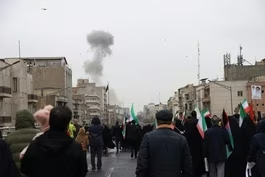
Around 2,500 U.S.
Marines are reportedly heading for the Middle East along with an amphibious warship.
Their mission is not yet clear, but it signals a marked increase in U.S.
forces in the region.
AMNA NAWAZ: The deployment comes as Defense Secretary Pete Hegseth said more than 15,000 targets had been struck in Iran over nearly two weeks of relentless bombing against the regime; 13 American personnel have now been killed during the war and more than 2,000 are dead, both in Iran and from Israeli strikes in Lebanon.
Stephanie Sy reports.
STEPHANIE SY: Mid-interview, a pro-regime demonstrator in Tehran interrupted.
An airstrike sends smoke rising over a crowded square, but doesn't disperse the masses.
These Iranians are defiant, chanting familiar slogans, "Death to America, Death to Israel," setting fire to Israeli and American flags.
The protesters had gathered for an annual rally in solidarity with Palestinians when the midday strike hit, killing at least one person.
Several top Iranian leaders, including the president, Masoud Pezeshkian, were in the crowd.
Iran's hard-line judiciary chief speaking to a reporter in the moment.
GHOLAM-HOSSEIN MOHSENI-EJEI, Head of Iranian Judiciary in Iran (through translator): We stand with the people until the last breath.
People don't fear these boom-boom sounds.
Under the rain and the missiles, they will not back down at all.
STEPHANIE SY: In Northern Israel, fear over cross-border retaliation.
A home where a family once lived is now filled with shrapnel and debris, another Iranian missile fired by Hezbollah in Lebanon, this one leaving at least 58 people injured.
(SIRENS BLARING) STEPHANIE SY: In the early hours Friday, Iran targeted a U.S.
air base in Southern Turkey.
The ballistic missile was intercepted by NATO defenses, as the American death toll is rising.
U.S.
Central Command said today six Americans were confirmed to cease when their aircraft was lost during Operation Epic Fury.
It added: "The circumstances of the incident, which occurred in Western Iraq, are under investigation."
Earlier today, Defense Secretary Pete Hegseth said Iran's -- quote -- "evil regime" is crumbling.
PETE HEGSETH, U.S.
Defense Secretary: They're confused and we know it.
Our response?
We will keep pressing.
We will keep pushing, keep advancing, no quarter, no mercy.
STEPHANIE SY: No quarter suggests even those who surrender could be killed, a violation of international law.
Meanwhile, market-shaking concerns remain over the closure of the Strait of Hormuz, a critical international oil route.
PETE HEGSETH: The only thing prohibiting transit in the straits right now is Iran shooting at shipping.
It is open for transit should Iran not do that.
STEPHANIE SY: The U.S.
is temporarily easing some of its sanctions on importing Russian oil in an effort to ease supplies.
But, today, Ukrainian President Volodymyr Zelenskyy, when meeting with French President Emmanuel Macron, emphasized the U.S.
sanction waivers won't help end the war he's fighting.
VOLODYMYR ZELENSKYY, Ukrainian President (through translator): The single easing of sanctions by America could provide Russia with approximately $10 billion for the war.
This certainly does not help peace.
STEPHANIE SY: German Chancellor Friedrich Merz today adding, it is a price problem, not a quantity problem.
FRIEDRICH MERZ, German Chancellor (through translator): There was a very clear opinion from six members of the G7 that this is not the right signal.
We then learned this morning that the American government has apparently decided otherwise.
Again, we believe this is wrong.
STEPHANIE SY: Meanwhile, President Trump today addressed reports that Russia is aiding the Iranian regime.
BRIAN KILMEADE, FOX News Anchor: Do you think Putin is helping them?
DONALD TRUMP, President of the United States: I think he might be helping him a little bit, yes, I guess.
And he probably thinks we're helping Ukraine, right?
BRIAN KILMEADE: And you are, right?
(LAUGHTER) DONALD TRUMP: Yes, we're helping them also.
And so he says that and China would say the same thing.
You know, it's like, hey, they do it and we do it, in all fairness.
STEPHANIE SY: The comments followed a social media post from the president earlier today saying the Iranian regime has been -- quote -- "killing innocent people all over the world for 47 years.
And now he is killing them.
A great honor," he added.
The U.S.
is now sending more aircraft into the Middle East, signaling the military campaign is far from over.
For the "PBS News Hour," I'm Stephanie Sy.
GEOFF BENNETT: In the day's other headlines: The Justice Department charged a man identified as Kenya Chapman, who they believe sold the weapon used in yesterday's shooting at Old Dominion University.
The alleged gunman, Mohamed Bailor Jalloh, was barred from owning a firearm after pleading guilty back in 2016 to attempting to aid the Islamic State group.
He had been released from prison early after completing a drug treatment program.
Authorities say the gun's serial number was partially obliterated, making it hard to trace.
The FBI says Jalloh shot and killed Lieutenant Colonel Brandon Shah and wounded two others.
The gunman was subdued and killed by ROTC students, who are being hailed as heroes.
A federal judge in Washington, D.C., blocked a set of Justice Department subpoenas today related to its investigation of Fed Chair Jerome Powell.
In his decision, Judge James Boasberg wrote that prosecutors presented essentially zero evidence of a crime, adding that a mountain of evidence suggests that the government served these subpoenas on the board to pressure its chair into voting for lower interest rates or resigning.
Last year, the U.S.
attorney's office issued subpoenas believed to be related to Powell's testimony to Congress about the Fed's renovation of its headquarters.
He has denied any wrongdoing.
Speaking at a news conference today, U.S.
attorney Jeanine Pirro said she would appeal the ruling.
A range of weather extremes is hitting areas clear across the country, starting in the West, where it's looking like summer in places like Los Angeles, even with one week technically left in winter.
Angelenos have been flocking to the beaches and to Santa Monica Pier, with temperatures climbing to 90 degrees there.
Next week, we could see records in the triple digits from Southern California to Phoenix.
Even those more accustomed to the heat say this is not normal.
DEE RICHARDSON, Los Angeles Resident: Especially in L.A., this is not typical.
I'm from Texas originally, so I'm always appreciative of the heat, but this is definitely different from L.A.
So, even for me, this is like, oh, this is kind of hot, right?
Like, we're sweating.
Why are we sweating in early March?
This is weird.
GEOFF BENNETT: Meantime, from Washington state to the Great Lakes, more than 24 million Americans are under winter storm alerts, and a polar vortex will bring another wallop of winter for much of the Eastern half of the country, including areas like Washington, D.C., that just saw record heat a few days ago.
Cuba's president confirmed today that his government has held talks with the Trump administration as a U.S.
oil blockade further cripples the island nation's economy.
At a political meeting today, President Miguel Diaz-Canel said the talks were, as he put it, aimed at finding solutions through dialogue.
His comments confirmed prior us media reports that such discussions were taking place.
Last week, Cuba was plunged into darkness as a blackout left millions of people without power.
At a press conference broadcast on state TV, the Cuban president blamed that on the ongoing U.S.
blockade.
MIGUEL DIAZ-CANEL, Cuban President (through translator): We are generating electricity during daytime hours with domestic crude and our thermoelectric plants.
The fault is not the government's.
The fault lies with the energy blockade that has been imposed on us.
GEOFF BENNETT: Diaz-Canel also said a decision to release more than 50 prisoners in the coming days was not, as he said, imposed by another country, even though yesterday's announcement was seen by some outsiders as an effort to win favor with the Trump administration.
There was new evidence today that the U.S.
economy is showing signs of strain even before the start of the war with Iran.
For one, the GDP grew at a slower pace at the end of last year than initially thought, growing just 0.7 percent in the fourth quarter.
Separately, the latest reading on core inflation came in at 3.1 percent.
That's well above the Fed's 2 percent target.
But there was a bit of good news from the labor market, with job openings rising more than expected in January.
That mixed economic picture only added to the downbeat mood on Wall Street.
The Dow Jones industrial average fell nearly 120 points to end the week.
The Nasdaq dropped more than 200 points.
The S&P 500 also ended in negative territory.
And John Burns, an award-winning foreign correspondent for The New York Times, has died.
Over a 40-year career, he reported on far-flung corners of the globe, from South Africa to the Soviet Union, China and the Middle East.
Burns won the first of his two Pulitzer Prizes for his coverage of the Bosnian conflict in the 1990s.
He was also a frequent guest here on the "News Hour," including this appearance in 2003 to discuss the Iraq War.
JOHN BURNS, The New York Times: Life under Saddam is a life lived constantly in terror, in fear, and consequence of which, for correspondents like myself, finding true voices in Iraq itself is not easy.
It's not impossible, but they have a tremendous yearning to tell their truth, and the truth is a terrible truth.
GEOFF BENNETT: John Burns died of pneumonia while under care in his native England.
He was 81 years old.
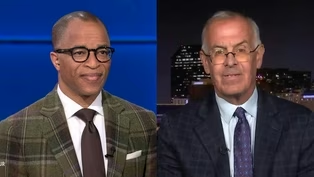
Still to come on the "News Hour": the wider war engulfs the border between Lebanon and Israel and the people living there; and David Brooks and Jonathan Capehart weigh in on the week's news.
AMNA NAWAZ: Law enforcement authorities in suburban Detroit say they're still searching for a motive behind yesterday's attack on a synagogue in school.
FBI officials said tonight the suspect had large quantities of commercial-grade fireworks and several jugs of flammable liquid believed to be gasoline in the truck he drove into the building.
They also said he had no prior criminal history and that he died of a self-inflicted gunshot wound to the head.
The FBI called it -- quote -- "a targeted act of violence against the Jewish community."
And it's touched off a wider conversation around antisemitism in the U.S.
A day after a man rammed his vehicle into a Michigan synagogue, the state's governor was clear.
GOV.
GRETCHEN WHITMER (D-MI): Yesterday's attack was antisemitism.
It was hate, plain and simple.
AMNA NAWAZ: Governor Gretchen Whitmer with a message of support to the Jewish community in her state and nationwide.
GOV.
GRETCHEN WHITMER: We must lower the rhetoric in this state and in this country, especially at this moment where we have seen such a rise in antisemitism and more attacks on the Jewish community.
AMNA NAWAZ: Officials have not yet identified a motive, but new details have emerged about the attacker; 41-year-old Ayman Mohamad Ghazali was born in Lebanon.
He came to the U.S.
in 2011 on an immediate relative visa as the spouse of a U.S.
citizen.
He became a U.S.
citizen himself in 2016.
The Associated Press reports that an Israeli airstrike in Eastern Lebanon last week killed his two brothers, his niece and his nephew.
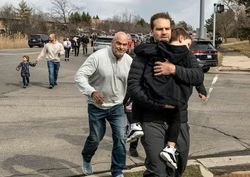
Yesterday, armed with a rifle and explosives in the trunk, he drove his truck into the Temple Israel synagogue and preschool.
None of the staff, teachers or over 100 children inside were injured.
One security officer was knocked unconscious by the car.
Dozens more were treated for smoke inhalation.
Allison Jacobs sends her 18-month-old daughter to the temple's day care.
ALLISON JACOBS, Mother: There are no words.
I was in complete another shock.
AMNA NAWAZ: Cassi Cohen was inside during the attack.
CASSI COHEN, Director of Strategic Development, Temple Israel: I heard a loud crash, and I saw some debris from the car and knew that something was very wrong.
I heard a bang, which was a shot, hid under my desk and stayed there until we got the all-clear from the SWAT team.
AMNA NAWAZ: This comes amid a rise in antisemitism worldwide and a recent string of related attacks.
Three synagogues in Canada were sprayed with gunfire in recent weeks.
In January, a man set fire to a synagogue in Jackson, Mississippi.
And, in December, a gunman targeting Jews killed 15 people in Bondi Beach, Australia.
Since the 2018 attack on Pittsburgh's Tree of Life Synagogue, more Jewish communities have been stepping up security.
Temple Israel had just held an active shooter prevention training in January.
An official said it was temple security officers who engaged the attacker.
RABBI JOSHUA BENNETT, Temple Israel: We are just absolutely amazed at the heroism of our security team.
We expect these things to happen.
We just never want them to be real.
AMNA NAWAZ: Today, the investigation continues.
Tonight, congregants attending Shabbat services will file by a phalanx of officers standing sentry outside their temple.
For some further perspective now, we turn to Rabbi Steven Abraham, who leads Beth El Synagogue.
That's a congregation in Omaha, Nebraska.
Rabbi, welcome to the "News Hour."
Thanks for joining us.
RABBI STEVEN ABRAHAM, Beth El Synagogue: Thanks for having me.
AMNA NAWAZ: Just give us a sense of what you've been hearing from people in your community, your congregants in these last 48 hours about what they're feeling, what they're worrying about right now.
RABBI STEVEN ABRAHAM: I think at the moment, really, there's a -- It's both a mixed sense of relief and gratitude, the fact that there was, of course, the security guard in Michigan who was injured, but that everybody in the synagogue and the school was safe, and that was kind of where things ended.
But clearly there is a heightened sense of fear and being scared of what is going on in our country, both abroad and locally here at home.
And so you have to think twice about certain actions you take, and being in your house of worship is a place that you're supposed to be able to be welcomed and not have fears of what took place yesterday afternoon.
AMNA NAWAZ: I mean, tell us about that difficult balance, because I should quote you.
Recently, you said, talking about this: "There's a level of PTSD with the heightened awareness.
We are synagogues.
We're houses of worship.
We are not Fort Knox."
So how do you keep that sense that your congregation is safe, they know they can come and pray safely, but not lose the sense that it's an open house of worship?
RABBI STEVEN ABRAHAM: Yes, it's a great question.
I think that the truth of the matter becomes is that synagogues, like churches and mosques, are there, houses of worship, right?
They are supposed to be places of welcoming, right?
That is what we -- that's who we are.
That's what we stand for.
And that's -- that is us acting at our very best.
So the idea of being able to have security guards, to metal detectors, to security bollards outside, to all of these extra precautions, which of course are so necessary in the world that we live in, unfortunately, kind of go against the idea of being so welcoming.
And so whether it is to your opening talking about Australia, to the Tree of Life synagogue, to Poway, to Colleyville, to what happened yesterday in the Detroit suburbs, there really is this balance of how do you figure out how to be a house of worship, where your doors are supposed to be open, and yet everything that's happening in the world is in some ways trying to make us close our doors and maybe even be closed-minded?
And I think that we have to fight back against that.
These type of actions are to make us think twice, to make me think about the kippah, or the head covering that I wear on my head, when I go outside and whether that is acceptable to wear, to make yourself known to be Jewish.
And I say this for other faith groups as well.
And the reality is, you have to be proud.
You can't hide.
That gives the person who is a terrorist the win in their ability to make us scared.
And that's not the way that we should live our lives as Jews or as any other religious tradition.
AMNA NAWAZ: Have you at Beth El had to step up your security in recent years?
RABBI STEVEN ABRAHAM: Certainly.
I mean, even pre-October 7, we had done different - - we had done a number of different things in regards to our security here and in the Omaha Jewish community.
And then, after October 7, clearly, there was a number of things that we did to make sure that we were both safe, that our congregation was safe, that our staff on a daily basis was being able to be safe.
When you're in a house of worship and you're here to pray and to celebrate, or even to mourn, but the last thing you want is to be thinking about your own personal security in those places.
AMNA NAWAZ: You mentioned the October 7 Hamas terrorist attack on Israel and this sense that what happens overseas inevitably has ripple effects across the rest of the globe.
And I should say that there's nothing that excuses the targeting of civilians or people in any house of worship or certainly not children, but I have heard that there has been a sense of heightened concern, heightened fear after the U.S.
and Israel launched this most recent war in Iran.
Did the launching of that war make you worry more about attacks here?
RABBI STEVEN ABRAHAM: For sure.
I think that anybody who would answer that question and say that it didn't make you think twice is simply either naive or they're lying to sound -- for a better sound bite.
But the reality is, of course.
Things that happen overseas, we have seen affect what happens in this country.
I believe quite firmly that the Jewish community in many ways has always been the canary in the coal mine to be able to understand the sense of what is going on with any number of minority groups, both in the United States and abroad.
And so, when this war kicked off two weeks ago at this point, certainly, there was a concern of what that would mean for us locally and nationally.
But the idea is that, as you stated so beautifully, nothing kind of justifies attacking a house of worship, a synagogue, a preschool.
And so I think we have to live in the reality of the world that we live in, but people come to the synagogue, as I hope they go to churches and mosques, to pray aspirationally for what the world may look like one day, God willing.
So we have to be realists.
It's still shocking every time it happens, but we're becoming a little bit numb.
I think you mentioned the word PTSD.
I think there is a level that the Jewish community, every time these things happen, it opens the wound and you don't actually get to mourn the previous time this happened, right?
Like, as a rabbi, I have now -- I should be proficient at writing sermons, and I'm getting proficient at writing letters to my congregation trying to explain the unexplainable.
AMNA NAWAZ: That is Rabbi Steven Abraham from the Beth El Synagogue in Omaha, Nebraska.
Rabbi, thank you so much for your time.
RABBI STEVEN ABRAHAM: My pleasure.
Thank you again.
GEOFF BENNETT: As the war with Iran continues to escalate, Northern Israel is yet again on the conflict's front line, facing a barrage of missile and drone fire from Hezbollah in Lebanon and Iran.
Communities still recovering from the fighting that followed the October 7 attacks now face once again the constant danger and mental trauma that comes with war.
For this report, a "News Hour" team filmed in Israel's north, and Nick Schifrin has the story.
(SIRENS BLARING) NICK SCHIFRIN: In Northern Israel, six miles from the Lebanese border, the siren has become the soundtrack.
Patients and their families head into the Galilee Medical Center in Nahariya.
They have only 30 seconds before a possible Hezbollah missile strike, which is why the emergency room is inside a bunker.
Dr.
Zvi Sheleg is the center's deputy director and gives producer Karl Bostic a tour.
DR.
ZVI SHELEG, Deputy Director, Galilee Medical Center: We're going now to the underground hospitalization departments.
NICK SCHIFRIN: Below ground, there are tunnels wide enough for an ambulance, a six-bed trauma room, and overall 450 beds.
DR.
ZVI SHELEG: Everything here is ready at all times for any missile attack, any drone attack.
NICK SCHIFRIN: In fewer than two weeks, Israel says Hezbollah has fired at least 850 drones and missiles into Northern Israel.
Hezbollah joined the war, breaking a 16-month-long tenuous cease-fire, leading Israel to bombard Beirut and targets throughout the country.
For the Galilee Medical Center, the war has meant moving the most vulnerable underground.
This is the neonatal intensive care unit, full of premature babies kept alive in incubators and on ventilators.
Haya Nakan's (ph) 2-month-old girl Razal was born weighing about one pound.
DR.
VERED FLEISHER-SHEFFER, Neonatal Unit Director, Galilee Medical Center: he smallest baby now.
It's 600 grams, but he was born 450 grams.
NICK SCHIFRIN: Dr.
Vered Fleisher-Sheffer is the NICU director.
She knows that in here, as in war, the line between life and death can be thin.
DR.
VERED FLEISHER-SHEFFER: They don't have name.
When they are bigger, the parents give names.
They don't give names when the baby's just born.
It's very challenging for the parents.
It's very challenging for all of us in Israel.
(SIRENS BLARING) NICK SCHIFRIN: The challenge to Northern Israel is overseen here, the Council of Northern Israel Communities, with Security Chief Nadav Shoshani and Director Moshe Davidowitz.
MOSHE DAVIDOWITZ, Council of Northern Israel Communities: We want to live here in the Galilee with our children and our parents in a peaceful area.
NICK SCHIFRIN: Israel has extensive air defense, but just today Hezbollah rockets hit this home in the north.
Many of these residents only recently returned to their communities after the 2024 cease-fire, but now the threat is once again constant.
Parts of a Hezbollah drone lie in the regional council's lobby.
MOSHE DAVIDOWITZ: The most difficult situation for our residents, I see it, is the mental health.
It's the trauma and the post-trauma that we see increase day by day.
And because of that, we demand that the war will finish soon.
COL.
NADAV SHOSHANI, IDF International Spokesperson: Right now, we will stay there for as long as necessary to protect our civilians.
NICK SCHIFRIN: But overlooking Lebanon, the Israeli military's international spokesman, Colonel Nadav Shoshani, predicted the war will not end any time soon, even if the U.S.
ends its war with Iran.
COL.
NADAV SHOSHANI: The timeline here is as long, as there is a threat on our civilians, we're going to defend our civilians.
That's the timeline against Hezbollah.
NICK SCHIFRIN: Along the border, there are political divides for how best to guarantee security.
But the closer you get to the border, the more it feels personal.
We visited Kibbutz Matzuva, just over one mile from the border.
Batya Safian was born in California, but has lived in this community for 37 years.
BATYA SAFIAN, Resident, Kibbutz Matzuva: We have gotten used to living with a lot of trauma on a daily basis.
He hears the boom, he wants to run down to the shelter.
NICK SCHIFRIN: They have a shelter, but this community is so close to the border there are no sirens.
They have to respond to the impacts.
She lives with her grandkids.
The local kindergarten has an attached bomb shelter.
BATYA SAFIAN: I don't want my grandchildren in another 20 years to be dealing with what I'm dealing with right now.
NICK SCHIFRIN: And yet, with neighbor 48-year-old Noa Rotem, they try to keep up their spirits.
Rotem has lived here for more than a decade.
After October the 7th, she evacuated and returned a year-and-a-half ago.
Now the threats that she fled from have returned.
NOA ROTEM, Resident, Kibbutz Matzuva: Sometimes, I'm jumping out of bed and I saw that I have been sleeping for 10 minutes or so.
Your body is like -- the fight, flight, freeze mechanism is working 24/7.
NICK SCHIFRIN: Like in many Israeli kibbutzes there is a dual desire, personal security and regional peace that's currently out of reach.
NOA ROTEM: It's not our reality and it's not the reality of the kids in Lebanon or in Gaza or in Iran.
No one wants I think to live in such fear.
NICK SCHIFRIN: But despite the fear, life and its rituals must go on, even if back in the hospital in a war zone.
Elihu Cohen is a cleaner at Galilee Medical Center.
He's also a newlywed.
But when the war started, his venue canceled.
So he got married in the hospital.
ELIHU COHEN, Galilee Medical Center (through translator): There was no other choice.
We got married here and everything was fine.
It was very, very fun.
It was nicer than doing it in a wedding hall.
NICK SCHIFRIN: And as the hospital marked a milestone of life, another life is about to begin.
We met Valentina (ph) and Michael Mission (ph) just before she went into labor, hoping to give birth in a world where bomb shelters are not needed.
QUESTION: Do you know, is it going to be a boy or a girl?
MICHAEL MISSION, Father: Girl.
VALENTINA MISSION, Mother: Girl.
Maria.
QUESTION: Oh, you already have a name for it?
VALENTINA MISSION: Yes, Maria.
NICK SCHIFRIN: And since we spoke to them, Valentina gave birth to a healthy Maria, a reminder that there is fortitude even in moments of fear.
For the "PBS News Hour" I'm Nick Schifrin.
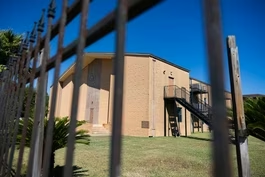
AMNA NAWAZ: Since last July, the Trump administration has been sending all pregnant unaccompanied minors apprehended by immigration enforcement to a single group shelter in South Texas.
Some of the administration's own child welfare officials object to this policy, saying the facility lacks specialized care the girls need.
I spoke yesterday to Mark Betancourt, a journalist who spent six months reporting to break this story for both The California Newsroom and The Texas Newsroom, which are collaborations of public media news outlets.
Mark, welcome.
Thanks for being here.
MARK BETANCOURT, The California Newsroom and The Texas Newsroom: Thanks for having me, Amna.
AMNA NAWAZ: Let's start with the girls.
Tell us a little bit about who we're talking about.
How old are they, where are they from, and how do they come into the U.S.
government custody?
MARK BETANCOURT: So, most of the time, what happens is that, when kids cross the border unaccompanied, which means they're not with a parent or guardian, they are transferred from Customs and Border Protection to ORR care, which is the Office of Refugee Resettlement.
It's under the Department of Health and Human Services.
They basically then distribute them among shelters throughout the country to hold them until they can be released to their sponsors, which are often family members.
So the goal is to actually hold them for as little time as possible so that they can then be released while the sponsors are vetted.
So when pregnant girls are brought in, these are kids who are under 18, so they're all minors.
They would normally be placed in places that have medical facilities nearby and trained staff who can handle what are often complicated pregnancies.
So that's what is normally supposed to happen under this process.
AMNA NAWAZ: Some of the girls you reported are as young as 13.
Is that right?
Many of them have been assaulted, raped on the journey that they're making to the U.S.?
MARK BETANCOURT: That's right.
So these girls are between 13 and 17.
Our -- my source within ORR said that about half of them were probably pregnant as a result of rape.
So that is obviously a big concern.
These girls have been through pretty traumatic experiences.
In some cases, they were raped on the journey or in their home countries before they came here, and that's how they became pregnant.
But a lot of times, they're also apprehended by ICE in the interior of the country and separated from their families.
So, while we don't know the exact situations of the girls who have been placed at the shelter now, that is definitely a concern.
And the trauma they have been through further complicates their pregnancies.
AMNA NAWAZ: So your reporting is based on conversations you had with a number of people who are currently officials inside this agency.
Why did they decide to speak to you?
What concerns did they share?
MARK BETANCOURT: So they decided to speak to me because I think they were concerned that it's not safe for these girls to be placed here.
Their primary concern was that they have heard from experts within ORR, the Office of Refugee Resettlement, that this shelter is not set up to handle the complicated pregnancies of a 13-year-old, and also that the region that the shelter is in the South Texas Rio Grande Valley is -- has limited health care, has limited obstetric care.
And so, especially in emergencies, it could be really difficult to get these kids the care that they need, depending on what could happen with their pregnancies.
So the ORR officials who spoke to me were really concerned, feeling like they needed to speak up, given that there didn't seem to be a response from leadership within the organization.
AMNA NAWAZ: We did reach out to HHS, which oversees ORR, the agency responsible here, to ask them about the report and request comment.
A couple of key points from their statement.
They say: "To be clear, we do not send all pregnant unaccompanied minors there" to this facility.
"There are others at other facilities as well."
And they also say that they make those placements based on child welfare best practices.
They say: "Each child is placed in a setting that meets their medical, developmental, and safety needs."
Does that line up with your sources and your reporting?
MARK BETANCOURT: It doesn't.
That's not at all what my sources within ORR said.
In fact, they made a point of saying that ORR's mission is child welfare.
It is designed to be first and foremost for the best interests of the child.
And they said, this is the opposite of -- this is the opposite of what you would do if that was your mission.
You wouldn't send them to somewhere they couldn't get the right care, especially if people within the organization were telling you not to do this.
But to their point of what they're saying about the fact that not all girls are being sent there, my understanding is that the directive is that all the new intakes, girls who are entering ORR care for the first time, as long as ORR knows that they're pregnant, they are still being sent there.
That directive still stands, according to people within ORR.
AMNA NAWAZ: There's another aspect of this you include in your reporting.
You spoke with advocates who say, this is a deliberate policy to shift them to Texas specifically to avoid access to abortion care or abortion services if the girls wanted them.
Why did they think that and did you find proof of that?
MARK BETANCOURT: So we couldn't find sort of direct evidence, documentation of that having been the reason for the decision, but current and former ORR officials who know this system very, very well said they couldn't think of any other reason.
Also, the first Trump administration tried to do exactly this, tried to prevent girls from being able to get abortion while they're in ORR care.
And so it seems to be just a continuation of that policy.
This is exactly what some of the officials I talked to expected, given the first Trump administration's behavior.
And now, of course, post-Dobbs, now that Roe v. Wade is no longer an obstruction to that, it is legally a lot more possible for them to restrict the access to abortion under the Constitution.
AMNA NAWAZ: And folks can, of course, read your full reporting online.
Mark Betancourt for The California Newsroom and The Texas Newsroom, thank you for being here.
MARK BETANCOURT: Thanks so much for having me.
GEOFF BENNETT: With the war in Iran intensifying, President Trump this week delivered conflicting messages on what -- when it could end.
And attacks here in the U.S.
prompted a wave of anti-Muslim and anti-immigrant rhetoric.
To discuss that more, we turn to the analysis of Brooks and Capehart.
That's "The Atlantic"'s David Brooks and Jonathan Capehart of MS NOW.
It's always great to see you both.
So, Jonathan, on Iran, if the goal was to weaken Iran and stabilize the region, the early picture looks complicated.
You have got a new supreme leader in Tehran, who is the son of the original supreme leader who was killed in the initial attack.
You have got higher oil prices, a widening regional war, and more than a dozen U.S.
troop casualties.
What, in your view, has been achieved so far?
JONATHAN CAPEHART: I don't know.
I really don't know.
And I'm glad you mentioned the casualties, because I was going to do something that the secretary of defense refuses to do when he -- immediately when he gets before the microphones, and acknowledge right now the 13 killed in action, including the six who lost their lives when their refueling aircraft crashed in Iraq.
I am still trying to understand what the endgame is here.
The president gives a lot of -- says a lot of happy talk about this will take a short period of time, and we had to do this because they were going to attack us.
But we have not heard a single coherent rationale since this war started, what is it, two weeks ago tomorrow.
GEOFF BENNETT: David, how do you see it?
DAVID BROOKS: Yes.
Well, this was not a good week.
I think things were achieved in the first week with the weakening of the regime and taking out some of the ballistic missiles and all that.
But this week, two big things happened not good for the U.S.
The first is every intelligence agency on Earth seems to have concluded that the odds of regime change, the odds that the Iranian people have any opportunity to rise up any time soon are very unlikely.
And so that means we're in a war of containment.
It looks a little more like the Cold War, where whatever happens in this military kinetic phase, there's going to be a long period we're going to have to contain Iran.
The second bad thing that happened was the effective closing of the Straits of Hormuz.
Now, I don't know what went through Pete Hegseth's head or Donald Trump's head, whether they anticipated this move or not, but it surely is impossible that the U.S.
military did not anticipate this, because we have been talking about this for 47 years, and closing the Straits of Hormuz has always been on the table.
The Iranians have been preparing for this for decades, and they have effective ability to do it, at least partially, so far, and we see what's happened to oil prices.
We see what's happened to the world economy.
And the problem is the U.S.
has no really good options here.
Ending a naval blockade, getting rid of naval mines is just not an easy thing to do.
Back in 1991, during the first George H.W.
Bush, the war in Kuwait and Ukraine -- I mean, Iraq -- Iraq had roughly 900 mines, and it took us nearly two months to clear them.
The pre-war estimates for Iranian mines were closer to 5,000, and then they have all these things that didn't exist in 1991, like underwater drones.
So that's a really long struggle to try to make the Straits of Hormuz open.
But if the U.S.
doesn't do that, then Iran is the effective victor, because they can say we can pull the economic string that will always deter a further U.S.
attack, we are the ones in charge here, and we won this war.
GEOFF BENNETT: And it speaks to how a weaker adversary can still impose enormous costs.
Jonathan, in the introduction here, we talked about the president's conflicting messaging.
He had previously said the war would last four to five weeks.
Earlier this week, he said it's -- quote -- "very complete, already won."
In an interview released today, he said it will be over -- and this is a quote -- "when I feel it, feel it in my bones."
Your reaction?
JONATHAN CAPEHART: This is -- that -- when I read that comment, I immediately thought that this, what we're in right now, this war with Iran, it is as unserious as it is dangerous.
David just talked about the danger that is involved here.
And you would think that a president of the United States, with a capable Defense Department, would have thought all of these things through.
If we go after Iran, if we take out the regime, what would they do in retaliation, and then how are we going to respond to that?
I don't think it's in anyone's interest -- David was saying that the best we have done is maybe created a situation where Iran has to be contained.
I don't know.
To me, that sounds like we, the world, are in a much more dangerous place than we were two weeks ago tomorrow.
GEOFF BENNETT: And, David, one unusual feature of this conflict has been the White House's messaging online.
They have been posting these meme-style videos, these pop culture montages celebrating the U.S.
strikes.
There are some of them are playing out right now on the screen.
What's your assessment of this?
I mean, does this reflect modern political communication or is something here more troubling about how this war is being framed to the public by the White House?
DAVID BROOKS: You know, the White House has pastors come in.
They have prayer breakfasts they go to.
They talk a lot about Christianity and upholding Christian values.
At the core of Christianity is a belief in the dignity of each person, that each human being is made in the image of God.
And that's true of all humans, not just the ones you happen to like.
And what's happening here, in Lebanon and in Iran is death, is human death.
And I don't care who's dying, whether it's good guys or bad guys, innocents or supposed guilties.
It's death.
And the people who fought World War II, who led our conflict in World War II, whether it was Franklin Roosevelt down to George Marshall to Omar Bradley, they understood the seriousness of this, that killing human beings is not a video game.
It's not pixels on a screen.
And whatever you think of the war -- and I'm probably a little more hopeful than most -- the way this is being described is almost barbaric.
There's a great tradition of just war theory.
Sometimes, wars are just, but they're never good.
They're never anything but horrific.
And to treat them otherwise is to insult the American people and to really be unnerving.
It should be unnerving to everybody to see this level of triviality.
GEOFF BENNETT: Well, we saw two attacks here in the U.S.
yesterday, a shooting at Old Dominion University being investigated as terrorism and a car ramming at a synagogue in Michigan.
The president, President Trump, was asked about it.
He said the perpetrators were sick people.
And then in an interview with Brian Kilmeade of FOX, he added this: DONALD TRUMP, President of the United States: They're sick people.
And a lot of them were let in here.
They shouldn't have been let in.
Others are just bad.
They go bad.
Something wrong.
There's something wrong there.
So, genetics are not exactly -- they're not exactly your genetic -- it's one of those problems.
GEOFF BENNETT: Genetics, he says.
JONATHAN CAPEHART: Genetics.
And no one should be surprised to hear that kind of language come from Donald Trump.
He ran -- his second presidential campaign was an openly racist, xenophobic, white nationalist campaign.
So the fact that he's talking about genetics in this circumstance, it's not surprising.
But, again, this is the president of the United States.
If we ever hope to put a lid on some of the passions and the hatreds that are in this country, we look usually, we should, to the president to be the example, to step out and say, this isn't who we are.
We band together.
People are hurting.
Say all the comforting words to bind the country together.
And instead, he and so many of his supporters are out there rending the garment of our American society.
It's really -- it's as troubling as it is angering.
GEOFF BENNETT: Well, in the time that remains, I want to get to the SAVE Act, which you both know.
It's this bill that would require proof of citizenship to register to vote in federal elections.
It would require stricter voter I.D.
rules.
Supporters say it's about election integrity.
Critics say it could make voting harder for millions of eligible Americans, to include Republicans.
David, for years, there's been this theory in Republican politics that higher turnout benefits Democrats.
Recent elections have proven that not to be the case.
But how much of this is still rooted in that old political thinking?
DAVID BROOKS: OK.
Yes, it is true now that higher turnout benefits the Republicans and lower turnout benefits the Democrats because they're more the party of the college-educated who vote in low-turnout elections.
But what the Republicans are doing, they're playing on this pure electoral politics.
You might agree with the SAVE Act.
You may disagree with the SAVE Act.
It's hugely popular.
You take every group in American society and you get 70 or 80 percent approval.
It sounds decent to people that, if you can have to hand over your driver's license to get on an airplane, you should be able to have to hand it over to show you're voting.
And there's some truth to that.
The problem is, it's not a problem.
The studies that have been done looking at how many times U.S.
noncitizens -- or the times noncitizens voted in U.S.
elections, it's like fewer than 100 cases.
in the last 25 years.
This is not a problem.
And the idea that we are going to paralyze the Senate for a solution looking for a problem, and the idea, especially egregious, that we're going to get rid of the filibuster, which to me is the only thing left that gives us a shred of hope of bipartisanship in the next few years, that just seems like a mistake.
GEOFF BENNETT: Jonathan?
JONATHAN CAPEHART: The idea that you could have a law that says it's OK -- you can prove that you're able to vote with, say, like a gun permit, but if you have a college I.D., you're not allowed to vote, or handing over voter rolls to the Department of Homeland Security, for what purpose?
When I look at the SAVE Act, I look at it as an attempt by the president, who has made it very clear that he does not want Republicans to lose the 2026 midterms, and that is what this is all about.
GEOFF BENNETT: Jonathan Capehart, David Brooks, our thanks to you both, as always.
JONATHAN CAPEHART: Thanks, Geoff.
DAVID BROOKS: Thank you.
AMNA NAWAZ: And we will be back shortly.
But, first, take a moment to hear from your local PBS station.
GEOFF BENNETT: It's a chance to offer your support, which helps to keep programs like the "News Hour" on the air.
For those of you staying with us, we take a second look now at how art is being used to help veterans with post-traumatic stress.
AMNA NAWAZ: Stephanie Sy is back with this encore report from Seattle for our ongoing coverage of the intersection of arts and health, part of our Canvas series.
(SINGING) STEPHANIE SY: On a recent afternoon at the Seattle Opera, a group of military veterans prepares for an upcoming performance.
WOMAN: OK.
Not a bad review.
Thank you.
STEPHANIE SY: This veterans choir is part of Path with Art, a Seattle nonprofit that offers a range of programming designed to promote public health.
WOMAN: Let's go again.
STEPHANIE SY: For Shanda De Anda, who served 24 years in the United States Air Force, the once a week ritual of singing with fellow service members has been healing.
MASTER SGT.
SHANDA L. DE ANDA (RET.
), U.S.
Air Force: Trauma changes who you are as a person.
STEPHANIE SY: De Anda served in combat roles in Iraq, Afghanistan, and Bosnia.
But it wasn't until she retired from the Air Force in 2019 that she began to process all that she'd seen on the battlefield.
She was diagnosed with PTSD.
MASTER SGT.
SHANDA L. DE ANDA (RET.
): But I was like, I'm sure I don't have that.
I'm sure that's not a problem for me.
And then COVID hit, and I lost the ability of being really active and in the community.
And so being alone with my thoughts became more a part of my life.
STEPHANIE SY: She says, when even leaving her house made her terrified, her therapist referred her to Path with Art.
MASTER SGT.
SHANDA L. DE ANDA (RET.
): Joining the veterans choir, where I'd be surrounded by other veterans, is a way of kind of finding my voice again.
STEPHANIE SY: Randy Schoesler has also found a new voice in the veterans choir.
He served in the Air Force for seven years until he says he was kicked out of the military in the early '80s for being gay.
2ND LT.
RANDY SCHOESLER (RET.
), U.S.
Air Force: Randy Schoesler, I was very much in the closet, because, at the time, this was before don't ask, don't tell even.
There was no defense.
If you were found to be gay, it was instant discharge.
STEPHANIE SY: What did you go through?
2ND LT.
RANDY SCHOESLER (RET.
): Well, first, it was the shock.
Then I lost my job because my clearance was immediately ripped.
STEPHANIE SY: Schoesler struggles with depression.
He's been coming to Path with Art for six years.
2ND LT.
RANDY SCHOESLER (RET.
): I need community.
I need camaraderie.
I need to be able to express myself.
STEPHANIE SY: Path with Art has offered classes on everything from learning the basics of podcasting... MAN: You both have nice big voices.
MAN: Really?
STEPHANIE SY: ... to pottery, acting and fashion design.
The classes are available to low-income adults and all veterans for free.
HOLLY JACOBSON, CEO, Path with Art: We have a mental health crisis.
There's no one magic pill that's going to solve it all.
And so the arts can play a role in helping fill that gap.
STEPHANIE SY: Holly Jacobson, the CEO of Path with Art, says since launching the veterans program in 2019, participation has skyrocketed.
HOLLY JACOBSON: It really did show that there was a need.
So it's now a quarter of our program, over 500 individuals last year.
SPC.
DONNA BAKER (RET.
), U.S.
Army: This is supposed to be a wolf.
STEPHANIE SY: Here veterans are also employed as teachers.
Artist Donna Baker teaches art classes using mixed media, including yarn.
SPC.
DONNA BAKER (RET.
): When I get to the point where I can't handle things, I go to art and it just kind of -- it calms me down.
It relaxes my mind.
I feel at ease.
I don't feel anxious.
I don't feel like I have to battle the world.
STEPHANIE SY: Baker was stationed in Germany during the late '80s and early '90s.
A survivor of sexual assault, she says she still struggles with PTSD from her time in the Army.
SPC.
DONNA BAKER (RET.
): In a lot of ways, I can totally connect.
I can totally connect with maybe what they're feeling, their angst, their pain, their suffering.
STEPHANIE SY: Feelings that other military sexual assault survivors like Chris Wisdom share.
She joined the Army in the late '90s.
PRIVATE 1ST CLASS CHRIS WISDOM (RET.
), U.S.
Army: They were telling the females not to go out at night alone because there were a lot of attacks, that there were a lot of rapes.
And it wasn't by civilians coming on post.
It was by your fellow soldiers.
And so the fire represents the anger and then the tears, the sorrow and sadness.
STEPHANIE SY: More than two decades later, her artwork, including this mask, expressed what she went through.
So that mask, I named Explosive Emotions.
I made that to represent when you try to suppress who you are and your feelings for so long with all that you have been through that eventually it's just going to explode.
SUSAN MAGSAMEN, Author, "Your Brain on Art": The folks that have served our country so beautifully have come home and have experienced trauma in a way that many of us can't understand.
STEPHANIE SY: Susan Magsamen is the co-author of "Your Brain on Art" and an assistant professor of neurology at Johns Hopkins University.
Her extensive research has included looking at Path with Arts programs and has found they are effective at improving mental health outcomes.
SUSAN MAGSAMEN: And a lot of times, people talk about well why can't you just get over something?
And trauma is not like that.
And so the way to get out, it turns out that these arts and aesthetic experiences can be incredibly valuable.
Something as simple as singing, which activates your parasympathetic nervous system, activates the vagus nerve, again connects you to each other, calms your physiology and makes you just feel better.
STEPHANIE SY: For Shanda De Anda, it's working.
MASTER SGT.
SHANDA L. DE ANDA (RET.
): For a long time, I was trying to get back to who that version of Shanda was.
But she isn't here anymore.
And mourning that loss and then celebrating the opportunity of developing a new Shanda is something I think Path with Art was extremely instrumental in making that happen.
STEPHANIE SY: For so many here, it's a step away from a painful past toward a more hopeful future.
For the "PBS News Hour" I'm Stephanie Sy in Seattle.
AMNA NAWAZ: Be sure to watch "Compass Points" this weekend.
Nick Schifrin and his panel discuss the consequences of the war with Iran.
GEOFF BENNETT: And, on "Horizons," William Brangham speaks with experts about the next frontier for GLP-1s, now commonly used for weight loss, with promising new advances in treating substance abuse.
WILLIAM BRANGHAM: And, Dr.
Lembke, are you now using this as a tool for people who are struggling with addiction?
DR.
ANNA LEMBKE, Stanford School of Medicine: So we are using GLP-1s in treatment refractory alcohol use disorder, that's to say, alcohol addiction, in our patients where we have tried all the other existing interventions, including the on-label FDA-approved drugs for alcohol addiction, and patients still haven't been able to get into recovery.
And it's been interesting to see that we have some patients for whom the GLP-1s really are remarkably effective, and that is very, very exciting, because we haven't had a new tool in our toolbox for a long time.
On the other hand, I will say we have some patients in whom we try the GLP-1s and they just kind of don't work, which is also not unexpected when you're talking about the brain, which is incredibly complicated and still -- where we still only scratch the surface of you know what's happening in the brain.
It's not really a surprise that our medications are only going to work for some of the people some of the time.
And that in our experience so far is true for GLP-1s as well.
AMNA NAWAZ: And that is the "News Hour" for tonight.
I'm Amna Nawaz.
GEOFF BENNETT: And I'm Geoff Bennett.
For all of us here at the "PBS News Hour," thanks for spending part of your evening with us.
Have a great weekend.
Brooks and Capehart on Trump's mixed signals on the Iran war
Video has Closed Captions
Brooks and Capehart on Trump's mixed signals on the Iran war (10m 29s)

Israelis near Lebanon adapt to life under Hezbollah threats
Video has Closed Captions
Israelis near Lebanon border try to maintain normal life despite Hezbollah threat (6m 36s)
More Marines head to Mideast as U.S. continues Iran strikes
Video has Closed Captions
More Marines heading to Middle East as U.S. continues relentless strikes on Iran (4m 56s)

News Wrap: Federal judge blocks subpoenas in Powell probe
Video has Closed Captions
News Wrap: Federal judge blocks subpoenas in DOJ's Powell probe (5m 34s)
Pregnant migrant girls face inadequate care in Texas center
Video has Closed Captions
Pregnant migrant girls held at Texas center criticized for inadequate care (5m 49s)
Synagogue attack highlights rise in antisemitic violence
Video has Closed Captions
Michigan synagogue attack highlights rise in antisemitic violence (9m 46s)
Providing Support for PBS.org
Learn Moreabout PBS online sponsorship
- News and Public Affairs

FRONTLINE is investigative journalism that questions, explains and changes our world.

- News and Public Affairs

Amanpour and Company features conversations with leaders and decision makers.












Support for PBS provided by:
Major corporate funding for the PBS News Hour is provided by BDO, BNSF, Consumer Cellular, American Cruise Lines, and Raymond James. Funding for the PBS NewsHour Weekend is provided by...