NJ Spotlight News
NJ Spotlight News: March 24, 2026
3/24/2026 | 26m 46sVideo has Closed Captions
Watch as the NJ Spotlight News team breaks down today’s top stories.
We bring you what’s relevant and important in New Jersey news and our insight. Watch as the NJ Spotlight News team breaks down today’s top stories.
Problems playing video? | Closed Captioning Feedback
Problems playing video? | Closed Captioning Feedback
NJ Spotlight News is a local public television program presented by THIRTEEN PBS
NJ Spotlight News
NJ Spotlight News: March 24, 2026
3/24/2026 | 26m 46sVideo has Closed Captions
We bring you what’s relevant and important in New Jersey news and our insight. Watch as the NJ Spotlight News team breaks down today’s top stories.
Problems playing video? | Closed Captioning Feedback
How to Watch NJ Spotlight News
NJ Spotlight News is available to stream on pbs.org and the free PBS App, available on iPhone, Apple TV, Android TV, Android smartphones, Amazon Fire TV, Amazon Fire Tablet, Roku, Samsung Smart TV, and Vizio.
Providing Support for PBS.org
Learn Moreabout PBS online sponsorship♪♪ >> From NJ PBS Studios, this is "NJ Spotlight News" with Brianna Vannozzi.
>> Hello, and thanks for joining us.
I'm Joanna Gagas.
Brianna Vannozzi is off.
Coming up in the broadcast, are budget battles looming in Trenton?
Assembly Speaker Craig Coughlin joins us to discuss the state's fiscal health.
Plus, a trio of controversial immigration bills have made it to the governor's desk.
Will she sign them?
And later, a data center being built in Vineland is causing concern for local residents.
But first, Newark is one of about a dozen airports around the country where President Trump has reportedly deployed ICE agents.
A partial DHS shutdown has left TSA workers without a paycheck.
And as a result, thousands of agents have called out of work and hundreds have quit their jobs.
Well, that's left airports with long lines, delays and canceled flights.
President Trump's border czar, Tom Homan, has said ICE agents won't be actively involved in screening passengers but can support TSA security measures.
Newark airport officials are warning travelers to expect delays but they've stopped updating security wait times on their site because of fluctuations in passenger volume and TSA staffing.
U.S.
Senator Cory Booker says a spending resolution is possible and he blames the president for the continued shutdown.
The message today is fund the TSA and get ice out.
We are in a national crisis by Donald Trump's making.
He has refused to let dollars flow to the TSA that we have seven times now on this floor of the Senate.
Democrats over and over again are offering up resolutions to fund the TSA.
But the reason why he's not doing it is because he wants to continue the reckless chaotic actions of ice.
New Jersey has a new U.S.
attorney.
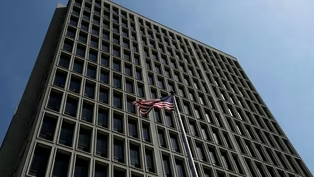
The bitter fight between the state's federal judges and President Trump has ended with Robert Frazier being appointed to the office.
Trump first appointed his personal lawyer Alina Haba as the state's U.S.
attorney, but a judge ruled she was disqualified to stay in the role after the Senate failed to confirm her.
Robert Frazier replaces a trio of assistant U.S.
attorneys who've been leading the office since Haba stepped down, a structure that the courts ruled unlawful.
Frazier has served in the U.S.
Attorney's Office for more than two decades, most recently as a senior trial counsel.
Coming up, we talk with Assembly Speaker Craig Coughlin about the state budget and what he thinks the priorities should be.
That's next.
Major funding for NJ Spotlight News is provided in part by NJM Insurance Group, serving the insurance needs of residents and businesses for more than 100 years.
>> The buzzword right now around Trenton is the budget.
What will stay and what will go as public hearings begin to finalize the numbers.
But the state is facing a $3 billion structural deficit and that's put some programs on the chopping block.
One of the key lawmakers involved in the budget negotiations is assembly speaker Craig Coughlin who joins us now as part of our under the dome series.
Assembly speaker, thank you so much for coming into the studio.
>> Joanne, it's great to be here.
>> The governor laid out her budget.
One of the first things we heard was that she does in fact plan to roll back the funds for stay NJ.
That's a program that you championed.
It's a senior property tax rebate program.
What are your thoughts about her cutting spending there?
>> I think stay is critically important and I think the governor recognizes that.
>> I think the governor's response was because she has proposed some modifications to that.
We're going to go through the process of what we do every year when we get to the budget.
I think it's important that we continue to stick up for working middle class folks, for seniors.
We want to stay here in the state of New Jersey.
And it's been wildly well received.
You need only ask anybody's district office how it's been received by senior citizens.
And I think it's an impactful and perhaps transformative program because when people start to think about New Jersey in a different way they'll make different decisions about where they're going to retire to.
We want people to stay in the state.
Why is that critical to keep them here.
First and foremost, there are people who help build the communities that they live in.
They generally love them.
They want to be near the people that they care about.
So senior citizens play an important role.
Go to any kind of historical society.
Go to street fairs.
Go to all of the things that make a community feel special about itself.
And you'll see seniors involved generally in a volunteer way.
And by the way don't underestimate their important role in child care.
They make an enormously positive impact on caring for their grandkids.
Do you generally agree that changing the eligibility requirements to save the state money is moving in the right direction.
Well I look I set the limit at $500,000 or we set the limit.
Remember it's the law.
This isn't it's been passed by both houses legislature signed by Governor Murphy and the reason for that was to try to include as many seniors as we can.
This cuts it in half.
Her proposal.
Well it cuts the eligibility dollar amount in half.
Right.
That wouldn't cut the number of people who receive it in half.
But look it's something that we're going to look at in the course of the budget review process.
Understand what the budget really is.
I mean it gets I think people oftentimes under appreciate the role of the legislature in this process.
There's a constitutional process.
Governor proposes a budget and then it becomes the product of the legislature.
And that's what we've done.
As you said in the lead we've already begun process the budget hearings.
One public session has already occurred.
There's more to come.
And then we'll talk to the department heads and go about crafting the budget.
And it's important to do that because the Constitution says to us take a look at this.
This is you know there's there's two houses that checks and balance system right.
They don't.
The governor doesn't give it to us to check the math and say if it's OK.
Give it back.
It's so that the legislature can weigh in on what it thinks is important to the people of New Jersey.
Do you think as the head of one of the chambers of the legislature that Christmas tree items are as big a problem as the governor has said they are.
She says she wants to eliminate this in the process.
Well I think that the governor talked about adding things in and having to find ways of reducing other costs in the budget.
Right.
Or cutting things.
And these tend to be the backroom.
They're not backroom deals.
That's a that's a preposterous.
How do you see it.
I see them as investments in communities.
No one knows the districts better than the legislators who serve it.
We live in those districts.
We spend enormous amounts of time.
We routinely consult with mayors and councils and legislative leaders and people within the district governor can't possibly do that right because she has responsibility for all 21 counties and all 40 districts.
So we know what what is most important to the towns and the notion that these things are Christmas trees or wasteful spending is just ridiculous frankly.
Look at the things that are we've invested in last year for example.
120 million dollars was in restored.
Governor Murphy had cut it.
We restored it so that kids that for higher ed and both at four-year colleges and a community colleges they would call that a Christmas tree.
Well ask the people whose kids are now able to go to school because they weren't going to be able to afford it if they think it was wasteful spending.
Talk about people who are brain injured.
Talk about people who are developmentally disabled and now there's a little bit more so that we can have more for the people who serve them.
Talk about all of the things that go into helping a community.
Those are investments in the community and the progress in the future.
So how do you do all that.
Assembly Speaker and still keep a balanced budget when we're already looking at a significant structural deficit between somewhere between three to four billion dollars as the numbers lay out.
Right.
So I think what we do and the evidence is that we have done one of the things we do is probably without much notice.
Last year we cut 400 million dollars out of the budget.
The year before that it was five.
So I mean we're constantly evaluating what goes in and what goes out of the budget.
And the governor has recognized that there's probably reasons to add in.
That's why I think she said that you want to add something.
We've got to find something to take out.
So I think we'll work with her on that, trying to find things that we can reduce.
Remember too, there's a process to all of this.
For example, our revenue numbers won't be certain until May sometime, right?
Because April 15th is tax return day, right?
Big piece of the revenue the state gets.
You find out what came in.
Yeah, exactly right.
And other costs will come up along the way.
State health benefit plan for example.
We'll know the numbers for that as we get later.
So that would be a cost.
So that's why it's a fluid document really until we pass it sometime in June.
Very quickly, we did see a package of immigration bills, pretty controversial, moved to the Governor's desk.
They took a while to get there.
Why do you believe those are right for New Jersey?
I think they're right for the people of New Jersey.
I mean, we have seen, first of all, it speaks to who we are, right?
We celebrate our diversity here in the state of New Jersey, one of our greatest strengths to do that.
But the impact that it has had, the chilling impact on people, whether they're American citizens or whether they're immigrants, has been profound.
People are afraid to send their children to school for fear that they'll come home to parents who aren't there.
We've seen it.
One of the things I do, one of the cornerstones, Joanna, has been the fight against food insecurity.
I regularly talk to food banks and food pantries.
They're seeing a decline in people wanting to come to get the food that they need.
Folks are afraid to come forward.
Yeah, same thing at going to hospitals or doctors, all those things.
So I think some of those bills are designed to do that.
We codified the Attorney General's directive, so that became law, not just a directive.
We've tried to build trust between the police and the citizenry forever.
Police officers and even military people have worn identification.
ICE isn't doing that.
They're covering their faces, they're wearing nondescript things.
That is a safety issue, certainly relative to police when they see somebody being grabbed, they don't know whether they're ICE agents or not.
And certainly it's terrifying for people.
There's a Republican assemblyman who filed an ethics complaint against Assemblywoman Katie Brennan.
She proposed a package of bills that are titled F-ICE.
Does this break the decorum of your chamber?
Well, look, I think there's some real raw emotion over these issues around immigrations and other things.
I think that that was manifest in the legislature that came out.
We're going to consider all of those things in totality.
Would you require a rewrite of the name of those bills?
I think the Assembly members, Senators get to draft their bills as they see fit.
And you leave it there.
All right.
Assembly Speaker Craig Coughlin, thank you.
Under the Dome is made possible in part by the Corporation for Public Broadcasting, a private corporation funded by the American people.
Could New Jersey's Immigrant Trust Directive be codified into law?
Democrats in Trenton have sent a package of controversial bills relating to immigration enforcement to Governor Sherrill's desk this week.
One of the bills would ban ICE agents from wearing masks in public.
The bills passed the Assembly and Senate over loud objections from Republicans.
Our senior writer and projects editor Colleen O'Day has more on the legislation and what comes next.
Colleen, thanks for sitting down.
This package of bills has had some fits and starts along the way, but it did make it to the governor's desk.
Can you just give us kind of a brief understanding of how the bills got there?
You know, the bill to codify the immigrant trust directive has actually been kicking around for a while because immigrant advocates have said, you know, just having the AG in charge of this, you know, makes it tenuous.
It might not survive.
But so at least that bill and this privacy protection bill were in the legislature last year.
They made it to the governor's desk, didn't get signed.
Governor Murphy at the time.
Governor Murphy at the time.
They're back.
Plus this, now this bill to require, it would be all police officers, but particularly it's aimed at ICE agents to be unmasked and provide proper identification.
We've talked about this as a package of bills quite a bit.
I want to break them down a little bit and just dive into what they do.
The Immigrant Trust Directive is a directive from the Attorney General's office right now.
One bill codifies that into law.
What are some of the tenets of that bill?
I mean the big pieces of it, and this was first put in place by former Attorney General Graywall under Murphy, again under former Governor Murphy.
It's designed to have immigrants feel confident enough to report crimes to police.
So local police, local law enforcement, county, state law enforcement is not able to work with federal immigration agents unless they are looking to detain a person who has a criminal complaint, not just a civil complaint.
A criminal warrant.
A criminal warrant.
So if you are in this country without proper documentation, that's a civil crime.
Not it's a civil offense not a crime.
So that's the main part of it.
And again advocates have been hoping for quite a while to get this put into law.
And now it might be also limits.
I believe how they ask questions about immigration.
Yes you can't write.
Indeed police officers cannot just ask based on the color of your skin or or the you know the accent you have what your status is.
There's also as you mentioned earlier the Privacy Protection Act.
What does this do so that again it's for government.
It's also for health care facilities.
It prevents the asking of questions again about your you know where you were born what's your immigration status and also things like Social Security number driver's license information just because they don't want that information getting to immigration officials.
But if it was necessary to ask that and ask those questions, then yes, you can be asked.
Otherwise, that is information that would remain private.
We're going to get into how legislators voted, but I do want to look at the last bill, which requires masks to come off.
And we did see one Republican break from the party lines there.
Who is in support of masks coming off of these ICE agents?
So that's Senator John Bramnick, a Republican from Union County.
He's enthusiastically in favor of that legislation.
He stood up and in fact talked about it on the floor yesterday.
He says, you know, when I look at the television and I see these masked agents jumping out of vans, pulling people in, it just doesn't look like my country.
So I think there is no reason why a law enforcement officer shouldn't have to identify himself, show his face, have an ID when he's approaching the public.
And of course in addition to those comments, he came on our air and said, "Hey, since when are we the party that trusts the government?
We can't have masked government agents walking around acting this way."
But he does break from his party quite a bit because many Republicans are very strongly opposed to this legislation.
Some say that this actually puts law enforcement and police officers and their families' lives in danger.
What else did you hear from some of those loud remarks in opposition to these bills?
You know, they said exactly what you said, Joanna.
They think that, they say that, you know, there's been doxing happening, particularly among federal, against federal ICE agents, and this puts them at risk.
They also just talked about the need for immigration enforcement very strongly.
Some of them mentioned some immigrants who were in this country who have committed crimes, some serious crimes, in the state of New Jersey.
So it was really kind of an echoing of the debate that's happening at the national level when you listen to the things that the Republicans and the Democrats were saying.
They also say that it should be police chiefs and sheriffs who make these decisions as to how coordination should happen, not Trenton bureaucrats, right?
They do say that, absolutely.
They want local police to have that choice.
Have you heard anything from any of the police unions on commentary either way on these bills?
You know, so we know that some of the unions have taken no position on the mask bill.
There were some unions that are against it, although there are some carve-outs.
Undercover officers could wear masks or not identify themselves also, depending on the weather.
So there are some carve-outs there for police.
Again, some unions are in opposition, some just didn't take a position.
So these bills are now on the Governor's desk.
We are waiting to see if Governor Sherrill is now in support of them.
There's been no real clear indication.
What can you gather based on some of her campaign promises?
So we know that she very specifically campaigned about unmasking ICE.
I think that may have been the term that she used.
So one might assume that she would sign that, although, again, lawyers are going to look at that from her office and see if maybe there are some tweaks that they would want to make if they don't like the language completely.
The one thing that we really don't know is how she feels about the immigrant trust directive.
She was very, very vague about that when she was campaigning.
The one thing she said and that ultimately former Governor Murphy said was that they don't want to do anything to jeopardize the directive that we have, which has upstood court challenges.
So the question is now, does this bill as written, as closely as possible, follow the directive so that it wouldn't be challenged in court?
And just quickly, there was a rewrite on one of these bills because as we saw Governor Murphy pocket vetoed one of them and said, I think it was the Privacy Protections Act, said it could jeopardize federal funding that the state receives.
Absolutely.
And that was based on just a couple words.
So that bill also has been rewritten.
The trust directive had been rewritten.
We'll see if the governor's office now, if Governor Sherrill thinks that these are OK to go.
Yeah, could continue to be controversial as her party clearly is in support.
We don't know where she stands.
Marlene O'Day, senior writer, thank you so much for the insight on this.
Thanks very much, Joanna.
Vineland residents are rallying against a massive data center that's being built in their town.
Locals have taken to social media to complain about a constant loud humming sound and rumblings coming from the construction site.
Data One is building the center as part of a $17 billion deal with Microsoft for a 2.6 million square foot AI data center that'll use about 300 megawatts of power.
That's enough to operate a small city.
The company says it'll generate 85% of its own energy through natural gas and will operate as a quote closed loop that won't require water.
But residents have questions and they're demanding more transparency around the project.
The group Sustain S.J.
held a protest this weekend and I'm joined now by one of its organizers who is a Vineland resident Matt Williams.
Matt so so glad to have you with us.
Thanks for taking a minute to talk.
Thanks for having me.
You were out protesting this weekend.
What are your chief concerns about this data center that's being built in Vineland?
I mean, really, the list is kind of the same what you hear everywhere.
You know, the water usage, the power, and really just the noise is really start to come to light for people.
Explain that noise for folks who haven't seen the videos or who aren't living there and don't understand what's happening on a really a constant basis from what we hear.
So people that live closer to the site, me personally, I'm about four miles.
But from what I understand, if you're like within like half or half mile or a mile or so, there's a, there's like a loud constant hum going on, really like later hours of the night.
And it's disturbing residents.
There's also concerns about water and what we're hearing from some environmentalists is that really, even when there are these closed loop systems, that there's still the risk for one, a lot of use of water and then water pollution.
What can you tell us about that?
So what we're told with this system is that they would use an initial allocation to prime the system.
And then any additional use would be to top off the system.
It's tough to think that there's any issues, that there wouldn't be any issues, especially like our area has been in significant drought conditions for almost two years now.
So it's it's really hard to to understand that.
Also what we're hearing from from some environmentalists is that even in a closed-loop system contaminated water still escapes and it can run into wells that it might be in the area and it can run into water systems that aren't equipped to properly strain out any contaminants.
Tell us about the region surrounding Vineland and what impact it could have if any contaminated water did escape from the center.
Well if that's the context, this is on a wellhead protected area regulated by the DEP.
So that specific site is more susceptible to groundwater contamination.
So that immediately affects our our water supply and certainly agriculture nearby too.
Yes.
Yeah absolutely.
There's a lot obviously Vineland's known as a as a farming community.
Yeah.
The data one CEO said that this could be much worse.
He says if this were an Amazon warehouse being built that you'd have significantly more noise pollution and that you know there would be trucks moving through the area that would create air pollution what did you hear from him so far and what's your response to those comments?
So when it comes to trucks I mean from what I understand of their revised site plan there's an LNG storage tank on site and to my knowledge I don't think that's connected to a direct pipeline so trucks have to bring that gas on site one way or another.
And that's for liquid natural gas.
Yes.
Correct.
Of course energy is one of the hot topics here in New Jersey.
Energy costs have risen significantly in the last year.
They say 85 percent of their own electricity will be generated by this liquid natural gas that you're talking about.
One is there any you know what could potentially be the impact for the remainder of that energy.
And how does that impact electricity bills in the area.
Let's start there.
So Vineland is still its independent utility.
I think the way that it was described to me, we are a peaker system.
But that still implies that they're going to have to take an electric pool off of somewhere, whether it's our substation or Atlantic City Electric substation nearby.
How it affects our rates, I'm not sure.
I don't think we, me personally, I don't think we would see that until maybe our next auction.
Listen, AI is not going anywhere.
We're just at the beginning of what will probably be the next phase of technology in our country, in our world.
And this data center is already being built.
What are you asking for?
What's the recourse here?
So you mentioned the town hall.
There were very specific claims made at that town hall.
And honestly, I would love to see those claims held onto paper.
You know, if they're if it's here to benefit our community, I think that that should be laid out and expressed for the community and held accountable for it.
When you say those claims laid out onto paper, what do you mean by that?
So there was it was expressed that this closed loop system would reclaim and capture some water use that would be redistributed to the city, which at the surface to me, I'm skeptical.
There is also claims of a digital citizen card that would provide fruits and vegetables from some of the heat capture or something to lower income residents of Vineland.
But we've kind of been left in the dark since the CEO made that claim in January.
Now what's your advice for other communities that are facing similar data centers coming into their their region.
I would stress to other communities to really get involved with their local government to make sure that they have data centers defined in their city codes and ordinances.
You know unfortunately in Vineland the rules weren't made so it caught a lot of people by surprise.
And finally just tell us about the protests and what they've looked like and what's happened there.
Yes.
So on Saturday really it was an amazing community turnout.
You know there are about 200 people.
The air is just filled with positivity.
You know most of this when you hear about data center fights you know it's irate residents communities but there's a lot more positivity in the air that I felt on Saturday than anything else.
All right well thank you so much appreciate coming on and talking with us Matt Williams organizer for Sustain NJ.
Thank you.
All right thank you.
All right that's gonna do it for us tonight.
I'm Joanna Gaggis for the entire team here at NJ Spotlight News.
Thanks for being with us.
We'll see you right back here tomorrow.
(upbeat music) - New Jersey Education Association, making public schools great for every child.
[MUSIC]
 New
NewNJ gets new U.S. attorney following Habba controversy
Video has Closed Captions
Robert Frazer has served in the U.S. attorney’s office for more than two decades (49s)
Providing Support for PBS.org
Learn Moreabout PBS online sponsorship
- News and Public Affairs

Top journalists deliver compelling original analysis of the hour's headlines.

- News and Public Affairs

FRONTLINE is investigative journalism that questions, explains and changes our world.












Support for PBS provided by:
NJ Spotlight News is a local public television program presented by THIRTEEN PBS