
Place Value with Mr. Romero - Miguel Romero - Fifth Grade
5/14/2020 | 57m 2sVideo has Closed Captions
In this bilingual math lesson, students will learn vocabulary associated with place value.
In this bilingual math lesson, students learn vocabulary associated with place value to read and write numbers. Created by NJTV in partnership with the NJEA and the NJ Department of Education, NJTV Learning Live remote learning classes are for grades 3-6, taught by NJ public school teachers. One-hour lessons include math, science, English language arts, social studies, physical education and more.
Problems playing video? | Closed Captioning Feedback
Problems playing video? | Closed Captioning Feedback
NJTV Learning Live is a local public television program presented by NJ PBS
Place Value with Mr. Romero - Miguel Romero - Fifth Grade
5/14/2020 | 57m 2sVideo has Closed Captions
In this bilingual math lesson, students learn vocabulary associated with place value to read and write numbers. Created by NJTV in partnership with the NJEA and the NJ Department of Education, NJTV Learning Live remote learning classes are for grades 3-6, taught by NJ public school teachers. One-hour lessons include math, science, English language arts, social studies, physical education and more.
Problems playing video? | Closed Captioning Feedback
How to Watch NJTV Learning Live
NJTV Learning Live is available to stream on pbs.org and the free PBS App, available on iPhone, Apple TV, Android TV, Android smartphones, Amazon Fire TV, Amazon Fire Tablet, Roku, Samsung Smart TV, LG TV, and Vizio.
Providing Support for PBS.org
Learn Moreabout PBS online sponsorshipMore from This Collection
NJTV Learning Live is a class for fifth graders taught by NJ public school teachers.
Galloping through Art Movements - Jason DeMaria -Fifth Grade
Video has Closed Captions
Students will identify artworks from art movements throughout the 19th and 21st centuries. (56m 24s)

National Holidays: Why Celebrate? -Jason Glezman-Fifth Grade
Video has Closed Captions
Students will explore the national holidays that are celebrated in the United States. (58m 46s)

Spoken Word Poetry - Thais Jackson - Fifth Grade
Video has Closed Captions
Students will learn the craft of writing, listening, and performing Spoken Word Poetry. (57m 27s)

Coordinate Planes with Corey Plane -Lauren Proda-Fifth Grade
Video has Closed Captions
Students will learn how to graph points on the coordinate plane to create and read maps. (57m 1s)
Design a Creature - Maria Montroni-Currais - Fifth Grade
Video has Closed Captions
Students will analyze attributes of ecosystems and then create a brand-new creature. (53m 38s)
ASL: Language & Community - Amy Andersen - Fifth Grade
Video has Closed Captions
Students will learn the three dimensions of American Sign Language. (55m 26s)

Decimal Dash! - Melissa Winters - Fifth Grade
Video has Closed Captions
Using a variety of sports statistics, students will compare, add, and subtract decimals. (56m 59s)
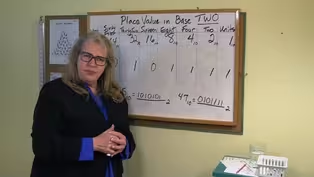
Exploring Place Value - Kristin Baker - Fifth Grade
Video has Closed Captions
Students will examine the structures of the Base Ten and Base Two place value systems. (56m 57s)
Close Reading - Tanya White - Fifth Grade
Video has Closed Captions
Students will explore how to closely analyze a text using the Close Reading method. (56m 2s)

Survival at Morristown - Christopher Kopitar - Fifth Grade
Video has Closed Captions
Students will learn about the Continental Army's survival during the American Revolution. (56m 37s)
The Elements of Drama - Maleesa Lamatina - Fifth Grade
Video has Closed Captions
The students will learn basic terms for the elements of drama. (55m 38s)

Descriptive Writing: Snacks - Christine Skalka - Fifth Grade
Video has Closed Captions
Students will learn how to write a descriptive paragraph, using their favorite snack food. (57m 57s)
Providing Support for PBS.org
Learn Moreabout PBS online sponsorship>> Hello, friend.
My name is mister Romero.
Today I can be your math teacher.
I'm a bilingual teacher at... I usually teach math, and science in 4th and 5th grade.
But today we are going to be focused just in 5th grade, and math.
You probably are thinking, "What a bilingual teacher mean?"
Bilingual teacher usually teach in both languages.
Can be in English, usually, and the other, in my case, is Spanish.
So during this video, I'm going to teach in both.
Don't worry about it.
I will teach you vocabulary, and...in both.
You can follow perfectly this -- this lesson.
So, let me teach, let me teach you something about math.
People usually say, "Oh, matemáticas son sólo números y cálculos".
Addition, subtraction, multiplication.
No.
Math is something else.
Las matemáticas yo pienso que es algo muy especial.
Es una asignatura muy especial, porque no sólo nos ayudan a calcular, esa es una parte muy pequeñita de las matemáticas, sino que también nos ayudan a pensar y a pensar mejor.
A utilizar todo nuestro razonamiento y ponerlo en cierto orden.
Hoy, today, we are going to learn about something very specific.
Algo muy específico de las matemáticas y que es la base de nuestro sistema numérico.
Nuestro tema hoy será el valor posicional.
Place value is the top today.
But before start with the lesson, let me tell you a story.
Te voy a contar una pequeña historia.
Okay, era un día soleado y el número infinito, que es un número que nunca acaba, quiso crear un nuevo número.
Invitó a unos cuantos amigos.
Al primero que invitó fue al número uno.
El número infinito... ...con sus siempre expectante, esperaba a sus amigos.
El primero que llegó fue el número uno.
¿Okay?
Y el número uno cuando llegó, por ser el primero, estaba un poquito tímido.
Llegó y dijo: "señor infinito, ya he llegado, soy el uno.
¿Dónde me pongo?"
"Este, ve colocándote.
Take a space, wait for the rest of the numbers."
"Okay, says number one."
El número infinito espero y después llegó el número cinco que tiene un poquito de barriga porque le gusta comer.
Entonces llegó el número cinco y el número cinco cuando llegó dijo: "señor Infinito, he llegado.
¿Dónde me pongo?"
Le dice colócate justo detrás del uno.
Muy bien, justo detrás del uno se colocó el número cinco.
Y el último número que llegó a la reunión fue el número nueve.
El número nueve era un poquito especial.
Llegó con su pecho bien alto, la barbilla bien arriba, y cuando llegó le preguntó al señor infinito: "Señor Infinito, ¿dónde me pongo?
Soy el número más grande.
Deme un espacio apropiado para mí".
El número infinito pensó un poco, le dijo: "Okay, colócate justo detrás del cinco".
Y se colocó aquí.
El señor infinito creó su número.
Su número era 159.
159.
En ese momento el número nueve empezó a llorar.
¡Bua!
Lloraba el señor nueve.
Lloraba y lloraba.
Esta es la primera pregunta.
This is the first question I have for you today.
Why do you think number nine is crying?
No sé, déjame pensar.
Número nueve estaba muy orgulloso de ser el número más grande, pero cuando el señor infinito le dijo que se colocara atrás, de repente empezó a llorar.
¿Saben por qué?
¡Ya sé!
¿Sabes qué pasa?
Que al colocarse en la última posición, nueve se convierte en un dígito mucho más pequeño que cinco y más pequeño que uno.
Nuestro sistema numérico se basa en dos cosas.
Se basa en símbolos a los que tú normalmente llamas números, cero, uno, dos, tres, cuatro, cinco, seis, siete, ocho, nueve.
Zero, one, two, three, four, five, six, seven, eight, and nine.
Y después en posición.
Ahora veremos cuando introduzcamos el vocabulario cómo se llaman esas posiciones.
Pues bien, este sistema compuesto de símbolos y posiciones lo llamamos... Do you know how?
Yes, place value.
El valor posicional se refiere a un sistema numérico compuesto de símbolos, a los que normalmente llamamos números, y posición, ¿okay?
Yo creo que estamos listos, I think that we are ready to start the lesson.
Deep breath, a little bit, wait a minute.
One more time, friend.
Perfect.
So now, for this lesson, you will need a notebook and a pencil.
Para esta lección vas a necesitar un cuaderno y un lápiz.
Go get it.
I will give you one minute.
Cógelo, te doy un minuto.
Okay, ready now?
Okay, the first thing that we are going to do is review our vocabulary, as I told you before, in both languages.
First Spanish.
Vocabulario.
Número, dígito.
A veces confundimos número y dígito, pero no significan exactamente lo mismo.
Símbolo, posición, valor, forma escrita, forma estándar y forma expandida.
Let's check the list in English now.
Number, digit, sometimes people think that it's the same, but has some differences.
Symbol, position, value, written form, standard form, expanded form.
And now let's see the number and the name of the place value, okay?
Vamos a empezar a la derecha del punto decimal.
Let's start to the right of decimal.
Alrighty?
El primer número que tenemos son centésimas.
La -- perdón, la primera posición, centésima.
Décimas, unidades, decenas, centenas, millares, aquí dependiendo del país o de la localidad, algunas personas la llaman unidades de millar, millares o miles.
Yo he decidido poner millares.
Decenas de millares, centenas de millar y millones.
Let's check every single place value name, in English now.
Hundreths.
Be careful with that sound because it sounds like "Hundred", but at the end we have to put the "th" sound, and don't for get the "s."
Hundreths.
Hundreths, alrighty?
Same thing with ten.
Tenths.
Tenths.
Look at my mouth.
The position of my tongue, and the position of my mouth.
Tenths.
Alrighty?
Ones, tens, hundreds, thousands, ten thousands, hundred thousands, a million.
Okay.
Ahora que tú sabes el vocabulario y el nombre de las posiciones... Now that we have symbol,and place value name, let's make a simple, a little challenging too, question.
Vamos a hacer una pregunta simple y de reto a la vez.
Un reto, okay?
Mirad.
Las posiciones cuando las primeras personas empezaban a contar -- imagínate como un pastor contando ovejas y contaba, the first person that start count, count animal, sheep, for example.
And he said, "1, 2, 3, 4, 5, 6, 7, 8, 9, 10."
Esa persona contando ovejas contaba 1, 2, 3, 4, 5, 6, 7, 8, 9, 10 y si tenía 11, ya no le quedaban dedos.
Entonces nuestro sistema numérico se basa en un sistema numérico de base 10.
¿Qué quiere decir eso?
Que cada vez que tengo 10 en una posición, ya tengo que poner uno en el siguiente valor posicional.
Have a system number based in 10 mean that you never can have two digit in the same place value.
That's why when you have 10 in one spot, you have mandatory to use the next spot, or because we know the vocabulary now, the next place value.
Entonces, mi pregunta para ti ahora, es te voy a dar un número y lo tienes que colocar en su posición adecuada.
Para eso fíjate en el número, en algunas pistas.
I will give you a number now that you have to put by place value in the right position, paying attention to some clue that you'll have, alright?
Look at my numbers.
This is the number, alright?
I'm going to read the number for you.
The number is 781,932.45.
Some people say, "and," and you can also say, "point 45."
You can see it in both, okay?
Déjame leer este número antes de que tú lo coloques en cada posición.
Sería 781.932,45.
Lo puedes ver traducido como, "Y 45", okay?
Puede verse de las dos maneras.
"Y 45" o "punto 45".
No -- no -- está correcto de las dos maneras.
Si lo ves de una manera o de la otra, las dos están perfectamente aceptadas.
Ahora, coge cinco segundos y tenemos uno, dos, tres, cuatro, cinco, seis, siete, ocho dígitos.
5 x 8 son 40.
We have eight digits, and five seconds to prove every digit.
Will be... 5 x 8, 40.
You have 40 seconds to put every single number in the right place value.
Hmm.
Very interesting case, right?
Think about some reference, there are some clue right here.
Let me put the clue in another color.
You have one clue right here, and other right here.
Yeah.
You see that the point and the comma are in our reference, too.
You got it.
Creo que lo entendiste.
Creo que estás bastante bien en el camino que tienes que seguir.
Mira, estas referencias nos ayudan a colocar el número.
¿Ves el punto?
This is a point.
We have a point right here to separate the decimal numbers, and the regular numbers.
So, este punto nos ayuda a separar números decimales de números naturales, vamos a llamarlos así.
Entonces, vamos detrás del punto, el primero número que tengo es el cuatro.
Pones justo detrás del número tengo el cuatro.
Es decir, so, meaning that four is tenth.
El cuarto cae en las décimas.
Vamos a colocar el número cinco.
Son dos posiciones detrás del punto.
Ya tenemos las décimas.
Y ahora si os fijáis, todos estos números van a seguir el primer orden.
Es decir, el dos va a ser las unidades, el tres serán las decenas, el nueve serán las centenas, so, meaning that if you follow the order, you can put it in the right space.
Two is already in ones.
Three is in tenths, nine is in hundredths.
Look at that!
It's my comma.
We have the same comma right here, you see?
You only have to follow the order.
Is the same order.
El uno, el ocho y el siete.
Check your number.
Check each position.
¿Puedes verla?
Bien.
Si no lo has conseguido, no pasa nada.
Puedes volver a repetirlo e intentarlo de nuevo.
Recuerda que estás para aprender, no tienes que saber hacer nada, sólo tienes que prestar atención.
You only have to pay attention, don't worry about it if you didn't get it.
You're here, and you're paying attention to learn.
Alright?
Okay.
Ahora, el siguiente paso es, tenemos que saber, we have to know, what's the real value that each number and position represent.
One of the most common question is, "What is the real value of nine?"
Let's see.
Si queremos saber cuál es el verdadero valor, cuál es la verdadera cantidad que está representando cada número, tenemos que pensar y colocar los espacios vacíos con ceros, okay?
El cero nos va a ayudar a saber el valor real de todos esos números.
Okay.
Mirad.
Vamos a co-- vamos a empezar por el más pequeño.
Let's start for the smaller one.
This is number five.
But in hundreths, the value of this number is 0.05.
Es 0.05.
¿Por qué?
Porque tiene un cero en las unidades, otro cero sería en las décimas y después sería el cinco.
El valor de este número sería 0.4.
Nada en las unidades y cuatro en las décimas.
El dos, ese se queda exactamente como está.
El valor de ese tres sería 3, y como tiene una posición completamente vacía detrás, because you have an empty space behind, you have to put zero.
So the real value of three in tens is 30.
Nueve representaría 900.
Ese uno, en realidad, si ves todos los espacios que tiene vacíos, sería uno, dos, tres.
Estos espacios detrás del punto no los vamos a contar porque no representan información en realidad.
When you try to put zeros behind the point, you are not showing extra information.
That's why you don't have to put it.
Okay?
So, this number one is equal or represents 1,000, okay?
Si seguimos este ocho representa en realidad 80.000.
Y el último, el siete, está representando 700.000.
Meaning 700,000.
Okay?
El siguiente paso sería escribir estos números de las tres maneras posibles.
Lo vimos al principio en el vocabulario.
Teníamos tres formas, la forma escrita, la forma estándar y la forma expandible.
We have three ways to write a number.
Written form, standard form, and expanded form.
Let's review before move forward.
Tenemos un sistema numérico basados en símbolos y posiciones.
Esto se llama valor posicional.
El valor posicional es un sistema numérico basado en posiciones y símbolos.
Un símbolo puede cambiar su valor dependiendo de la posición que ocupa.
Un nueve en las unidades representa un valor y un nueve en las centenas representa otro valor, okay?
Numbers change its value depending on the position that they are, alright?
So you have to keep in mind that the symbol represent an amount of something, but also the position, too.
So, después, lo próximo que vimos era representar la cantidad, el valor total de esos números en esa posición.
Ahora lo escribiremos de tres maneras diferentes.
Vamos a calmarnos.
Let's try a second deep breath, and continue with our lesson, alright?
Wait a minute, what is the difference between numbers and digits?
Oh, bien, amigos.
La diferencia entre número y dígitos es muy sencilla.
A number can be any single number, like this one.
8,925.
This is a number.
Otro número puede ser, por ejemplo, el 15.
Esos son números, so what is a digit?
A digit are all these symbols.
Okay?
We call digit to all these symbols that we usually call as a number.
So one, two, three, four, five.
Cinco, seis, siete, ocho, nueve y el cero son dígitos.
¿Qué pasa por ejemplo con el 10?
¿Es un dígito?
Wrong.
No, 10 is a number.
Digit can only have one position.
Un dígito solo tiene una posición.
Entonces, volvemos y decimos que los dígitos son nuestros símbolos.
Veamos un ejemplo.
Let's see an example.
8,925 has 5 digits.
Sorry.
Just four digits.
8 is one digit.
9 is another digit.
2 is another digit.
And 5 is the last digit in that number.
Entonces, los dígitos.
8, 9, 2 y 5 componen el número 8.925.
In other words, 8,925 are composed by all these digits.
Same thing with 15.
15 is composed by the digit 1 and 5, but the number is 15.
15 -- el número 15 -- está compuesto por el dígito 1 y el dígito 5, que conforman en esa posición de unidad y de decena, el número 15.
Pues esta es la diferencia entre número y dígito.
This is the difference between number and digit.
>> Hi, guys, this is your Brain Break.
It's something that I always use in my classroom with my students.
And I really hope that you enjoy it.
This is...for the school 15.
Ahora, esto es tu Descanso Mental.
Algunos de la escuela 15 lo recordarán.
Con muchísimo cariño, va para todos ellos.
Está dedicado a la escuela 15.
Espero que te guste.
Enjoy the music.
Okay, guys, now we are going to start the second part of this wonderful lesson.
I told you at the beginning that we are going to talk about the different forms that we can show a number.
So, let's put this in place.
I'm going to show you a number, and then, I'm going to show you the different ways that you can write it, say it, read it, or create it, all right?
Ahora en la segunda parte de la lección, vamos a coger un número y vamos a enseñarlo, mostrarlo, de las tres maneras diferentes.
Forma escrita, forma estándar y forma expandida, ¿okay?
Vamos a escoger este número.
1.932.
1.932.
Para volver al concepto de el valor que tiene cada número en este número que yo he creado, voy a usar una herramienta... Si tienes bloques de tu hermano o de tu primo, lo puedes usar igual que yo.
Mira, este es nuestro número.
En cuarto grado -- in fourth grade -- we show expanded form using addition.
So en cuarto grado hemos visto que el número lo podemos poner en forma expandida, en forma de suma.
Entonces, fijaros.
Yo tengo aquí 1.000, porque... el 1 en los millares, 1,000, represents 1,000.
El 9 -- number 9 -- in hundreds represents 900.
Exactly the same that I have here, okay?
El número 3, que está en las decenas, en realidad representa un valor de 30.
Y el número 2 representa 2 unidades.
Esto es tremendamente útil.
Por ejemplo, el valor posicional se utiliza en las sumas.
Cuando colocamos los números por valor posicional, los podemos sumar.
2 + 0 + 0 + 0 es 2.
Las unidades.
3 + 0 + 0 serían... 3 en las decenas.
30.
9 sumado más 0 sería el 9.
Y después, el 1.
Es decir, si yo pusiera todos estos números juntos sumados, el resultado sería 1,932.
El valor posicional nos vale para sumar.
Podemos colocar los números por valor posicional para sumarlos.
También lo podemos utilizar en la resta.
Este sistema es tremendamente útil.
The place value can be used for addition and subtraction.
It's very useful.
So keep in mind that when you put numbers on top of the other, you are adding or subtracting by place value.
This is amazing.
So let's move on, okay?
I put here the number in written form.
One thousand nine hundred thirty two.
Right here we don't have to put.
And then, we have... En español sería: mil novecientos treinta y dos.
Mil novecientos treinta y dos.
Esta sería la forma estándar.
De la manera regular, normal, que se presentan los números.
This is the standard form.
There are four ways.
You probably saw the expanded form.
1,000 + 900 + 30 + 2.
En cuarto grado, seguramente viste 1.000 + 900 + 30 + 2.
Pero en quinto grado nos piden que hagamos esta forma expandida utilizando la multiplicación.
¿Recuerdas que te comenté que tenemos un sistema numérico de base 10?
Quiere decir que cada vez que tenemos 10 en un valor posicional, tienes que saltar al siguiente valor posicional.
Meaning that if you have a number system in base 10, everything that you got 10 in one place value, you have to jump to the other place value.
So if I want to represent 1, meaning the first place value once, the number has to be the same.
El número se tiene que quedar igual.
Entonces, tenemos 2 x 1, que sigue siendo 2.
Para representar tres decenas, tenemos que multiplicar 3 x 10.
3 x 10 son 30.
Okay, lo tenemos aquí arriba.
30.
30.
900 -- para conseguir 900 utilizando la multiplicación, sería un valor posicional 100 veces mayor -- 9 x 100.
That way we are representing 100 times more, okay?
9 x 100 is 900.
Now, the last one, 1,000 will be 1 x 1,000.
En el último, 1 x 1.000 conseguiríamos 1.000.
Pero en quinto grado -- in fifth grade, we have to show decimals, too.
En quinto grado también tenemos que enseñar los decimales.
Entonces, vamos a imaginarnos que vamos a poner unas décimas más.
Coloquemos un 5 en las décimas, y un 3 en las centésimas.
Now, how I can represent 5 tenths and 3 hundredths?
Okay, estas décimas representan un valor menor que uno.
Now we have something that is smaller than 1, than the ones, than the units.
So, when I grow up, I multiply by 10, by 100, by 1,000.
If now I want to go down, what is the opposite of multiplication?
Si para que crezcan los números en valores posicionales multiplicamos por 10, por 100, por 1.000, para representar un valor posicional más pequeño tengo que hacer lo contrario a multiplicar.
The opposite way to multiplication -- Lo contrario a multiplicar es... Now we go.
División.
Divide.
Tú tienes que dividir.
Y empezamos de la misma manera.
Fijaros.
Este 5 sería más 5... Podemos ponerlo en forma de fracción.
Dividido por 10.
O también 5 ÷ 10.
Either way is fine.
Plus 3.
That 3 is 3/100 in fraction, or you calculate an equation.
A little equation... is exactly the same.
Okay?
Oh, I put 5.
And this is 3.
Sorry about that.
Everybody makes mistakes, right?
That's the way to learn.
Make wonderful mistakes.
Me encantaba un maestro que me decía: "Equivócate más.
Equivócate mejor".
Todo mundo comete fallos.
No nos preocupemos por eso.
Ahora, vamos a hacer un resumen de todo, ¿okay?
Nuestro valor posicional se basa en símbolo y en posición que crecen cada 10 números.
Tiene una base 10.
We have a whole system based on symbol and position.
When you combine both, you have place value.
It's based also in 10.
Everything that you have 10 in one place value, your number jumps to the next one, meaning that it's 10 times bigger, okay?
Ahora, después, fíjate que cada número puede ser escrito de tres maneras.
Los números se escriben en forma escrita, forma expandida y forma estándar.
You can show a number in three different ways -- standard form, written form, and... Let me see.
Written, standard, expanded form, of course.
Think about it.
You can show your expanded form in two different ways -- using just addition or using multiplication.
Multiplication and division is the way in fifth grade.
So if you are in fifth grade, you have to show the expanded form using multiplication and division, okay?
Remember, for those positions that show or that are less than the unit, you have to divide, okay?
Remember, the opposite way to multiplication is division.
Okay, guys, now you have this as an example.
Now it's your turn.
Let's change the number.
We are going to make a new number and you have to do it, all right?
You can pick your own number or you can take the same number that I do.
Ahora es tu turno.
Tú tienes que hacer esta práctica, ¿okay?
Ya tienes el ejemplo, y ahora vamos a ver un nuevo número.
Tú puedes escoger el que yo voy a poner, o te puedes inventar uno.
Vamos a borrarlo.
Déjame borrar los números.
Mi ejemplo anterior.
Okay.
Pongo mi borrador aquí.
Y vamos a poner un número nuevo.
Vamos a poner... 7, 6, 3, 2, 5 y 9, por ejemplo.
El 9 seguramente está muy triste, porque mira dónde lo he puesto.
Probably 9 is crying again because look at its place value.
Hmmm.
Okay.
Ahora es tu turno, ¿okay?
Mientras tú vas pensando la forma escrita, yo voy a ir poniendo los números aquí, ¿okay?
[ Hums ] Okay.
Aquí estarían hasta las unidades.
Tendría que añadir las décimas.
Las décimas serían algo que represente menos que esto, ¿okay?
Yo no tengo nada, okay.
Entonces, sólo lo voy a poner aquí, ¿sí?
Lo voy a poner todo.
Lo primero es, voy a leer el número.
Voy a leerlo para ayudarte a que tú lo puedas escribir.
Siete mil seiscientos treinta y dos punto cincuenta y nueve.
Seven thousand six hundred thirty two of fifty nine.
Okay?
Ahora, asegúrate de escribirlo y de practicar la forma expandida.
Voy a poner la forma expandida aquí, ¿sí?
7 x... Mira esto.
Voy a poner 1, la coma, y voy a contar los espacios.
Por cada espacio pondré un 0.
Good job.
Serían 7 x 1.000.
7 x 1,000.
Plus 6 x... Pongo un 1 y cuento los espacios que hay detrás del 6.
Uno, dos.
Pues dos 0.
6 x 100.
Why?
Because we have two place values behind number 6.
Plus 3 times... I write 1, and then the number 0 is the number of places that I have behind.
One, okay?
Después, tenemos el 2.
Sería 2 x 1.
¿Y qué hacíamos para los decimales?
Shh.... ¿Lo contrario de multiplicar qué era?
Dividir.
Entonces, mirad.
Antes he usado fracción o división.
Quiero que sepan que muchas veces seguimos utilizando la multiplicación, pero es lo mismo.
Sometimes we can use multiplication to show decimals, too.
It's the same thing.
It's the same strategy with a different dress, okay?
Por ejemplo, 5 x 0,1.
Espero vuestros maestros hayan enseñado a multiplicar por decimales.
Y la última, ya casi lo acabo, sería 9 x 0,01.
Y ya tendría mi forma expandida de multiplicación.
La forma escrita te la voy a dejar para ti.
Juega con tu familia y practica, a ver si lo saben leer.
Play a little bit with your family with this number, okay?
Let's see if they can read it with you, all righty?
Hi, friends.
This is our additional practice.
Hola, amigos.
Vamos a hacer una práctica más.
En esta práctica tenemos este número, que no voy a leer para no ayudarte.
Y lo tienes que escribir en forma expandida y en forma escrita.
Guys, you have this number.
I am not going to read it for you, but you have to create an expanded form and written form.
Let's start with expanded form.
Right here.
So where do you think think this number should go?
Maybe here?
No.
Creo que es 10.000.
Debería de ir aquí.
Uno representa el mayor valor de este número, ya que está en el valor posicional más grande.
When you see a number in the bigger place value, meaning that it's the biggest number.
So, let's continue putting in order.
2,000.
Oh... 900 should go here... or should go here?
¿Qué crees?
¿Debería de ir con este o con este?
Sí, está en las centenas.
Entonces, el número de ese 9 es 900.
Pongamos también el 3, que vale 30, porque está en las decenas.
El 1 de las unidades, y en las centésimas, in tenths, we have 0.9.
Okay.
El siguiente movimiento sería hacer la forma escrita.
Recuerda que para leer y escribir un número, empezamos por la izquierda.
Empieza desde la izquierda hacia el último número.
In order to write a number, you have to start from the left and finish to the right.
Yes?
¿Lo tienes ya?
Espero que sí.
Yo tengo la respuesta aquí preparada para ti.
La voy a subir.
And now you can check.
Espero que te haya gustado.
I really think that this practice is really good.
So enjoy it.
Me gustaría coger estos últimos momentos para saludar y darle un caluroso abrazo a los estudiantes de la escuela 15 y a todos sus maravillosos maestros.
I would like to appreciate all the teachers that in this difficult time they are putting all their energy to make sure that you continue learning.
You have to continue learning.
You have to continue reading books.
You have to continue solving problems and practicing all your subjects.
All of them are important.
Because you are the future.
You are the future.
And you have to continue learning all the time.
I'm pretty sure that all your teachers love helping you and supporting you every single day.
So continúa aprendiendo.
Continúa equivocándote.
Continúa leyendo y practicando tu asignatura.
Tienes que seguir aprendiendo.
No puedes parar.
Eres nuestro futuro.
Y tienes que apoyarte en tus maestros que seguro te van a ayudar.
Quiero decir una cosa más.
The best assets that a country has is the education of their citizens.
El mejor valor, la mayor riqueza que tiene un país, es la educación de su población.
Por favor, continúa aprendiendo.
No pares.
















Support for PBS provided by:
NJTV Learning Live is a local public television program presented by NJ PBS