Reading Fun with Nonfiction Texts - Sara Jimenez-Fifth Grade
5/12/2020 | 56m 40sVideo has Closed Captions
Students explore what it looks like to be a good reader and dive into nonfiction texts.
Students explore what it looks like to be a good reader and dive into the nonfiction text structures. Created by NJTV in partnership with the NJEA and the NJ Department of Education, NJTV Learning Live remote learning classes are for grades 3-6, taught by NJ public school teachers. One-hour lessons include math, science, English language arts, social studies, physical education and more.
Problems playing video? | Closed Captioning Feedback
Problems playing video? | Closed Captioning Feedback
NJTV Learning Live is a local public television program presented by NJ PBS
Reading Fun with Nonfiction Texts - Sara Jimenez-Fifth Grade
5/12/2020 | 56m 40sVideo has Closed Captions
Students explore what it looks like to be a good reader and dive into the nonfiction text structures. Created by NJTV in partnership with the NJEA and the NJ Department of Education, NJTV Learning Live remote learning classes are for grades 3-6, taught by NJ public school teachers. One-hour lessons include math, science, English language arts, social studies, physical education and more.
Problems playing video? | Closed Captioning Feedback
How to Watch NJTV Learning Live
NJTV Learning Live is available to stream on pbs.org and the free PBS App, available on iPhone, Apple TV, Android TV, Android smartphones, Amazon Fire TV, Amazon Fire Tablet, Roku, Samsung Smart TV, LG TV, and Vizio.
Providing Support for PBS.org
Learn Moreabout PBS online sponsorshipMore from This Collection
NJTV Learning Live is a class for fifth graders taught by NJ public school teachers.
Galloping through Art Movements - Jason DeMaria -Fifth Grade
Video has Closed Captions
Students will identify artworks from art movements throughout the 19th and 21st centuries. (56m 24s)

National Holidays: Why Celebrate? -Jason Glezman-Fifth Grade
Video has Closed Captions
Students will explore the national holidays that are celebrated in the United States. (58m 46s)
Spoken Word Poetry - Thais Jackson - Fifth Grade
Video has Closed Captions
Students will learn the craft of writing, listening, and performing Spoken Word Poetry. (57m 27s)
Coordinate Planes with Corey Plane -Lauren Proda-Fifth Grade
Video has Closed Captions
Students will learn how to graph points on the coordinate plane to create and read maps. (57m 1s)
Design a Creature - Maria Montroni-Currais - Fifth Grade
Video has Closed Captions
Students will analyze attributes of ecosystems and then create a brand-new creature. (53m 38s)
ASL: Language & Community - Amy Andersen - Fifth Grade
Video has Closed Captions
Students will learn the three dimensions of American Sign Language. (55m 26s)
Decimal Dash! - Melissa Winters - Fifth Grade
Video has Closed Captions
Using a variety of sports statistics, students will compare, add, and subtract decimals. (56m 59s)
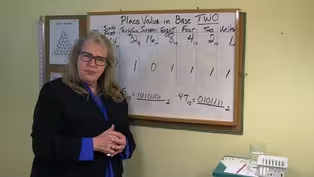
Exploring Place Value - Kristin Baker - Fifth Grade
Video has Closed Captions
Students will examine the structures of the Base Ten and Base Two place value systems. (56m 57s)
Close Reading - Tanya White - Fifth Grade
Video has Closed Captions
Students will explore how to closely analyze a text using the Close Reading method. (56m 2s)
Survival at Morristown - Christopher Kopitar - Fifth Grade
Video has Closed Captions
Students will learn about the Continental Army's survival during the American Revolution. (56m 37s)
The Elements of Drama - Maleesa Lamatina - Fifth Grade
Video has Closed Captions
The students will learn basic terms for the elements of drama. (55m 38s)
Descriptive Writing: Snacks - Christine Skalka - Fifth Grade
Video has Closed Captions
Students will learn how to write a descriptive paragraph, using their favorite snack food. (57m 57s)
Providing Support for PBS.org
Learn Moreabout PBS online sponsorship>> Hello, amazing readers.
I'm so happy to be joining you on your learning journey through this remote-learning process.
My name is Sara Jimenez.
and I teach fifth grade at Nathan Hale School in Carteret.
Carteret is in Middlesex County.
I teach my fifth graders at Nathan Hale reading and writing.
I'd love to share with you something that makes me a happy reader.
I read stories about friendships, stories about overcoming challenges, and amazing stories about crazy adventures.
I'd love to share with you something that I enjoyed this past school year with my students.
We were able to read "The One and Only Ivan," and it has become my favorite book.
It's a heartwarming and inspiring story.
So if you haven't read it yet, I really recommend putting that title on your book wish list.
Today we're going to be learning together and practicing becoming the best readers we can be.
And that takes practice, and it takes a lot of different strategies.
But the beauty about reading is that it looks different for every reader.
Reading itself is a journey all on its own.
So today, together, we're going to take a nonfiction journey.
We're going to notice how the author presents the information to us.
Those are called text structures.
And if you have heard of those terms before, awesome.
And if you haven't, don't worry.
If it seems a little foggy, I know it's been a while, but this is going -- we're going to review the text structures.
So don't worry.
It's gonna be a great review for everyone's reading brains.
We are going to use all that information, and we're going to create nonfiction text summaries.
So we are going to be able to summarize what our texts are about today that we read together.
So today's materials, you are going to need a pen or a pencil.
Whatever you're in the mood for.
Sometimes you're in the mood for pencil.
Sometimes you're in the mood for a pen.
And you also need a piece of paper or a notebook to write on.
Go get those items now, and I'll see you back here in a little bit.
But before we jump into our world of reading today, I'd love for you to join me in a mindfulness practice that I've been learning and practicing with my students in our classroom.
My students and I love to make sure we have the ability to focus when it's time for learning.
So this exercise is going to help us create that ability to focus.
This mindfulness practice requires you to stand up.
So if you can stand up, get some room, stretch it out.
Come a little closer to the TV.
Not too close.
Don't want you to hurt your eyes.
And we're going to practice focusing on each other.
Nothing else matters, and we're just going to focus on our movements.
You are going to follow where my hands go at all times.
We're not going to talk.
I'm not going to tell you where my hands are going next.
You are going to have to focus and anticipate my moves.
So if someone were to come in the room, no one would know who was following.
We are all one motion.
Are you ready?
Let's practice.
[ Down-tempo music plays ] [ Exhales sharply ] ♪♪ ♪♪ ♪♪ ♪♪ ♪♪ Wow, I really feel ready to focus.
Can't wait to start learning with you.
Okay, so when we enter our world of reading, there's some things and strategies that we all can benefit from when we are becoming those great readers that we know we can be.
So this little guy here is going to help us really demonstrate, what do good readers do?
Check out his shirt.
His "I love to read!"
shirt, right?
Don't we all?
I just want to remind you amazing readers that you can always write down what you see here on the anchor chart on your paper, in your notebook, just for future reference, so when you want to practice these strategies, you can.
So we're going to start at the top, just like our heads.
We, as readers, we have to ask questions.
When we're asking questions while we read, we have a better understanding as to what is going on and what the author is trying to show us.
We ask questions about why characters say things or why characters do things or how come they're feeling that way.
It gets us more connected within the story and the characters.
The second thing -- We need to visualize.
"Visualize" means you are making a picture in your head just using the details on the page.
You're bringing it to life.
It's a movie based on what happens in a book, but you're the director.
And the other thing that we need to do as readers is we have to make predictions.
Making predictions means we want to guess what comes next.
And that's a great game to keep us readers on our toes.
We want to make sure that we are, you know, surprised, but not too surprised.
And also we love those twists and turns.
So making predictions could help us, and making predictions can really, you know, bring the suspense to the story.
As we move down to our little buddy, he's holding a couple of things.
So if you see, very slowly, he's holding a book in one of his hands.
And I have here -- good readers use a bookmark to mark their place because sometimes you got to stretch, you've got to come back to reality, and, you know, we have to save our place in our book world.
So using a bookmark is a great way to do that.
Another, in his other hand, is using a pencil and maybe Post-it note or a notebook or a piece of paper to write down your thoughts.
We want to share, with our notebook and our paper and even with people that we know, all the thinking that we're doing while we're reading, because these thoughts are so precious and so important to our reading world.
So we want to make sure that we save those cherished thoughts about our stories.
So if you see, then, there's an arrow that says, "Reread if you can't remember what you read."
This is so important, boys and girls, because there's no shame in rereading a page or two or even rereading a chapter.
If you don't remember it, you're going to need to reread.
And if you remembered it, but you're kind of confused, that's the beauty of a book.
The pages never go away.
So make sure you reread when you don't understand something or you're a little confused.
We're going to move down our chart here.
And our little buddy also reminds us to make connections.
Connections brings the story to our hearts.
Now, we can do a text-to-text connection when the story is reminding us about another story that we read or maybe a movie that we have seen.
We can do a text-to-world connection, that something happens in the story that reminds us what has happened in the world.
Also, another connection is a text-to-self connection.
So maybe you have had an experience that your character had in your book or in your story.
And it's fun to say, "Hey, I know exactly how my character feels."
Or, "Oh, man, I wish I can help him out because I know how that feels."
So that's one way to make a great connection.
All right, and we also have something that's called "Find the 'just right' book."
And it's almost like finding the right pair of shoes.
You have to find a book that fits you, your reading level, and your interests.
It's really hard to really get into a book if you're not really interested in the topic or really what the characters are doing.
So you want to make sure you pick a book that has a great story line that you want to follow.
Another thing that's really important -- When you open up a book, you want to skim through the pages to find words that maybe you don't really understand, and there's a lot of words you don't understand, so you want to make sure that you find the words -- find books that have words that are not too hard and not too easy, because then if it's too easy, it kind of gets boring very quick.
And last but certainly not least on our great reminders of what good readers do -- It's all about context clues.
And if you don't know a word, you can always ask a trusted adult, "Hey, can you help me figure out this word?"
Or, "Can you sound out this word with me?
I'm unsure."
And another thing is context clues.
Authors leave these tiny little bread crumbs and clues that, when there's a big word or an important word of the story and we haven't really heard it or we're not really sure what it means, authors put little clues in the pictures and in the stories and in the paragraphs and all over the place to help us readers because good readers, we like to take the challenge.
So I hope this is a really great review for you on what good readers do.
All right, so now that we have all the tools to become the greatest readers we can be, I'd love for you guys to join me in a conversation about, what is nonfiction?
So, nonfiction is a type of genre that us readers can read.
We also have fiction.
So, today, since we're taking a nonfiction journey, I just would like for us to make sure we remember and remind ourselves what is nonfiction texts.
So here I have our anchor chart that we're gonna build together.
So I started it on my own because I haven't seen you guys in a while, so I had to start it on my own, but I'd love for you guys to help me.
So, what is nonfiction?
It tells us about something real.
So the beauty of a nonfiction journey is that we get to find what we read about in the world.
It's pretty cool.
Another thing -- includes true facts.
We always like to have the correct knowledge when we're learning.
It often has photographs.
So photographs are pictures that are taken by a camera.
They're not drawn.
So that's, again, the exciting thing is that we get to see pictures of real-life things when we read nonfiction texts.
Another, they include text features such as captions, headings, and labels.
Labels and all of those text features help us understand extra information that the author hasn't put in the direct text.
And it always teaches us something.
We always need a purpose for reading, so today our nonfiction journey is the purpose of to learn something new.
So I have here -- and I need your help -- "Nonfiction can be about..." Hmm.
Since it's about real-life things, it could be about anything that we have experienced or want to experience or something that we really are interested in.
So I'm going to add something that I'm really interested in, and that is cooking.
I can learn about cooking through nonfiction texts.
Can you think of something else that we can add to our anchor chart?
What can nonfiction be about?
Hmm.
I have one.
Did you say school?
Nonfiction can be about school.
I'm gonna change my colors up.
I love a colorful anchor chart.
Have you thought of anything else?
Nonfiction could be about... video games?
Why don't you continue making your list on your notebook or piece of paper?
♪♪ ♪♪ What a great review we just had about nonfiction texts and what it takes to be a great reader.
I hope you can keep these strategies with you from here on out so that you can remember what it takes and what it looks like to be a really good reader.
Now I would love to talk about how authors structure their texts.
And when authors are writing nonfiction texts, it's really important that they organize the information in a way that is fun for us readers to read.
We always like to have fun when we read.
But it's also organized in a way where we can understand what's important about the topic.
Authors use what's called text structures to build their writing, and I'd love to invite you into my reader's notebook for us to talk about text structures.
So here we go.
We're gonna jump into Ms.
Jimenez's reading notebook.
Welcome, students, to my reader's notebook cover.
It's something I want to share with you because it's been a tradition in my classroom that students and I create a reader's notebook, and we decorate the cover.
And we decorate the cover to represent us as people, as learners, as part of the world.
So I want to go through my cover with you so you get to know me as a person and as a teacher.
So the first picture I want to talk to guys about is the Yankees symbol.
So the Yankees are a baseball team in New York, and I've grown up watching them, and I'm a very, very big fan.
My favorite player is Derek Jeter.
Next to that picture is a light bulb.
So the light bulb represents a lot for me.
A light bulb represents an idea.
I love new ideas.
I love sharing ideas.
I love hearing ideas.
But also it represents that light-bulb moment for my students.
I love watching their eyes light up when they get the right answer or they figure something out that they worked really hard for.
So I love those light-bulb moments in my classroom.
Another sticker that I have, you can see in the corner, it says, "Family over everything."
I'm a very big believer that your family members will always be there for you, and they have for me, and my family is very important and dear to my heart.
Underneath that is a cool little disco guy.
That represents dancing.
I love to dance.
I've been dancing all of my life since I was a little girl.
I've been doing and practicing and studying all different types of dance, and it's still a really big part of who I am.
At the bottom are my two little sisters, my dog sisters.
Holly is a puggle.
She's wearing the hat.
And then Brooklyn, who likes to hang out under the table.
She's a puppy Havanese.
She's a new addition to the family this year, and she's been, you know, really awesome.
At the top, you see a sticker that says, "The best teachers teach from the heart, not from the book."
And I really, really believe in that sticker because I teach with passion.
I believe that, you know, learning is such a great part of who we are as human beings, and I hope I pass on the passion that I have for teaching, that my students have for learning.
So every day that's my goal, to have my students be more and more passionate about learning about the world.
Underneath that, there is a guy, you know, holding weights.
I work out a lot.
I enjoy it.
It's a stress reliever for me.
And it's a really big part of my routine, so it's definitely something I had to put on my notebook.
So here's my cover.
I hope this inspires you to start your own cover and start clipping pictures out of magazines, newspapers, maybe old photos.
You know, ask a trusted adult if you can take those photos and put them on your cover to represent you.
It's something that invites you to share your ideas about what you've read, and it brings out, you know, who you are as a person as well as a reader.
Hey, it's so good to see you inside of my reading notebook.
Thanks for coming in.
So I want to start by inviting you into my page that I wrote about our text structures for nonfiction texts.
So there's a list of five general text structures that authors use to present us readers with information when they're writing.
Instead of it being, you know, all over the place and we kind of have to figure out what they're talking about.
The text structure helps us readers be organized and really understand the important information that's given to us in a nonfiction text.
So, please follow along on the list.
I'm just going to briefly talk about each one so that we can kind of have a refresher for our reading brains once we get into our read-aloud today.
So the first one that you see here is called compare and contrast.
And that is this guy here.
When authors use compare-and-contrast text structure, they're comparing -- finding the similarities between two or more things -- or they're finding the differences of those things.
And they talk about them in detail.
Next, we have what's called sequence.
So it's a step-by-step process that the author takes us through.
It could be a recipe.
It could be how to put something together in a directions manual.
It could be, you know, how to draw.
A lot of authors like to tell us step-by-step drawing opportunities.
Another sequential -- or chronological order, we like to call it -- structure is used when authors want to take us through an event.
So usually those kind of articles or stories or pieces of writing can be translated into a timeline because there'll be dates, there'll be times.
There'll be key words to tell us, you know, what comes after that next event.
It takes us through time.
The next text structure that you see there, that is called problem and solution.
So that's this image here.
The author usually starts with presenting a problem.
And then as we read through, they could be presenting solutions or something that really solves the issue.
Again, light-bulb moments.
All right.
Next we have cause and effect.
So cause and effect sound pretty much exactly what it sounds like.
There's a reason for something happening -- a cause -- and then something happens, the event, because of the cause.
So a lot of authors really like to explain what happens in the world, and there's research and facts that tell us why it happens.
That's a lot of scientific articles and texts.
And last -- description.
Description is where our minds can go so many different places.
So, usually when an author is writing a description text structure, they have one topic that's really focused on, and then they use all different kind of adjectives to describe the topic, so you can, you know, really create that picture -- visualization -- about what we're reading in the text.
So the next page of my reader's notebook is something that I'm really excited to show you all.
Come, take a look.
So this page is super fun.
So I have this wonderful rap from Flocabulary that really gets us going.
So this is going to be like a dance break/ learning opportunity.
So I'd love for you to get up.
Stretch it out.
And we are going to rap out our five text structures that we just saw on our last page.
So I invite you to dance.
I invite you to take some notes.
I invite you to just, you know, rap along.
And this is a really fun way to kind of hear how these text structures are used and what are some of our clue words that we can use when we're reading.
So dance along with me.
Come on, let's go.
[ Mid-tempo music plays ] >> You know, much like buildings, texts -- especially informational and nonfiction texts -- have to be structurally sound.
Or else they'll fall over.
You feel me?
Yeah.
Let's get it.
Let's go!
[ Rapping ] ♪ When you read informational text ♪ ♪ You see the pattern in the way that it's written, oh, yes ♪ ♪ There are five main structures you can check ♪ ♪ Find the structure, and they get less complex ♪ ♪ Let's flex and break down all five ♪ ♪ Follow me, the Text Structure Mastermind ♪ ♪ This first text structure is called description ♪ ♪ It describes a topic and its characteristics ♪ ♪ You'll see "such as" and "for example" ♪ ♪ And details and adjectives like in this sample ♪ ♪ "The famous Leaning Tower of Pisa is located in Italy" ♪ ♪ Mamma mia ♪ ♪ "It stands over 180 feet tall ♪ ♪ Tilted four degrees like it's starting to fall" ♪ ♪ That's description ♪ ♪ The author described the tower ♪ ♪ So you have the image in your mind ♪ ♪ Now peep this ♪ ♪ The structure called sequence ♪ ♪ It gives events from way back to most recent ♪ ♪ "Construction began in 1173 ♪ ♪ But it was halted when war was decreed ♪ ♪ Building stopped for a while, then resumed ♪ ♪ Many years later in 1272" ♪ ♪ Sequence contains dates and the words ♪ ♪ "Next," "then," "before," "first," "second," and "third" ♪ ♪ Cause and effect is another way to organize ♪ ♪ It's when authors tell what happened and why ♪ ♪ "Soft soil made the tower settle unevenly ♪ ♪ As a result, it leaned increasingly ♪ ♪ Builders tried to balance it with more floors ♪ ♪ But due to extra weight, it leaned even more" ♪ ♪ Words like "because," "since," "if," "then," "due to" ♪ ♪ Mean a cause and effect is coming right to you ♪ ♪ In text, I find description ♪ ♪ I find sequence, cause and effect ♪ ♪ We can compare and contrast all day, all day ♪ ♪ There's a problem and solution, I bet ♪ ♪ In text, I find description ♪ ♪ I find sequence, cause and effect ♪ ♪ We can compare and contrast all day, all day ♪ ♪ There's a problem and solution, I bet ♪ ♪ If you heard the hook, you already know ♪ ♪ There's two more text structures to go ♪ ♪ Sometimes an author introduces a problem ♪ ♪ And then explains how somebody solved it ♪ ♪ "The tower leaned more with each passing century ♪ ♪ The tilt increased to more than five degrees ♪ ♪ The people feared it would collapse into ruins" ♪ ♪ Now we know the problem ♪ ♪ What's the solution?
♪ ♪ "Earth was removed from under the monument ♪ ♪ And weights were added to balance out the top of it ♪ ♪ They corrected the lean -- at least a little bit" ♪ ♪ That's problem and solution, not a riddle, kid ♪ ♪ Just look out for the words involved ♪ ♪ "Since," "question," "problem" ♪ ♪ "Solution" and "solve" ♪ ♪ I got another text ♪ ♪ You don't have to ask ♪ ♪ And its text structure?
♪ ♪ Compare and contrast ♪ ♪ It explains how things are different and the same ♪ ♪ With the words in bold I'm about to say ♪ ♪ "Both the Tower of Pisa's construction ♪ ♪ And the Washington Monument's saw disruption ♪ ♪ The Washington Monument, named after George ♪ ♪ Had construction paused for the Civil War ♪ ♪ Like the Leaning Tower, it took years to finish ♪ ♪ But the purposes of the buildings were different ♪ ♪ One was erected as a church bell's tower ♪ ♪ While the other honored a Founding Father" ♪ ♪ There we compared the two different towers ♪ ♪ That's five text structures in 1/16 of an hour ♪ ♪ In text, I find description ♪ ♪ I find sequence, cause and effect ♪ ♪ We can compare and contrast all day, all day ♪ ♪ There's a problem and solution, I bet ♪ ♪ In text, I find description ♪ ♪ I find sequence, cause and effect ♪ ♪ We can compare and contrast all day, all day ♪ ♪ There's a problem and solution, I bet ♪ >> Wasn't that an awesome way to get up and dance and learn at the same time?
I had so much fun.
I hope you did too.
I have here and I'm going to leave on the screen for a couple minutes a nice anchor chart that has exactly what we were singing and dancing about.
So you have your text structures, you have signal words.
So those are clue words that authors leave in a text to help us identify the text structure.
And then on the last column, those are visual.
So those are the little pictures that I was showing up to you all as we were dancing and talking so that you know this is how you can organize your thoughts in a visual way when we are reading a nonfiction text and we're trying to figure out how is the author giving us all of this information.
So I'm gonna leave here a nice thinking moment, and if you'd like to write these down, I would totally encourage you to do so.
If not, just read over it.
And it's a great way to refresh our brains as we are getting ready for our read-aloud and interact with our articles that we are going to be able to dissect by the text structure and also start writing a summary based on what we've read and based on what the text structure is.
♪♪ ♪♪ ♪♪ ♪♪ ♪♪ ♪♪ ♪♪ ♪♪ ♪♪ ♪♪ ♪♪ ♪♪ Fabulous readers, I invite you into our read-aloud section today.
And when I do this in my classroom, I quietly call up each table full of students, and we sit down nice and quietly in our carpet spots and we get ready to listen and be active readers and thinkers as we are reading our text together.
So I'd like to take some time for you to find a comfy spot, maybe sitting criss-cross applesauce on the floor, or get nice and comfy in your couch or your chair and just sit up nice and tall, shoulders back, head up.
And we're going to actively listen today.
And we're reading for a purpose.
So our nonfiction journey is about understanding the text structure the author is writing to us today.
And we do that by looking for clue words and key text evidence to help us determine what text structure the author is writing in.
And we're gonna to look for interesting facts.
We love to learn.
We love to learn through text.
We love to learn through experience.
And nonfiction articles really provide us with that text-to-world connection.
And we're going to understand what the text is saying.
We have to take time to understand what the topic is and what information is provided to us.
And the first step into doing that is looking at the title.
So I'm going to bring my little mouse over to the title and underline "Beastly Bee-havior?"
And the author ends the title with a question mark.
So I'm seeing that maybe us readers, we're going to have to develop an opinion after this reading is all done.
Even though nonfiction texts are about true facts, we also, as people, can have our own opinions about the topic and what the facts make us think.
Our author today is Nancy Finton, and we have some huge clues in just the title.
So do you see the word "bee-havior"?
That is not how you spell "behavior."
"Behavior" has only one E in it.
And I'm thinking she's giving us a huge clue, huge clue of what our topic is today.
And I put those thoughts right here in the article.
So I have a picture of killer bees and honeybees.
These are what bees look like close-up, because I don't think anybody wants to get that close to a bee.
So our background knowledge, we understand that bees could be harmful.
Bees are also important to the environment.
So the adjective that the author uses here in the title makes me kind of confused a little.
Because she's calling them "beastly"?
A beast, I'm thinking, is huge and scary.
And the bees are pretty opposite of a beast.
So we definitely are going to have to form our own opinions after we read our article.
Let's get started.
"'Killer bees' have a nasty name and a bad reputation.
Do they deserve it?
Or are they just doing what comes naturally?
Scientists have a joke about killer bees -- How can you tell the difference between a regular honeybee hive and a 'killer' bee hive?
Kick the hive and see how far you run!"
I have to stop here.
I love when authors put jokes in nonfiction texts.
That makes me laugh.
Because do we all run from bees?
Pretty much.
And if you don't, you are so brave.
But I also want to take a serious look at this joke because the author left something really, really important here.
The words "difference between" definitely makes me think that we're going to be comparing and contrasting here in this article.
But just one sentence is not enough, so we're going to keep on reading and find those clues.
"'Regular bees might buzz you for 100 feet or so,' explains insect expert Margaret McMichael.
'But killer bees might chase you for two miles!'"
Two miles!
That is definitely a "wow."
Interesting fact for me.
And I'm definitely going to tag this as an interesting fact for myself.
Definitely a long -- a long run from a bee.
Also, readers, we have someone also talking to us -- an expert.
Her name is Margaret McMichael, and her words are going to be in quotations.
So that's another great way authors tell us that we are reading true facts.
Let's continue.
"Killer bees first flew into the U.S.
in 1990.
Since then, they've attacked more than 200 victims, killing two.
Some people say the bees are brutal -- but should you believe it?
Read on and decide for yourself."
So our opening -- our introduction of our article ends with the author, again, inviting us to develop our own opinions about these killer bees and honeybees.
We're going to continue on with our first text feature that we see here.
That is called a heading or a subheading, which means that this isn't the main title of the article, but it's within the article so that we understand that each section of the entire text is broken up into specific topics about the entire subject of the article.
"A killer-bee sting is no more deadly than a regular bee sting.
All honey bees have venom -- poison -- in their stingers.
'500 bee stings hold as much poison as a rattlesnake bite,' says Margaret.
People who are allergic to bee venom can die from just one sting.
But most people can tolerate hundreds."
So the author has given us another text evidence or a signal word here.
"No more deadly than."
So they're definitely contrasting a killer-bee sting and a regular-bee sting.
So we know that there's a huge difference there.
Or a huge similarity there as well.
"In many ways, killer bees also behave like regular honeybees.
'All bees attack when they think their hive is in danger,' says Margaret.
To a bee, any sound or sudden motion can signal danger -- like a bear or a hyena out to steal honey."
So we definitely have our two topics here.
Regular honeybees and killer bees.
And again, we are comparing their behavior, that they act the same way.
"But some differences in behavior make killer bees more deadly."
That's a huge contrasting sentence with some great text evidence.
"Compared to original honeybees, killer bees have..." And we have some more text evidence of text features.
So, bullet points.
"Quick triggers -- It takes very little to get killer bees riled up.
'They can sense you walking from about two car lengths away,' says Margaret.
Big colonies -- Hives can hold more than 50,000 bees.
So lots of bees answer an alarm signal!
Staying power -- 'A cloud of bees once followed me for 20 minutes,' remembers Margaret.
'Luckily, there were no holes in my bee suit!'"
And our first page ends with another text evidence of some text features, a second heading or a subheading -- "Living With Killer Bees."
Please follow me, readers up to the second page.
"'I don't think it's possible to stop bees altogether,' says Margaret.
So people are learning ways to get along with them.
Here's what South American beekeepers do."
Now we have some more bullet points.
I have to stop here, and I have to share my thinking because this sounds like a problem and solution.
The author has been comparing and contrasting the whole time.
As you can see, our underlining and our text evidence really shows that there's a lot of comparing and contrasting.
But the second page or this last section of the article is giving me the feeling that there's a problem and solution.
So I'm going to keep reading, see if these are really solutions to keeping away from bees.
And then I have to make my final decision -- What is the text structure of this entire article?
"Here's what South American beekeepers do -- Avoid loud noises and sudden movements.
Work at night -- It's cooler and bees are less active.
Smoke them out -- 'Smoke makes them think their house is on fire,' says Margaret.
'To get energy to fly away, they swallow a bellyful of honey.
It's hard to sting with a full belly!'
As the bees move north, people in their path learn ways to avoid being stung.
'It's best to leave them alone,' says Margaret.
If all else fails, cover your head and run for shelter!"
And we've come to the end of our text right now, and I feel like definitely the last part of the article is a problem and solution.
So I understand as a reader that there definitely is multiple text structures, but I have to weigh in on how much text evidence I have for comparing and contrasting.
So this overall text structure for the entire article, I'm going to determine it as a comparing and contrasting.
I hope you agree.
Or if not, think about it.
And we have a lot of key words and signal words for comparing and contrasting.
So now we are going to take all of this information and our determination that this is a comparing and contrasting article, and we are going to build a summary of what this text is providing.
We, as amazing readers have to check for understanding.
And today we're going to use summaries as making sure we understand what we have read.
So we always want to practice this, and there's so many different strategies because that's the amazing part of reading.
Today our goal is to write a summary in order to check our understanding.
So I just want to go over the difference between what a nonfiction summary is and what a fiction summary is so that we understand that, you know, there are different ways to retell the most important part of what we read.
So as a reminder for us, a summary is a brief statement of the main points of the text.
It's not the whole thing.
We're not reading word for word or we're not copying word for word.
We're really just making sure that everybody understands and we understand what the main points of the text are.
So in a fiction summary, if we were reading fiction today together, we would be writing the character names and who the story was about, and we would be using a very basic plot summary.
So we want to talk about the -- "Somebody wanted to.
But there's a problem.
So they decided to do this.
And then there is the resolution."
It's not the whole story -- versus a nonfiction summary.
We don't have any characters.
We have topics.
Because they're really most likely world-related topics.
There is no plot.
There is no beginning, middle, and end.
It's giving us information.
And maybe there is a problem and solution, just like in a nonfiction -- I'm sorry, in a fiction summary.
But in nonfiction, there could be or couldn't, or there could be something else besides a problem and solution.
And typically nonfiction summaries are a little bit longer than when we retell and summarize a fiction text.
So our nonfiction summaries are going to provide the most important pieces of information that us readers have gotten from the author.
So we are all ready to create our nonfiction summary about "Beastly Bee-havior?"
article.
All right, readers.
So here we are ready to write our summary.
And I provided with you what's called a summary frame, which means we have the building blocks or the foundation of our summary sentence.
And we together are going to provide the text evidence that we read and understood from our article to fill in the blanks here.
Now, we've all determined that "Beastly Bee-havior?"
article was written in a compare-and-contrast text structure.
So we are going to actually see and have compare-and-contrasting key words in our summary frame, which is really good so that we can retell the best part of -- and the most important parts -- of the article based on the text structure.
So we have our summary frame that looks like this -- "'Blank' and 'blank' are similar in that they both 'blank' and 'blank.'
They are different because 'blank,' 'blank,' and 'blank.'"
So we know that "similar" and "different" are major words to help us talk about the differences and the similarities between our topics.
So let's fill in our topics.
So we have, "Honeybees... and killer bees."
Those are the two topics.
And they "are similar in that they 'blank' and 'blank.'"
So we don't want to make anything up, we don't want to get the information wrong, so good readers go back into the text and use their text evidence.
So let's go back into the text and find the similarity text evidence.
So we have a lot of things underlined to kind of give us -- to tell us where our eyes should go.
So our similarities, It says, "A killer bee sting," here, "is no more deadly than a regular bee sting."
So their stings are the same.
They both have venom -- poison -- in them.
And so -- and their behaviors are alike, it says.
"Regular honeybees.
All bees attack when they think they're in danger."
So all bees attack.
That means both killer bees and honeybees attack when they feel like their hive is in danger.
So we need to make sure we put those evidence -- pieces of evidence into our similarities in this article.
So, "Honeybees and killer bees are similar in that they both... have venom... in their stings... and... and they... both attack... when their... hives are in danger."
These are really, really the key points that our author makes that are similar.
I'm just gonna change my font here so that we have enough room and you guys can still see.
There we go.
That makes it a little bit easier.
All right, now our next sentence in our summary, we need to indicate how these two topics are different.
So honeybees and killer bees, again, we're gonna go back into the text.
We don't want to mess anything up.
We don't want to misword something.
So we go back into the text to reread because that's what good readers do.
So the differences, we have a lot of those underlined already.
So it says, "Some differences in behavior make killer bees more deadly."
So that is definitely one major difference, so let's go back into our notebook.
And it says here, "They are different because..." We are going to really indicate that, "Because killer bees are more deadly than honeybees."
And make sure we spell things right.
And let's change this font one more time.
Beautiful.
They're more deadly.
And let's go back into the text one more time.
Killer bees have quicker triggers, big colonies, and staying in power.
So we have to kind of bring all that together in our sentence, but using our own words.
That's called paraphrasing, and that's what we're doing here in our summary.
So, "They are different because killer bees are more deadly than honeybees and they have a quicker trigger timing and they live in bigger colonies."
Okay, here we have created our summary of our nonfiction text, "Beastly Bee-havior?"
We were able to comprehend the text, and then we were able to identify the text structure by using our key words and our clues that the author left for us, and then developed a summary based on the information we read and the text structure.
So, you guys did such an amazing job with this, I'm so happy to lead you into our next article.
You are going to read.
I will read it for you out loud so you can follow along with me on your screen.
And then you are going to determine the text structure and develop a summary based on what you've read and what you've understood.
Get ready.
Let's go.
"'A Big Birthday Celebration,' by ReadWorks.
Maeve Wilson was in fourth grade the first time she went to the Lotus Lantern Festival in Seoul, the capital of South Korea.
The festival celebrates the birthday of Buddha, the founder of the Buddhist religion.
Twelve years later, in 2013, Maeve is studying in university, but she can clearly remember how beautiful the celebration was the first time she went.
'All the people in the city parade through the traditional area of Seoul, called Insadong, where there are many temples,' she remembers.
People walk from temple to temple to see the different decorations and lights.
In the Buddhist faith, lanterns symbolize the knowledge that is given to the world, since lanterns provide light.
Traditionally, the act of lighting a lantern gives respect to Buddha.
Almost half the population of South Korea is Buddhist, so the festival is very popular in the country.
The parade floats were built to look like lotus flowers or traditional Buddhist figures.
'Some of the floats were even completely made of lotus flowers,' Maeve says.
The festival is celebrated around May 16th every year and invites visitors from all over the world.
The first time Maeve attended the celebration, she went with her father.
They held hands as they pushed through the large crowd to the main stage, where monks played traditional Buddhist music.
'It's mostly just drumming on gongs and everyone dances and sings,' Maeve says.
Onstage, people tossed lotus flowers and mints shaped like miniature elephant tusks into the big audience.
While she and her father stood there, listening to the traditional Korean music, a monk next to them tapped the arm of Maeve's father.
'Would your daughter like to go on my shoulders to see more?'
the monk asked him.
Maeve nodded in excitement, and up she soared into the air to see the stage.
On it, she saw several monks in both gray and orange robes.
They played their drums and sang Buddhist prayers.
As Maeve grew older, She tried to go to the Lantern Festival every year.
'I always just wanted to see the lanterns,' she says.
'Some looked like flowers, with petals hanging off the lamps.
Those were smaller.
Others were big, and hand-painted.'
Even though she went to boarding school in Ireland and now goes to university in New York, she tries to travel to South Korea in May to see the lanterns in honor of Buddha's birthday."
Wow, what an amazing experience that sounds like.
I can just picture it in my head.
There were so many signal words for us readers to develop such a great picture in our heads.
I wonder what text structure that is.
Now it's your turn, boys and girls, to be that active reader.
I want you to think about all of the different words that we read here.
What text structure do you think they will fall under?
And how are you going to write your summary about those main important points of what this article is about?
Go ahead.
Start thinking now.
♪♪ ♪♪ ♪♪ ♪♪ ♪♪ All right, if you guess the answer of the text structure of this article is description, you are right!
Awesome job.
It described everything we could possibly imagine about this big birthday celebration.
Great job.
And you can see here that I've gone ahead and underlined all of the clue words, all the adjectives that brought this to life.
Now, with all of these clue words and all this information, you are able to take the text evidence and put this into a summary to really make sure you have a clear understanding of what the article is saying, but you also can share all the knowledge that you just gained about the Lantern Festival.
If you need some guidance, amazing readers, I created a sentence frame for you so you can fill in the blanks with the text evidence, just like we did with our honeybees and our killer bees summary.
So you want to start by understanding that the topic is about the big Lantern Lotus -- the Lotus Lantern Festival, and then you're going to take all the characteristics that we've underlined, that you've understood and created a picture with, and you are going to fill in the blanks.
Go ahead and try that out now.
And if it doesn't sound exactly like what it has on my reader's notebook, don't worry.
We're all in this together, and we all have different reading brains.
But here is just a suggestion for you to get started.
Good luck.
♪♪ ♪♪ ♪♪ ♪♪ ♪♪ ♪♪ ♪♪ ♪♪ ♪♪ ♪♪ ♪♪ ♪♪ ♪♪ ♪♪ Okay, amazing readers, I hope your summaries are looking wonderful.
I just wanted to share my summary with you.
It doesn't have to sound exactly the same, but I did want to share my thinking.
So here's my summary of "A Big Birthday Celebration" article by ReadWorks.
"The Lotus Lantern Festival has many characteristics.
It is a large and popular festival that celebrates Buddha's birthday.
The festival has many people singing and dancing to traditional Korean music and Buddha prayers.
The Lotus Lantern Festival also has a big parade of floats and people lighting lanterns of all different shapes, colors and sizes in celebration of the knowledge given to the world."
Wow, what a wonderful time we've had today, amazing readers.
We were able to go over so many different practices and strategies that make us a good reader, especially when it comes to nonfiction texts.
Once we realize all the clues that the author leaves us about how they write and what text structure they give us the information, we can go so many places.
And today we checked our understanding by writing a summary about the main important parts of our articles.
Great job, everyone.
And remember, nonfiction is everywhere.
It could be in your next magazine, in the newspaper that's sitting on your kitchen table, or it could be the next recipe that you try in your kitchen.
And I want to tell all my Junior Ramblers that this fifth-grade teacher misses you so very much, and I am so, so proud of all the hard work that you are doing at home.
I'm going to take everything we learned today, and I'm going to go right into my reading world.
Bye, everyone.














Support for PBS provided by:
NJTV Learning Live is a local public television program presented by NJ PBS