
Tariff Truce, Fire Recovery and the Data Center Land Battle – August 21, 2026 Market to Market
Season 52 Episode 5201 | 27m 36sVideo has Closed Captions
Canada tariffs, wildfire recovery, data centers and market analysis with Chris Robinson.
A 50% tariff on Canadian goods is paused while trade talks continue. An Oregon ranching family recovers after wildfires burned 60,000 acres. Rural communities weigh who pays for the data center boom. And Chris Robinson breaks down a crop-tour-fueled rally in corn and beans, and a rough week for cattle following the president's beef import announcement on this edition of Market to Market.
Problems playing video? | Closed Captioning Feedback
Problems playing video? | Closed Captioning Feedback
Market to Market is a local public television program presented by Iowa PBS
Tariff Truce, Fire Recovery and the Data Center Land Battle – August 21, 2026 Market to Market
Season 52 Episode 5201 | 27m 36sVideo has Closed Captions
A 50% tariff on Canadian goods is paused while trade talks continue. An Oregon ranching family recovers after wildfires burned 60,000 acres. Rural communities weigh who pays for the data center boom. And Chris Robinson breaks down a crop-tour-fueled rally in corn and beans, and a rough week for cattle following the president's beef import announcement on this edition of Market to Market.
Problems playing video? | Closed Captioning Feedback
Where to Watch Market to Market
Market to Market is available to stream on pbs.org and the PBS app.
Providing Support for PBS.org
Learn Moreabout PBS online sponsorshipComing up on Market to Market, a tariff war with Canada has been averted for now.
A ranching couple's recovery efforts after devastating fires, a land battle brewing over data centers and commodity market analysis with Chris Robinson.
Next >> I wouldn't be here without my customers.
>> Yeah, I'd like to thank the customers there.
They're very dear to our hearts.
>> It's about the people that you're working with and the relationships that you have.
>> Thank you, thank you, thank you.
>> Thank you from the bottom of my.
>> Heart.
>> [MUSIC] >> Tomorrow for over 100 years, we've worked to help our customers be ready for tomorrow >> [MUSIC] >> Trust in tomorrow.
Information is available from a Grinnell Mutual agent today.
>> Family owned and operated for more than 60 years.
Sukup Manufacturing is a full service provider of grain handling, storage and drying equipment, helping farmers feed and fuel the world >> Support for Market to Market has been provided by a bequest from Philip Leeds of Alta, Iowa, in recognition of public television's commitment to agricultural programing.
>> Market to market is made possible in part by a grant from the Corporation for Public Broadcasting.
>> This is the.
Friday, August 21st edition of Market to Market, the weekly Journal of Rural America.
>> Hello, I'm Paul Yeager.
The cattle industry is under pressure from two fronts this week.
First, the southern border with Mexico is set to allow cattle imports in three locations beginning Monday.
Second, the president announced a deal bringing 300,000 metric tons of ground beef into the country, tariff free for the next 90 days.
This is aimed at the consumer who has been paying higher prices at the meat counter.
The president added in a social media post that there was a commitment that this beef will be sold at 25% below current market prices.
The source of the meat and which retailers have committed to lowering prices, were not immediately released.
Tariffs on products from Canada have been put on hold until the weekend.
So final work can be completed on a deal.
Up until this past Wednesday, the White House was threatening a 50% tariff on a long list of Canadian goods.
Canada is the nation's second largest trading partner and is responsible for a combined import export load of nearly $900 billion worth of goods and services.
Laurel Bower updates the latest on the sticking points between the two sides.
>> I think.
The.
>> This week, President Trump temporarily paused a planned hefty tariff on roughly $30 billion in Canadian imports, pushing the deadline to August 22nd.
>> It was supposed to be a 50% straight across the board tariff that was going into effect at 7:00 this morning.
And I delayed it at the request of Canada for three days.
So we can iron out the details.
>> The tentative agreement would pause tariffs on Canadian imports in exchange for increased U.S.
Market access, slashing duties on food and restoring wine and spirits shelf space.
In return, the U.S.
May cut steel and aluminum tariffs from 50% to 25%.
One of the major sticking points has been U.S.
Access to the Canadian dairy market.
The new deal promises to eliminate barriers for American farmers.
But Canadian dairy producers worry it will dismantle their protected supply system and allow a flood of cheap American imports.
>> Our farmers were paying tremendous tariffs into Canada, and those tariffs are going to be totally eviscerated down to zero.
>> For Market to Market, I'm Laurel Bower.
>> So far this year, the National Interagency Fire Center has dispatched crews to more than 50,000 wildfires that have burned more than 7.6 million acres.
Lives have been lost, homes decimated and roadways closed, with the most active areas smoldering in Oregon and Washington.
A ranching family in Oregon is still assessing the damage, but has already come up with a defensive plan moving forward.
Our Mountain West bureau chief, Tami Scardino, has more.
>> I really like using my stock rack and.
>> Danny and Anna Posey are living the American dream along with other family members.
They run about 3000 head of cattle near Ventura, Oregon.
The recent wildfires haven't been easy on the fourth generation ranching couple.
>> It was hard on these fires because, you know, you work so hard and you're trying to grow these things and your businesses, and you're trying to create something for the next generation, and you're just watching it just kind of go up in flames.
>> Three different fires have passed through the family's property so far.
The latest was the lightning caused Coleman Creek fire in all flames consumed an estimated 60,000 acres.
But their cattle survived.
Unlike some ranchers in neighboring areas of the state who lost everything.
>> It burned around like big patches of yellow, and it didn't touch it.
And so the cows would get on that patch, and they stayed safe as the fire burned around them.
>> The family will be working to improve roadway access, checking fence lines and monitoring their cattle for burns and respiratory issues.
Danny believes rotating pastures for grazing and selective logging could help reduce the risk of fires igniting in rural America, or urban areas like Spokane, Washington, where hundreds of people lost their homes.
>> To be able to run more cattle.
During the seasons that we need to, and to turn the loggers loose and let them log our forest and clean our forests up.
That's why we're having these massive fires.
>> For Market to Market.
I'm Tami Scardino.
>> Technology companies make up more than 30% of the S&P 500.
Big tech is now driving land acquisition to build data centers to allow more growth and all types of ground are in play.
The issue is even center stage in two Senate races in Ohio and Michigan, AI has become a major consumer of electricity, with developers seeking new ways to feed that demand.
Our cover story by Peter Tubbs looks at the rural communities working on who is paying for the power and footing the bill for infrastructure costs.
>> The construction of data centers has become a divisive topic in rural America, with developers finding opposition from both sides of the political aisle.
Microsoft, alphabet, Meta and Amazon will collectively spend over $1 trillion in data center construction by the end of 2026.
The data storage industry believes that data demand per year will quadruple over the next five years.
>> The average household today has 21 connected devices in it.
We're going to use twice the amount of data in the next five years that we used in the last ten years.
Again, everything we do online, it's not just AI, it's not just entertainment, it's your health care records, it's your it's your banking records, it's government and school data, telehealth, remote work, you know, kind of our modern way of life is powered and processed through data centers.
>> Data centers have historically been limited to a floor of an office building or a nondescript structure in a metropolitan area.
But the computing demands of AI require structures that are measured in acres rather than square feet.
>> Since 2022 and 2023, when a lot of private investment into artificial intelligence came around, that we've started to see these facilities get bigger and bigger and bigger and much more prominent across the country.
>> Industry spokespeople say.
While current data center capacity meets demand, the industry is late on constructing new data centers, putting them behind the demand curve for computing capacity.
>> Only 25% of the workloads occurring in today's data centers are AI related.
About 55% of that is for cloud, and the rest of that is for traditional storage practices.
>> But the majority of data center growth over the next five years will be to manage the shift from training AI models to AI inference, compute, according to data from Atrio, a business information company, there are 2000 active data centers in the United States, with another 799 under construction and an additional 3700 that have been proposed.
A J.P.
Morgan study from May of 2026 estimates that 60% of data center capacity slated to open in 2027, has yet to break ground.
>> I think it's important to point out, too, though, you know, there is a lot of speculation in the market right now.
Not all these data centers are being proposed are going to come to fruition >> One struggle in the race to bring data centers online are delays and connecting new data centers to the local power grid.
Some centers use as much electricity as cities of 80,000 people, so a connection can dramatically increase electricity demands for a utility.
>> To the extent that it's forecasted that electricity use by data centers is going to triple in just a few years.
And here in Wisconsin, we're seeing utilities nearly double their electrical demand just from the addition of a few data center customers.
>> Analysts estimate that data centers represented less than 1% of national electrical demand in 2020, but will drive over 11% of demand in 2030.
Almost all of the electricity demand growth in the next five years will be to serve AI data center Buildout may be an opportunity for utilities to modernize their distribution systems.
>> We have not seen significant investment or the kind of investment that's needed for the last several decades.
So our industry can help modernize the grid.
And, you know, support a bunch of new kinds of innovations in the energy space >> Communities are concerned that the data center developers will avoid paying the cost of the infrastructure that data centers will require.
>> And that is paid for typically through these tax increment financing deals.
The data center developer will pay the city to build the infrastructure up front And then over time, the city will reimburse the data center developer through the tax increment financing deal.
So it's essentially a city forgoing tax revenue from that data center developer in order to finance that initial water infrastructure build out.
>> Critics of the AI industry point to mounting losses by AI companies and suggest that a financial bubble is being created.
So far, more than 26 states have declared moratoriums on data center construction as most operational data centers employ fewer than 100 workers.
Communities may decide that the upside of increasing property taxes fails to outweigh the downsides of hosting a hyperscale data center Griff says.
Local authorities who approve and decline economic development projects are often tempted to accept a data center project for the property taxes that will be generated.
>> The best course of action is to engage with your local city council, your local mayor.
If you can persuade those people that this is not in the interests of the community, that goes a long way to stopping a project or making sure it gets built in a way that respects the community's interests and is ultimately in the interest of the people who are going to have to live near it.
>> I think in five years, you're going to see some communities wishing they hadn't kind of had this reaction to this industry and looking at other communities who, you know, were open to a conversation, and then all of a sudden there's there's things like new schools and new parks and all these things that the property tax benefits can bring.
So it's our hope to get there.
We'll get through this kind of the heat of the moment and, and move forward from there.
As a country.
>> For Market to Market.
I'm Peter Tubbs.
>> Next, the Market to Market report >> Lack of movement at Black Sea ports along with crop report data indicating a reduced corn crop fueled rallies in the trade for the trading week ending August 21st, the nearby wheat contract added a dime and the December corn contract gained a quarter, with China behind the pace to fulfill its purchase obligations, along with a smaller crop that dominated the headlines in the soy complex.
The November soybean contract improved $0.47 in December.
Meal expanded 9.50 per ton.
December cotton added 3.55 per hundredweight.
September Class three milk futures fell $0.81.
The livestock complex was lower.
October cattle lost $0.95.
September.
September feeders cut 178 and the October Lean hog.
Contract declined $0.87 in the currency markets, U.S.
Dollar Index shed 84 ticks.
October.
Crude oil gained 1017 per barrel.
Comex gold increased by 248 30 per ounce, and the Goldman Sachs Commodity Index added almost 50 points to settle at 71171.
Here now to lend us his insight on these and other trends, as regular market analyst Chris Robinson.
Hello, sir.
>> Hey, boss.
>> This week has been very easily.
We could have continued the cattle discussion.
Then there's the president's news today.
Then we have this crop tour.
What's your headline for the commodities this week >> Highest prices in three years for corn and beans.
Best recovery we've had going into August.
I think this has happened 3 or 4 times historically to have this rally.
And if you take where we were last week, this is a great, great recovery.
I think it's being fueled by short covering, but also by the the data that they came from the crop tour.
>> And the three major commodities that we talk about have almost three different stories.
Let's start with wheat.
Is Black Sea still the main driver of this discussion?
>> Yeah, absolutely.
And you've seen how we'll whipsaw with different headlines.
But at the end of the day, I always look at it this way.
You know we're a near two year highs near contract highs.
The reason why can go away tomorrow.
So that's the one thing we've seen.
And we've had these dollar rallies in 60 cent breaks for now.
We've went home this weekend, you know on a strong footing and particularly for next year's wheat.
You've got Casey De Sweet out there at $8.
So that's a positive.
>> Yeah.
Casey was the kind of the headliner this week.
Is there any particular reason why.
>> Typically it's a higher protein and a little less thinly traded market than than Chicago.
But at the end of the day, if you want to get long wheat, you go for the higher protein.
So they'll usually go after the Casey.
>> In the corn market.
We flip to talking December 1st.
This week, looking at the field, getting boots on the ground.
That wasn't a government survey.
I'm not saying that the crop tour from pro farmer is the only mover of the market, but it certainly added fuel to the bulls.
Right?
>> Yeah.
It didn't hurt.
And I've seen it where they've gone out and they've been bullish.
And the market doesn't care.
This time it was kind of a perfect storm.
And we'll see if it lasts.
We'll know in a couple of months when it's all when the rubber hits the road.
Like I told all my guys in the last this last week to rally in eight days, the way we have.
I don't care why.
Just take advantage of it, guys.
>> Okay?
That's what I was going to ask.
So if you can do that in eight days, what can you do in 16?
>> Well, we've been here before.
Back in May, we were at these same level highs.
We had the managed money all along.
We were looking forward to the big meeting with chairman G in May.
And then it fizzled.
And then a month we dropped, you know, $0.80.
So that's what's been hard about this year.
We've had a couple really good rallies which have fizzled.
We've had 3 or 4 in the beans where we've rallied $0.80 and lost it $0.80 and lost it.
So I would say this don't look a gift horse in the mouth.
We've seen how fragile these markets can be.
Take advantage of it.
But fundamentally, you know, once we know the real supply and demand we'll find out.
But if the yields aren't there then yeah you're going to have higher prices, which at the end of the day, it's good for the producers.
>> We have a question that will follow up to that in Market Plus that I'll get to David's question from Nebraska, but I want to go first to Tim in Iowa, because it's asking what I've already asked just a little bit differently.
Can this rally keep prices on a new high, or are we going to give everything back in corn, or are the fundamentals changing.
>> The fundamentals might be changing.
We'll see.
When we get the actual yields.
If the if we did have do have a smaller crop, you know, there's there's competing analysts out there.
There's competing ideas.
The USDA is much higher.
There's a couple other surveys I'm not going to mention.
They're also higher.
So I am always a big believer.
And you know, eight days ago it looked pretty pretty dismal.
It looked pretty dismal.
We had soybeans at 1160 at the 100 day moving average.
And people were worried about going down to 200, moving average down to 1135.
You had December corn at 460 sitting there, and if that level had fallen, we could have gone right back down to 425.
So I think that was an impressive recovery.
And also to not to get too far in the weeds.
Corn was in this big wedge, two trend lines higher or lower.
We bounced off the bottom wedge.
We took out the top of the wedge.
We broken out.
So all the computer traders out there and the guys that trade Bitcoin and everything else, and they're like, oh, look at this breakout formation.
It's kind of a perfect storm.
So it's a good place to be for farmers and producers And you know, is there another $0.50 to go.
We'll see.
You know beans will be made in the next 35 days.
We'll see.
But I mean, I, I'm just tickled pink.
I mean, it's great.
I mean, ten days ago, I was miserable because I knew I was coming out here.
I'm like, please, let's have some better prices.
>> Well, and by the way, we have you here to talk about the weeds.
And so good.
You've kind of tiptoed around beans a little bit here.
Is this an independent movement or is this a, hey, corn's doing it.
I'm going to go along for the ride.
>> I think the biggest driver has been the the recovery in soybeans for sure.
And we've had steady buying from China.
Right.
They bought a thousand contracts here, a thousand contracts there.
That sounds like a lot.
But you know, if they're going to buy a billion bushels, that's 200,000 contracts.
They're they've bought about 15, 17% of it.
So they still have more to go.
That I think is going to be the key to watch because we have a meeting next month.
And we'll see how that meeting goes.
We know what happened in the last meeting.
So that could be another thing too.
People are getting pulled up for that meeting.
>> Are you more in a hurry to sell beans or to sell corn right now?
>> I don't think I'd want to actually sell because I want to wait and see what's happening.
I've told all my guys to get to at least 50% sold for corn, maybe 60 or 70 in soybeans.
These are the highest prices we've had in three, three years, almost three and a half years for soybeans.
So you have to look at it that way.
But I would be cautiously bullish.
But protect, protect, protect.
You don't have to spend a lot of money.
You can protect $12 beans through harvest for $0.17.
You can protect for 80 corn, which is going to look pretty good if we go back down to 425.
A 480 put today.
I was buying them for guys for 91 days was $0.12.
So why would you do that?
Well, you want to sacrifice the $0.12 and hope that corn goes higher.
You want to sacrifice the $0.17 and hope that beans rally another dollar.
But I can tell you, if we're right back where we were, you know, at the lows, it's going to be really nice to have $12 beans covered.
And for 80 corn covered.
And that's really what it comes down to.
So rather than pound your chest like Tarzan and say, I'm right, defend it.
You're a farmer, you're a producer, you're always bet long defend the rally.
And again, remember how upsetting it was at 425 corn and, you know, 1150 beans, you know.
>> I have to insert quickly on cotton because that too is in this party.
>> Why they go with the beans and also to cotton has had a lot of money pouring in to alongside.
I think it's in anticipation partially.
You know, we had a very dry summer.
So there was some yield issues there.
The big technical levels.
We got up to 88 and then broke to 70.
A lot of people bought that.
It was a 62% retracement.
So a lot of these computers go towards that.
We'll talk about that later.
In cattle.
The importance of these technical retracements, it's bananas.
How important they are.
And now it looks like with beans keep going.
It'll a rising tide will lift all boats.
And you have to remember China is the single biggest producer and the biggest end user of cotton.
So.
And they like our cotton better because it's higher quality than their cotton.
But I think people are getting positioned for, again, the possibility that we can take off.
>> Let's get to cattle now.
So the president's news about importing beef, not sure who's sourcing it, what retailers going along for the ride.
Cattle groups are critical.
Senators and representatives who are very supportive of the president, very critical of this.
Looking for the consumer or the producer 217 is that just the beginning of a low side.
>> For fat cattle life?
Cattle?
You know, it's interesting.
I talk about the the big moves back in November.
You think the November low to the all time high this low this this 217 area was a 62% retracement.
So you've got all the computer people out there watching that.
Now, we were here once before when we had the New World Screwworm.
And then we had, you know, the border was opening again.
We knew the border was opening, you know, two weeks ago.
It's supposed to open up on the 24th.
I think that's the bigger thing too.
We kept all this cattle.
Coming on board.
So the market had kind of digested that.
I think this surprised a lot of people.
The only positive I can see out of this is it's only lasting for 90 days.
But at the end of the day, it's definitely a blow to producers.
We did recover today after the initial sell off, so we finished kind of where we were yesterday, but I would say it's a shot across the bow for guys.
Is this 2015 where we peaked out and then had two years of lower prices, grinding, grinding, grinding lower.
I don't know if it is.
I was talking to guys today.
You know, all is not lost.
We lost half.
Don't you don't obligated to lose the other half and go back and look at where we were in November.
So protect what you can.
This is going to be the next six months is going to be dicey.
>> 90 days gets us right after the election.
All right.
On the feeder market, the cattle on feed report came out just before we rolled today on feed 102 placed 89, marketed 93.
What do you see there?
>> No surprises.
I checked with my cattle experts.
So no surprises there.
We're going to be digesting this.
This news piece today.
>> And and I have to interrupt one more time on hogs in 10 seconds.
Is this bottom in yet.
>> You know it broke through key support long term six year bull trend line.
There could be some more downside risk there.
There's too many animals out there.
If you look at that, we're oversupplied worldwide.
There's some issues going on there with, you know, China's herd and so on and so forth So yeah, I would say the same thing defend, defend, defend.
>> And we will say goodbye.
Goodbye, goodbye.
Thanks, Chris.
Thanks.
Chris Robinson here.
And you've been watching the analysis portion of our program.
In a moment, we'll continue our discussion in the online only segment that we find.
Or you find it by searching Market Plus with Chris Robinson.
Wherever you get your podcasts.
You can also go to our website at Markettomarket.org.
Monday morning is the time that we send you an update on this program, what happened on and off the camera.
Subscribe to the Market Insider newsletter.
You can go to our website there and get a new edition every Monday morning.
Next week, the Mountain West squares off over a shrinking water supply.
Thank you so much for watching.
Have a great week.
>> [MUSIC] [MUSIC] [MUSIC] >> Market to market is a production of Iowa PBS, which is solely responsible for its content.
>> Market to market is made possible in part by a grant from the Corporation for Public Broadcasting.
>> Support for Market to Market has been provided by a bequest from Philip Leeds of Alta, Iowa in recognition of public television's commitment to agricultural programing.
>> [MUSIC] >> Family owned and operated for more than 60 years, Sukup Manufacturing is a full service provider of grain handling, storage and drying equipment, helping farmers feed and fuel the world >> I wouldn't be here without my customers.
>> Yeah, I'd like to thank the customers.
They're.
They're very dear to our hearts.
>> It's about the people that you're working with and the relationships that you have.
>> Thank you, thank you, thank you, thank.
>> You from the bottom of my.
>> Heart.
>> [MUSIC] >> Tomorrow for over 100 years, we've worked to help our customers be ready for tomorrow >> [MUSIC] >> Trust in tomorrow.
With $5 corn and $12 beans, don't be angry with profitable sales
Video has Closed Captions
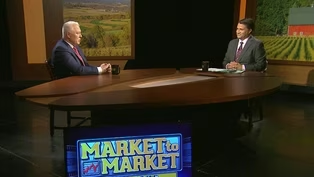
Clip: S52 Ep5201 | 13m 27s | Chris Robinson talks the volatility of the markets and to know where your break even is. (13m 27s)
Providing Support for PBS.org
Learn Moreabout PBS online sponsorship New Episode
- News and Public Affairs

Top journalists deliver compelling original analysis of the hour's headlines.
 New Episode
- News and Public Affairs

Today's top journalists discuss Washington's current political events and public affairs.


 New Episode
 New Episode
 New Episode
 New Episode
 New Episode

 New Episode
 New Episode
Support for PBS provided by:
Market to Market is a local public television program presented by Iowa PBS