
Doing Good in the Great Outdoors
Season 43 Episode 1 | 56m 46sVideo has Closed Captions
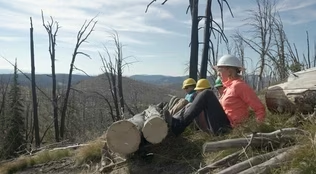
Trail crews, naturalists, hunters and parks volunteers work to improve Idaho’s inspiring landscapes.
We meet trail crews, naturalists, hunters, parks volunteers and even some budding high school biologists who give of their time and their talents to make the Idaho outdoors a better place, and model America’s spirit of volunteerism and citizenship in doing so.
Problems playing video? | Closed Captioning Feedback
Problems playing video? | Closed Captioning Feedback
Outdoor Idaho is a local public television program presented by IdahoPTV
Major Funding by the Laura Moore Cunningham Foundation. Additional Funding by the Corporation for Public Broadcasting and the Friends of Idaho Public Television.
Doing Good in the Great Outdoors
Season 43 Episode 1 | 56m 46sVideo has Closed Captions
We meet trail crews, naturalists, hunters, parks volunteers and even some budding high school biologists who give of their time and their talents to make the Idaho outdoors a better place, and model America’s spirit of volunteerism and citizenship in doing so.
Problems playing video? | Closed Captioning Feedback
How to Watch Outdoor Idaho
Outdoor Idaho is available to stream on pbs.org and the free PBS App, available on iPhone, Apple TV, Android TV, Android smartphones, Amazon Fire TV, Amazon Fire Tablet, Roku, Samsung Smart TV, and Vizio.
Outdoor Idaho on YouTube
Can't get enough Outdoor Idaho? Neither can we. Subscribe to the Outdoor Idaho YouTube channel for even more great content. You'll find full episodes, sneak peeks, behind-the-scenes footage, and exclusive content you won't find anywhere else. Subscribe today!Providing Support for PBS.org
Learn Moreabout PBS online sponsorshipLonnie Johnson: Without volunteers, the park wouldn’t probably be open seven days a week.
Alex Cravener: I mean, there wouldn't be an ITA without volunteers.
One, two, three.
Tessa Atwood: Idaho wilderness, Idaho's wild spaces would not be what it is without our volunteers.
Trent Van Leuven: The important resources that they have are the people in the community.
Every school needs a Mick Hoover.
Every school needs a Bart Gamett.
Mason Smawley: As a volunteer, I don't really look at it as a job.
every opportunity I get to stop, to talk to somebody, to help them maybe have a better experience that's why I do it.
Chris Colt: There's a huge value in not only the volunteers that are out doing the work, but then coming back and interacting in the community.
And the more people you get out there caring for the land, protecting the land, the better it is for all of us.
Funding for Outdoor Idaho is made possible by the Laura Moore Cunningham Foundation, committed to fulfilling the Moore and Bettis family legacy of building the great State of Idaho by the Friends of Idaho Public Television, by the Corporation for Public Broadcasting, and by the Idaho Public Television Endowment.
Trent Van Leuven: Hey, I'm Trent Van Leuven, and we're at the Mackay FFA fish lab in the Mick Hoover Aquaculture Facility at Mackay High School.
(Music) It's a culmination of the work that all the students had over this last, you know, five, six months working in the fish lab, replumbing things, raising the fish, feeding them, scrubbing the tanks.
Aquaculture and rearing fish is a lot of work and this is a reward is being able to go out and take those fish out and put them into a creek and see those fish that they've been caring for out there.
As teachers, we need to be able to create talent pipelines and we can find students that have interests, and we can work with these students and we can help them find, you know, their career aspirations and give them some hands on experiences, but more importantly find people that can also see their talent and be able to work with them.
One of the great things that we got going on in this area is that the students can go work for the Fish and Game, they can go work at Riverence.
We have so many students that work with the U.S.
Forest Service, and, you know, I would have died to have had that job, right, to go backpacking and to survey lakes and take fish up to lakes and creeks and be able to do trail maintenance.
But those are the opportunities that they have, and, you know, schools can do a lot of great things, but what they really need to think about is what are their local resources and the most important resources that they have are the people in the community.
like Mick Hoover, who's been working for the program for years, and we've got Bart Gamett, and, you know, I kind of give him an idea of what we'd like to do, and they give us some ideas about what we can do, and we figure out a way to make it work.
And that takes a lot of the legwork out of it, because, you know, I still have to be in the classroom teaching.
Mick Hoover: It’s survived to what it is now.
And, now it's state of the art.
A standalone building, of actually a high school fish hatchery Going from egg incubation all the way up to what you see here today is stocking the fish.
You get the response of the kids when they see something working.
And you kind of get them hooked when you start feeding the fish, you see that feeding response and the kids, it's kind of addictive.
and then when they see them growing up and surviving when they get to stock the fish, that is the reward at the end of all that work.
And well, you can see all the smiles here today.
Trent: Things are a lot easier with the new lab and the facility and the way things are plumbed up.
But I think back on one of the older moments in the old lab, and we'd have quite a few problems just because of the way things were plumbed and just the way it was designed.
And I was out of town and I got back into town, and I think it was about midnight and I walked into the fish lab and there was Mick Hoover hovering over a drain, watching the water go down because he had noticed a problem.
He was working on it.
And there it is, midnight right now.
That's a story about volunteerism, right?
At a moment's notice, Mick will drop everything, and he'll come and turn on the auxiliary water lines and turn on the oxygen and put the bubblers in there to keep the fish going.
Every school needs a Mick Hoover.
Every school needs a Bart Gamett.
Bart Gamett: When I was a little boy, I was riding in the hay track up the Big Lost River Valley with my dad and he told me about this really rare fish that only lived in the very highest parts of the mountains, and that fish was a golden trout.
I decided if I ever had a daughter, I would name her after the California Golden Trout.
I did end up having a daughter, and my wife agreed to let us name her Kali after the California Golden Trout.
And Kali's actually the student that stocked the very first golden trout in this stream, In the fall of 2014, she got some fish from the Mackay, The Idaho Department of Fish and Game Hatchery raised them over the winter at the school, and they needed a place to stock up in the spring, she worked with the Forest Service and Idaho Department of Fish and Game, and we identified Lower Cedar Creek as a place that they could be released She started a golden trout fishery in a stream, first one in the state of Idaho.
and she came back a couple years later and caught one of them.
And it was the very first, golden trout catch and release state record in the state of Idaho.
Kali Farnsworth: Dad always talks about when he helps with fishing and makes the world a better place and when I saw that young boy how excited he was I did feel like I was making the world a little bit of a better place for that boy, and so that was really special.
Bart: Some of the coolest experiences I had were fishing and hunting and backpacking on Idaho public lands with with my dad and with my family and with my friends.
And so one of the goals I have is to try and make those opportunities available to other people as well, and working with the students to develop this golden trout fishery has been one of the ways that I've done that.
It's been a real honor and I'm just so excited that we've been able to provide this opportunity to so many other anglers.
Brett High: This program is unique in that it's creating a fishery that likely would not exist otherwise.
So this stream did not have fish in it.
And honestly, our hatchery systems are maxed out, and it's unlikely that we could have, as a Department of Fish and Game taken on the role that Mackay High School Aquaculture Facility is doing by raising fish to the size needed to make it in this stream.
We wouldn't have room for that.
We wouldn’t to have the capacity to do that.
And so through these collaborations, the volunteers, the assistance of the high school in these organizations that make this whole thing possible is providing something that wouldn't be here on the landscape, this unique fishery.
Good job.
Okay.
What number can you read?
18, so 180.
Yep.
Clipped.
Good job.
And then watch this, you can slide it right down like that.
Brett: I don't think you could do this anywhere or everywhere where this stream is not connected with other waterways.
And so it provides a perfect setting to introduce a species that is not native here, but is very valued and provides benefits to our public and the community is has this opportunity to get hands on experience, to provide some career training and experience Some vocational opportunities or options for students looking for what to do after high school.
There's a private hatchery here in the Big Lost Valley, and the Department of Fish and Game has a Fish and Game Hatchery as well.
So it's a very realistic career option if these kids learn that they enjoy it and they're good at it, they can go right into education and hopefully a career.
Okay here we go.
Can you tip it?
Tip it.
Perfect.
Good job.
Nice job.
Trent: A number of years ago, we had the idea, we had a few fish left over.
And, you know, I had a son at home that was three years old.
And I thought, you know, this is an opportunity for my kid to see what we get to do.
And so we invited all the preschool aged kids, and we've been doing it for off and on for, nine, ten years now.
And so it's been great because this is Kids Creek, this is where the kids in the town of Mackay get to come and fish, and they get to stock their own creek with some fish.
What I love about is my students, you know, they've had the opportunity to release some fish, but now they're the teachers, and they're helping, these younger children be able to put some fish in the Kid’s Creek.
And that's great, because they're the teachers.
And I just get to sit back and listen to them go, so it's awesome.
Look at who caught the fish.
Look how many you got?
I caught two!
(Music) Greg Harman: We're at Bruneau Dunes State Park right now.
About 20 miles south of Mountain Home, not too far from Boise.
(Music) My name is Greg Harman and I'm the Astronomy Ranger.
The Boise Astronomical Society, they actually had the idea to get this all started back in 1998 is when this building that we're in right now, was dedicated.
And that's what started these programs down here.
Richard Beaver: This is a unique building.
It was designed with the idea of this 25 inch Obsession Telescope.
It's a 25 inch Newtonian, and when it's pointed at the zenith, that eyepiece is almost ten feet off the ground.
I was on the formation committee.
We came up with the design and, and then a number of BAS members helped with the construction of this building.
And it was all donated labor, not one dollar taxpayer fund was used for this project.
Greg: When I first started back in 2009, I started as a volunteer.
A few employees just can't manage that many people coming in.
And so having the Boise Astronomical Society and other volunteers really helps to be able to.
We can talk to everybody when people can.
The lines aren't really long.
And it's just more of a personal experience rather than just waiting in line.
(Music) I have not but I'll come up your way and we can talk about it.
Does he mean first target?
Right.
Finding something on the telescope.
Jim Crow: There's a couple of presentations that they give here, and as people then are waiting between presentations or just milling around out there, we have different the scopes are pointing at different objects in the sky, like this scope will be pointing at something.
And we kind of coordinate among the volunteers that are out there.
Make sure that we got different things so people can go see the different things there are to see in the sky.
(Music) Greg: The IDAstro Program started earlier last year, and what it allows us to do is work with Boise State University, College of Western Idaho, College of Idaho, and College of Southern Idaho.
So four colleges and they have different projects that they're doing.
It's, you know, all astronomy related.
But a big part of what they're doing is they're helping us with our programing.
And then the the big advantage for them is they're able to then use the new observatory that was just put in 2023.
That is a research grade, facility.
And so being able to give them access to that telescope, it's a really good, collaboration.
(Music) Hailey Stubbers: We come down here in the summer, on Friday and Saturday and help with Bruneau's public programs.
So this includes, looking through telescopes.
So we have a solar scope set up and then smaller telescopes around the park, and we help people to, find objects in the sky to look at things that we think are interesting and that we think the public would like to see and answer any astronomy questions that they have.
With this collaboration between Bruneau Dunes State Park and the Southern Idaho colleges, because it's NSF funded and we send out students to outreach.
And then in return, we get time on the telescope to do our research.
So that means that we actually get to publish papers using, the data that we get from these telescopes, which means that Idaho science in general gets to be, you know, more put out there and, on a larger scale.
Students are getting experience, but also the park gets the volunteers.
And it's just been yeah, been great.
Very mutually beneficial.
(Birds flapping) (Music) Greg: A big part of what we are promoting is dark skies.
When people come down, when they're talking to volunteers, when volunteers are showing them the night sky, you know, giving the what we call night sky tours or looking through the telescopes, people are realizing what we have as a natural resource and gives them a sense of ownership and wanting to protect our night skies.
And it really connects people and creating those experiences that we have available at our state parks.
(Sawing noises) Chris Keilty: Most of my friends aren't outdoor folks, so they think I'm crazy for doing this stuff.
Bill Foxcroft: There's a geometry to it.
There's a way to cut it in an appropriate way.
There's ways to do it safe and so part of it, there's a little puzzle to try to figure out.
And I love that part of it too.
It’s just figuring out the puzzle.
Lorraine Cuevas: First you have to evaluate to see.
I'll try to see what the log is going to do and clear out around it.
And figure out where you want to cut, where there's not branches and stuff sticking in the way.
(One, two, three) Then we had to move the log out off the trail.
So the easiest way to do that is everybody sit on their butt and push with their legs, because that's your strongest muscles.
I know it's amazing how big a log you can move when you're using your legs.
Chris: Yeah, we had a lot of butt power in that one today.
(Cheering) Bob Kaiser: There’s just a bond that starts to happen just by doing things, and especially physical things like the saws or or talking through a problem.
How are you going to cut this?
Or picking up a log and throwing it, or moving it, or pushing it with your feet, and then you start hiking and all of a sudden you start talking and you start to learn a lot about people.
And then you come back to camp and everybody's a little silly.
And it's just really it's just fun.
(Chatter around fire) Chris: I enjoy being out in the wilderness.
I'm seeing places that I've never seen before and the people that I meet on these.
It's like we're all like-minded people.
We have the same purpose.
We have the same goals.
So everybody gets along.
It's really a bonding experience with everybody.
Bill: I'm out here Lake Goat Lake in the Frank Church River Of No Return Wilderness.
I’m here with the Idaho Trails Association.
We're on a seven-day trip working on trails, cutting down logs across the trail and doing another trail maintenance kind of stuff.
This is a great way to meet new people.
So I tell my friends, you know, if you're looking for something to do and meet new people and get some exercise and get get into the backcountry and see new places, this is a great this is a great thing to do.
John McCarthy: You get folks who've never worked a pulaski, never work a pick-mattock, never work a crosscut.
They catch it, they figure it out.
They want to get stuff done.
So we're out here for the experience, and we're out here for the work.
And and it and it's magic.
We're all over the state.
And as a volunteer group we're bringing people into the public lands.
We are bringing people out to do incredibly great work, and we're exposing people to this great place.
Wildlife can get around on game trails, but people really need a good trail.
We're sustaining this trail network and it's slipping away.
We're losing it, but we're helping sustain.
We're helping the Forest Service, the BLM, the National Park Service sustain this wonderful resource that allows people to get out in these really wild places, these places that, you know, you really can't get there without a trail.
These trails were put in 100 years ago.
They were put in with the same tools.
The crosscut saw, the ax horses, mules, backs, strong backs, we’re connected multi generations going back with the people who put together this whole incredible trail resource.
And it's an amazing resource that we want to help sustained.
And we want to help people appreciate.
Chris: Sometimes those tools are pretty heavy to carry for the day.
They get pretty heavy coming back.
You definitely are glad to set them down.
At the end of the day.
We've got silkies which are hand saws.
We got shorter hand saws like this.
We've got loppers, some smaller loppers, some bigger loppers.
We've got of course, the cross-cut saws, which are a little hard to carry, just awkward.
So we have pulaskis.
A pulaski has an ax on one end and a digging tool on the other.
So you can dig with it.
And then you could also use the other side as an ax.
John: I mean the crosscut is a really fine tool and two people are required to do it.
They're the two handled saw.
And that's where you can really get good work done.
And they've got to talk to each other.
And they got to be paying attention to each other.
And the log and themselves.
Bob: Well I really like is with the teamwork.
We're just in there., we're doing it together, we're out doing the best we can and the results are always the same.
It's like you're done and you cut it and you feel very satisfied.
Alex Cravener: This year we did 98 projects.
We had 400 miles of trail.
We had over 900 volunteer spots filled.
We had over 16,000 volunteer hours.
I think almost 6,000 logs cut.
Take that back 15 years.
You know, it's thousands of people and thousands of miles of trail, so many volunteer hours.
That's pretty incredible.
I mean, there wouldn't be an ITA without volunteers.
We have four full time staff.
We can only cut so many trees between the four of us.
And so if we didn't have volunteers, we wouldn't exist.
Phil McNeal: The importance of volunteers.
I mean, they can't be understated.
The agency relies very heavily on volunteers.
You know, the Forest Services has been generally underfunded in recreation and trails.
And then you have groups like the Idaho Trail Association.
You know, you have folks like the Continental Divide Trail Coalition and some of those groups.
They do incredible work.
John: We're cutting out logs.
We're digging tread.
We're doing real work.
But as an organization, we're also advocating for trails.
We're advocating for public lands.
We're advocating for the wilderness.
We have to push the people who make decisions to try to see that there's the community support, there's a citizen support.
There's a political support for trails, for public lands, for wilderness.
Alex: The White Goat Project, we had pack support so people with mules and horses to carry in and out the gear for the crew and all the food.
So that's a much easier ask for a volunteer.
So you weren't necessarily beholden to just freeze dried food the whole time.
You could have some luxuries which sometimes luxuries.
It's just cheese and a bigger sleeping bag, but those make a huge difference when you're out there for a week.
We've got trips where we'll take a tiny backcountry airplane, a little Cessna.
We'll fly people into the backcountry airstrips, drop them off for a week.
We've got projects where we'll jet boat up like a lot in Hell's Canyon.
We've got projects where we'll set you up with a full kitchen and all the food provided, and we'll send a cook in to cook for you.
And then some are just good old fashioned, like you're carrying all your stuff and you're backpacking yourself in and out.
And those are fun too.
Whatever we can do to make it fun and accessible and productive.
You know, we'll do it.
(Chatter around fire) Chris: We're really lucky this time of year to be able to have a fire.
It's definitely made it a lot more comfortable and given us a place to really gather as, as a group.
We got the tarp set up first thing when we got here, because we knew we were going to have rain, and thank goodness that we got that tarp up because it rained like crazy the first night we were here.
And it looks right over to the lake and we've been watching the the rain go across the lake and the winds come through, and then it calms down and the lake is just gorgeous.
And the reflections of the mountains on the lake it’s just been amazing.
John: Work is why we're out here.
But what we're doing is we're being in the wilderness.
We're going to experience trails.
We're going to learn about how to work together.
Alex: The first thing you do when you get together as a crew is you circle up and you go over safety and debrief all the tools and the different rules and stuff like that.
But then every morning, you know, a lot of crew leaders will group people up to to stretch and talk about the plan for the day.
Getting feedback from everyone on how they're feeling and, you know, maybe what do we what are we going to do tomorrow and starting to plan ahead?
So a lot of lot of crew start with a with a big circle in the morning.
The number one reason people say that they enjoyed it was the camaraderie the the great crew, the laughs, the teamwork, Meeting, like-minded people.
And then, you know, I've heard it from different people, meeting new friends through ITA, and you know, some people will sign up together.
They want to do a trip again.
Lorraine: It's a lot of fun.
There's a great crew that we have.
It's just a good way to get stuff done.
And you meet some wonderful people out here.
(Chatter) Paul Allen: You're probably going to want to be collecting 3 or 4 species.
So I've got bags over here for you.
Let's go look at some native plants up on the hill.
I picked out a little walk where we'll see many of our common natives.
So follow me over here, please, (Music) Paul: Every walk in the wild is an adventure.
It's like a treasure hunt.
You just never know what you're going to stumble upon.
And you have a, a bunch of bags with you.
You can just stop and harvest as you go along the way, and you come home with a treasure.
Today, we're going to be harvesting the native seeds for restoration projects.
We're going to focus on seeds that help stabilize the soil and create a platform for development of a native plant community.
But we're going to collect forbs.
We're going to collect trees.
We're going to collect shrubbery, get a wide diversity of of plants.
Right now there's an abundance of rubber rabbit brush of green rabbit brush.
The hawthorn that you see right here is ready for harvest.
We're going to see blue flax up the way.
Snake weed.
A lot of the things that we think are quite beautiful on the landscape.
We collect the seeds.
(Converasation) Those are cool looking.
Sarah Jackson: Something that I've learned gradually about what to collect, how to collect it, what time to collect it.
I mean, depending on the maturity of the plant.
So we'll actually be doing doing some seed collection, and we're creating a seed bank.
We've also planted a lot of the seeds that we've collected out at Aberdeen, at the plant facility out here.
And it's really neat to see what we planted has grown.
And then we're able to go out and actually put that out at the various places that we're working on.
Tessa Atwood: We are lucky enough that within our group of Idaho master naturalists, all we had to do is we merely had to say, you know, what would be really cool is a native seed repository.
And it happened.
They organized the effort.
They found the smaller group that goes out, they collect seed, they raise it at a greenhouse facility.
They sort, all the seedlings, they pot, and then they put everything out on the hill.
So they are they are seeing some of these plants that go out from start to finish.
Volunteers: Yay!
Everything else is gravy today!
Maria Pacioretty: Today we're out at the Sterling Wildlife Management Area, which is northeast of Aberdeen, Idaho, and today we're out on a big volunteer project helping my program do some wetland and marshland restoration work, mainly focusing on cottonwoods.
We have been busy the past couple of years removing invasive species such as Russian olives, and we're wanting to replace that tree with something that's the most kind of more beneficial for wildlife.
We actually go out in the winter and cut branches from local trees.
We use volunteers to then repot those branches at a volunteer nursery, and we grow them out all year.
And then now it's the fall and perfect conditions to get’em planted.
We're also looking at a lot of our native forbs.
So our wildflowers, native shrubs, grasses and stuff like that.
So we're looking at the ecosystem as a whole and what is going to be best for different wildlife species at different times of the year.
It's myself and one other biologist full time, and we have some seasonal technicians, but that's it.
And our area of work is about 5.5 million acres.
And so having volunteers enables us to get some meaningful work done on the ground every year.
This just wouldn't happen without this group of folks, so we're extremely appreciative and that's why I always make sure to feed them well.
Sarah: No, it's not glamorous, but it's fun.
It's just it's just fun being with like-minded people.
And it's just a wonderful, wonderful group of people to spend time with and hopefully make a difference.
Holly Reavis: One of the wonderful things about this program is that you do get to participate in the full cycle.
It was a really rainy day in March when a group of us all gathered at Joe Foster's property and we just took cuttings of cottonwoods, dipped them in root starter and then put them in a pot and he starts them in the greenhouse for us, and he moves them outdoors.
And then we get to move all these trees to our wildlife management areas in southeastern Idaho.
Joe Foster: We're at my home outside of McCammon, Idaho, and we've been looking at some of the tree projects and habitat restoration work that kind of starts here with the beginning of the trees that go out onto different wildlife management areas and public, private, state.
A lot of different areas end up using trees that grow out of here.
We're sitting in a 30 by 50 greenhouse that is kind of an experiment.
We built a pond in the middle of it.
The pond goes three feet down and three feet up ends up as kind of a heat sink to keep the greenhouse temperature and humidity regulated.
There's two sturgeon in here.
Tessa: It's where the magic happens.
He has been donating the use of this greenhouse for several years now.
It's his personal greenhouse.
He is the one who put this up.
He loans the space.
He tends to everything that he grows in here.
Every single day.
It's a much bigger operation.
And he's doing that all for us.
And we're very appreciative of him.
Joe: This year, our focus was on cottonwoods.
But every year we will do whatever we come up with.
We do numerous different kinds of trees.
Cottonwoods are the preferred roosting tree for wild turkeys.
So a lot of them are going in there.
Also good for beavers and a lot of other animals.
But we do burgambel oak trees, ponderosa pines, junipers, different types of shrubs, pollinators, all sorts of different plants.
I certainly don't do it for fame and fortune.
I just do it because I like to do it.
I get a kick out of it.
Over the last ten years, thousand a year coming out of this.
These different projects of all different kinds of trees for all different types of habitat conservation groups.
That's a pretty cool thing.
Burgambel oak trees are going to be around 300 years from now.
That's pretty neat.
Holly: We live in a big world and there's a lot of issues in our world, but I know that the work I do here with the Idaho Master Naturalist affects my community and the things that I care about.
I care about our wildlife and our habitat.
And I know that every single project I work with here is actually making an impact.
My time is really worthwhile.
Volunteer: This is a willow herb of some kind, Holly: It's a real sense of community.
Everyone that's a part of the Idaho master naturalists, they're all involved for the exact same reason.
They want to make improvements to our local area and to our habitat.
And so you're just really with like-minded people.
But also, if you don't know a lot about birds, you're going to find someone that knows a lot about birds.
If you don't know a lot about plants, you're going to learn about plants.
You're going to learn about beavers.
You're going to talk with a herpetologist and learn about amphibians and reptiles.
And the next thing you know, you're going to be at City of Rocks looking for skinks.
I mean, just out of the world things that, you know, I didn't even know I had an interest in.
It's just sparked so much for me.
Tessa: I have the best tribe of people here in Southeast Idaho, and we've got folks any where from students in high school or college professionals who are still working.
A lot of educators and retired folks from all walks of life.
You're enjoying a greenbelt, or you're enjoying a cross-country trail, or you're a bird watcher.
Or you love to fly fish, or literally anything.
A volunteer is involved.
They’re the wizard behind the curtain.
No matter what you're doing, if you're enjoying conservation in Idaho, you have volunteers to thank for that.
Chris Colt: There’s a huge value in not only the volunteers that are out doing the work, but then coming back and interacting in the community and sort of sharing that fire, sharing that passion, the love of the outdoors, and that I guess that volunteerism can be contagious and so it can spread like wildfire and the more people you get out there caring for the land, protecting the land, the better it is for all of us.
Linda Popelka: I didn't realize that there were that many people around that had that same kind of passion.
So it's very empowering and it's very encouraging because you know that you can make a change.
You know, you're getting in the dirt, you're getting dirty, and everybody's happy because they're doing something and they know they're making a difference.
I think it's the best thing that's ever happened to me.
So I will have to say that.
As old as I am and as many years I've put on on the earth.
I think it's the best thing that's ever happened to me.
Because, because because of the people (Car engine) Chris: You've got all these different user groups that don't necessarily interact, Chris: The reason why I think these projects bring people together is because of a shared love of the outdoors, a shared love of public lands, and a shared love of recreation.
Jonathan Lucas: Backcountry Hunters & Anglers really appreciates your effort of being out here, so, thank you all.
So what we're going to be doing today is hiking fenceline, Hunter Whitten: The Armed Forces initiative portion of that is BHA's project to get veterans military affiliated, active duty, involved in the outdoors in a way that they're not always focused on.
Jonathan: You first record what type of fence it is; barbed wire, sheep fence, smooth wire or other.
Hunter: Today, we're doing a project in the Boise River WMA where we're looking at fence lines to try to figure out what fence needs replace, what fences repaired.
Downed fences are a big problem for wildlife because this is a major wildlife corridor throughout the Boise foothills.
Deer don't see’em, elk don’t see’em.
They get wrapped around them, they get caught and die So our goal here is to identify what fences are problems, either fix them or move them, and try and make this a better habitat for wildlife.
Kyle Blasch: I'm a scientist in the environmental realm, and right now, management of our lands and our waters and our our critters.
We're at a point now where we are, in my mind, data limited.
And when you have a lot of multi-use management.
The more tools we have, the more information and data we have, the better we're going to do.
I'm also a trail runner, an avid trail runner, and I mean, there are hundreds of miles of trails that go through private lands here around Boise.
I love the fact that these private landowners are taking and providing us a resource.
So in my way, I feel this is one way, as a volunteer, that we can help give back to those those private landowners and say we actually do value what you're doing.
I've been in the Air Force since 1994, then multiple deployments and then all over the world, mostly with the Air Force.
It's a great opportunity to see it do new things.
But also, I think for some people there is this loss of connection over time.
I think a lot of folks have been trying to push veterans in to go outside and force that reconnection.
Ray White: It's a hard transition to go for military life and integrate back into the civilian world in a way, completely different way of life.
Just everything is so different.
And then I think the outdoors provides a little bit of that peace and a little of that calm that just helps with the transition to be able to go out and to be active in the community and to to volunteer and just being outdoors in general.
(Birds, golf cart engine) Sherri Wheeler: We camp at a state park in Arizona, Parker, Arizona, on the Colorado River.
And John was picking up garbage, and one of the hosts came out and said, are you the new host?
John goes, no.
He goes, what are you picking up garbage for?
John goes, I pick up garbage everywhere I go.
And he goes, you need to go to Priest Lake, Idaho.
And okay, so three years go by and John had retired and he said, I'm not staying another summer in Arizona I don't have to contact Priest Lake, Idaho and see what we have to do to get to come up there.
I made a phone call and that's how we got up here.
(Laughs) Lonnie Johnson: So I met John and Sherri, we're talking maybe five years ago, and they said they wanted to try volunteer hosting, and little did we know.
Not only have they come back year after year after year, but we're family.
We're friends.
They mean a lot to the park.
There are visitors who come back hoping John and Sherri will be back.
They clean their own bathrooms.
So we have, we have like, five bathrooms at Indian Creek.
White Pine is where Johnny and Sherri are based.
There's 51 campsites there.
Water and power sites, their own restroom, shower building.
And they like to take that on their self.
John Wheeler: Cleaning!
Lonnie: And they take pride in it.
In fact, there's people who come to us and say, it's like they go in there every time somebody leaves, they're in there cleaning it to make it look so nice.
So yeah, besides that, returning people look forward to seeing John and Sherri.
They handle people with kid gloves, but they can also bring the hammer down when needed.
And when I mean that, they do it in a very nice way, treating people like family.
However, when the rules are being broken, blatantly, Sherri goes in and the people are like, oh, here comes Sherri.
We promise we won't do this again.
Yeah.
Plus their skills, John's maintenance skills, Sherri's people skills.
They're just a great duo.
Sherri: You just always feel like you are important to them.
And that's important to us because we have worked at parks before that they didn't care.
They didn't care that you were here.
They didn't care if you thought maybe something should be fixed up here, you suggest something and they don't look at you like you have no business saying anything.
You are.
You are included.
You feel like you're included up here.
John: We start at 7 a.m.
We could start later, but we start at 7 a.m.
We clean one set of bathrooms which we are not required to maintenance cleans those, but we take over because maintenance is short-hands.
After the bathrooms we do, walk about, drive around, compliance to make sure everybody's registered.
See the orange tags?
They have to have an orange check.
So that's all we're going to do right now.
John: After that we have a lull.
Get some time to do whatever you want to do.
Then it starts to pick up around 10 or 11.
People are leaving.
We clean the campsites, make sure everything's ready to go for the next campers.
Sherri: We also, sometimes people have never camped before and you have to explain to them why they can't do whatever they're doing.
And usually you get a compliance, you know, they'll they'll understand when somebody tells them that you can't have a fire up to your waist, you know?
And this is why.
You can't even have propane fires up here because in the kids put sticks in them and then they do like sparklers and blow on’em, but some people have never camped.
They don't.
They don't know how, you know, don't know how to put a tent up, you know, stuff like that.
And you get to help them.
You get to teach them the right way to camp.
Lonnie: So Paula is that person who fits any mold.
She can fit in any position that you need.
So we're talking maybe a decade ago, we were short on permanent staff.
Paula filled in as a volunteer ranger.
So she was doing ranger duties.
She was doing the maintenance.
She was doing the PR.
She did minor enforcement.
Paula can run a chainsaw.
Paula can run equipment.
Paula knows how to talk to people.
Paula can do plumbing.
Her previous life, she worked for the power company.
So she's used to being around equipment and working hard.
And there's times she fills the job of three people.
And we do have to say.
Hey, Paula, the sun's going down.
Let's go enjoy ourselves.
Let's go.
Let's go back to the campsite.
Let's go to a fire ring.
Let's go down to the beach.
But.
yeah, Paula ensures at the park, she wants to look like possibly her backyard.
So if there's trash and she sees it, she'll pick it up.
If people are doing things wrong, she'll let them know.
You know, if you do that, it's not enjoyable for other people.
She's a person that if she wasn't here, I don't think the park would actually run as smooth.
I don't.
Paula Nikerson: Try to keep the park looking nice.
Picking up trash.
Picking up branches.
Helping chop wood, helping bag ice, helping bag wood, helping keep the beach clean, the trails clean.
Lonnie: So Paula is kind of like a, she's a cross between a drill sergeant and a kindergarten teacher.
Paula sometimes is the first one at the shop with her family, and she's usually the last one to leave.
They come in the spring to get the campgrounds ready.
They stay in the fall to, close the campgrounds, turn off the water, get the buildings closed up.
They come in the winter time to make sure, winter project signs being painted.
Firewood being cut and split and stacked.
She helps getting things ready for the future volunteers to come.
She pretty much knows this park inside and out, and her family treats it like it's their place.
You know, so a lot of respect from all of our volunteers.
Sherri: There should probably be more Paulas in state parks.
She's just she's a hard, hard worker and she's fun.
(Laughs) Lonnie: Well, since we have a year round park, we are very reliant on volunteers.
We have seven full time staff.
We employ 15 part time seasonals, and we have 30 volunteers.
So they do jobs from camp hosting.
They run our entrance booth.
They work in the store.
They do maintenance.
We couldn't keep the standards of the park up to what people are used to If we had no volunteers.
The park wouldn’t be open seven days a week.
It wouldn't be open around the clock.
Facilities wouldn't look the way they do.
The grounds wouldn't look the way they do.
The public wouldn't feel as appreciated as they are.
They are our eyes and ears.
So when we're not on duty, if there's an issue, they live right in the campground and they can get access to us.
So we're talking they're the lifeline Mason Smawley: Well, welcome to the Land of the Yankee Fork State Park.
My name is, Ken Mason Smawley, and this is my home.
Come on in.
(Music plays) So my interpretive tour starts usually outside right here where I talk about why that building looks the way it does.
And a lot of times when we're doing this in May, in early June, it's elementary schools and middle schools from around the region.
And I ask, why does it look so funny?
And I get all kinds of things like chicken coop and stuff like that, but it's actually to resemble a stamp mill.
And later today, we’ll be up to Bay Horse and you'll see what the actual stamp mill looks like.
But this is a pretty good rendition of kind of what one would look like.
So come on.
So the design of the interpretive center here at Land of the Yankee Fork State Park is to resemble a stamp mill.
And you see these massive glulams that are on this angle.
And that would kind of represent how a stamp mill is, is situated on the side of the hill to take advantage of gravity during the stamping and the reduction from an ore-sized rock down to, a hard core sand.
Blake Packer: They play a very vital and valuable component to the operation and they do it, you know, for nothing.
They're not being paid again.
So that really, I think, shows and reflects, you know, how volunteers, help out in the state of Idaho and how Idaho has developed this over time.
Over at this location at the Interpretive Center, the two volunteers over here primarily help out in the office.
They help out a lot with interpretive, information, providing that to the public.
And really conveying then the history of the local area, including the historic mining history at Bay Horse Ghost Town, which is also part of the park, as well as Custer, Bonanza and the Yankee Fork Gold Dredge, which are all really important aspects of what we do here at the park.
Mason: I like, Late May and early June when we have school trips.
Because that's always, like hands on deck when you have 40 kids running around and and, and I'm just a big kid at heart, so it's it's fun.
I really I really enjoy the kids and they, they all they all enjoy it as well.
It's a lot of fun.
And a visit to land of the Yankee Fork State Park is not complete without visiting our gold panning station.
So come on, let me show you how to do this.
So as I'm as I'm spinning in the water, I'm looking right here for gold.
There it is.
There is your gold flake.
So at this time, when I tell our park visitors is to dump the water out, come inside, and then we take this gold flake and we put it on a souvenir card that says, I struck it rich set the land of the Yankee Fork State Park.
Blake: So I know early on he did a lot of projects and this is prior to me.
He's helped out with projects up at Bay Horse Ghost Town, some preservation projects up there.
That location takes a lot of work in order to preserve that.
So future generations are going to be able to come up and hear the history and see those structures.
So he's played a pretty big component in that.
Mason: People get to come and walk through a self-guided tour of the Bay Horse Townsite.
My first season here, so 2020 and I was working with the ranger at the time and we reroofed, so we reframed, reroofed, and then from there then I've just gone on and replaced the lower the lower deck, the upper deck, fabricated siding that was missing.
It's it's a labor of love.
So Bay Horse is Idaho’s only dedicated OHV state park, and our trail system drops into the townsite from various United States Forestry Service trails.
(Dirtbike engine) So I'm going to go.
I'm going to go from my park mode to my, rec mode.
And this is where I turn into a trail ranger working for the rec side of Parks and Rec.
Normally, what we initially start to do is just clear deadfall.
So we'll go on trails, begin to cut trees.
That's why we run with saws.
And then from there they will identify if, if a trail needs, drainage work, if it needs equipment work to come in.
So not only me, there's a dedicated crew crews on the rec side of IDPR.
The R in Idaho Parks and Rec that are out there doing ten day stints and doing trail work.
It's fun, but the volunteering part is somebody's got to do the work.
So Forestry is being cut, BLM is being cut.
Somebody's got to do it.
And if you're going to ride, you got to go out and clear and you got to do the work.
And so I'm already with IDPR and this was just a natural progression because of my riding already to go and do trail work.
I think a lot of it is, is how you how you communicate or one of them is just the bearing.
So when you when you when I walk up, you know, I have a posture of a somebody that's in authority because that's what I was doing.
The, the hair is, is always like that.
How you, how you introduce yourself, how you conduct, you know, two way communication.
The 32 years in the military has given me, a massive toolkit with, with tools that I can use in any situation, whether whether it's on a professional, you know, trying to get work done or just dealing with the public.
So, so I give all the credit to my mom, but then the Army fine tuned this stuff.
(Music plays) If this is a job.
I don't know a whole lot of people that really, really love their job and so as a volunteer, I don't really look at it as a job.
So every opportunity I get to stop, to talk to somebody, to help them maybe have a better experience or something like that.
I mean, it's just I mean, that's why I do it.
because I've ridden just about every forest road and single track within 75 to 100 miles of here.
And it's just it's.
Yeah, it's gorgeous country.
It's gorgeous country.
Bart: ...and then grab the back with this.
And then you're going to want to kneel down like this.
And then you'll be facing the camera like this.
And I'm not kidding... Holly: I think a lot of people don't volunteer because they don't feel like they know enough.
And if you wait till you become an expert on something in order to be able to volunteer, you'll never learn enough to actually be able to contribute.
Chris: Sometimes it feels like there's a bit of a barrier to entry because you don't know who's there.
You don't know what you're doing when you go just show up, and then you find yourself doing all kinds of neat things that you never even thought you could do.
Whether it's tagging waterfowl, wrestling deer to put radio collars on, all these opportunities for volunteer projects that can come about as you build that network of friends.
Tessa: The potential for how you can contribute, to our agency is limitless and can be very much tailored to your skill set and interests.
Alex: There's so many different groups out there that no matter, you know what your favorite outdoor recreation activity is and your favorite area is like there's a group out there that needs your help and would take volunteers.
So no matter what you're interested in, there's there's a place for you.
Mason: You want to volunteer and and you want a way to do it that isn't expensive then come to Idaho, look at Parks and Rec and and find a site that suits what you like to do in the outdoors and just do it.
(Music) Funding for Outdoor Idaho is made possible by the Laura Moore Cunningham Foundation, committed to fulfilling the Moore and Bettis family legacy of building the great State of Idaho.
By the Friends of Idaho Public Television, by the Corporation for Public Broadcasting, To find more information about these shows, visit us at idahoptv.org.
Preview of "Doing Good in the Great Outdoors"
Preview: S43 Ep1 | 30s | Trail crews, naturalists, hunters and parks volunteers work to improve Idaho’s inspiring landscapes. (30s)
Providing Support for PBS.org
Learn Moreabout PBS online sponsorship
- Science and Nature

Explore scientific discoveries on television's most acclaimed science documentary series.

- Science and Nature

Capturing the splendor of the natural world, from the African plains to the Antarctic ice.










Support for PBS provided by:
Outdoor Idaho is a local public television program presented by IdahoPTV
Major Funding by the Laura Moore Cunningham Foundation. Additional Funding by the Corporation for Public Broadcasting and the Friends of Idaho Public Television.