
Gridiron Innovations: The Kibbie Dome, The Minidome & the Blue
Season 10 Episode 1 | 39m 31sVideo has Closed Captions
The origins of Idaho’s Kibbie Dome, the Blue Turf, and the Minidome.
Three of Idaho’s iconic football landmarks: The Kibbie Dome, The Minidome and The Blue turf. The conception of the Kibbie Dome, the world’s longest wooden roof and how Trus Joist was instrumental in its construction. Boise State’s famed blue turf’s orign: where the idea came from, its creation, lore, and myths. And the genesis of College football’s first domed stadium – Idaho State’s Minidome.
Problems playing video? | Closed Captioning Feedback
Problems playing video? | Closed Captioning Feedback
Idaho Experience is a local public television program presented by IdahoPTV
Major funding for Idaho Experience provided by the James and Barbara Cimino Foundation, Anne Voillequé and Louise Nelson, Judy and Steve Meyer. Additional funding by the J.A. and Kathryn Albertson...
Gridiron Innovations: The Kibbie Dome, The Minidome & the Blue
Season 10 Episode 1 | 39m 31sVideo has Closed Captions
Three of Idaho’s iconic football landmarks: The Kibbie Dome, The Minidome and The Blue turf. The conception of the Kibbie Dome, the world’s longest wooden roof and how Trus Joist was instrumental in its construction. Boise State’s famed blue turf’s orign: where the idea came from, its creation, lore, and myths. And the genesis of College football’s first domed stadium – Idaho State’s Minidome.
Problems playing video? | Closed Captioning Feedback
Where to Watch Idaho Experience
Idaho Experience is available to stream on pbs.org and the PBS app.
Providing Support for PBS.org
Learn Moreabout PBS online sponsorshipMajor funding for Idaho Experience is provided The Laura Moore Cunnigham Foundation.
Helping Idahoans reach new heights for generations.
And by the estate of Darrell Arthur Kammer In support of independent media.
that connects communities.
And expands understanding.
Additional funding provided by James and Barbara Cimino Foundation.
Judy and Steve Meyer.
And contributions to The Friends of Idaho Public Television.
From viewers like you.
Thank you!
[Narrator] The world's first colored turf, the first domed stadium in college athletics, and the world's longest wooden roof all hail from Idaho.
Boise State, Idaho State, and the University of Idaho's stadiums all share origin stories that included innovation, bold plans, and doubters who were proven wrong.
[Gene Bleymaier] There was a lot of reactions which we anticipated because it was a new idea and nobody else had ever done it before.
[Narrator] When a novel idea for blue turf became a reality, it left many wondering, but it became an iconic piece of the college football and national landscape.
[Chris Petersen] People buzz about it.
That's the beauty of the blue turf is people talk about it so much.
Opponents talk about it.
The fans talk about it.
It's an iconic venue in all of college football.
If you're a college football fan, it's something that you need to check off on the bucket list.
[Narrator] At Idaho State students voted to fund The Minidome - college football's first domed stadium.
[Jerry Dunne] I think everybody was as excited as the players to see what the facility was actually going to be like.
[Narrator] Ingenuity and creativity led to the world's longest wooden roof enclosing Idaho Stadium.
We now call it the Kibbie Dome.
[Nels Reese] This is like a piece of art; and it took so much effort to piece thing ogether.
[Thomas Ford] There's no question that we have the most unique venue in all of college football.
[Narrator] Next on Idaho Experience - Gridiron Innovations: The Kibbie Dome, The Minidome, and the Blue.
[Music] [Narrator] Prior to 1986 blue and orange were just colors on Boise State's uniforms.
Green turf stretched across Bronco Stadium and the idea of a blue field wasn't on anyone's radar.
[Gene Bleymaier, Fmr.
Boise State Athletic Director] We were getting ready to replace the, the astroturf at Bronco Stadium.
At the time, we were gonna take out the old green field and put in another green field and if we put another green field in, nobody's really going to notice.
[Narrator] You never know when or where creativity will strike.
[Bleymaier] I was on a flight going to the NCAA convention.
And on the plane thinking about this replacement and how much it was going to cost.
And, it kind of bothered me that we were going to spend all that money, and nobody would notice or care.
So I was sitting there thinking about it and saying, well you know, there's no real reason that it's green other than, you know, astroturf had always made the fields green because that's the color of grass.
I said, what if what if we did it in our school colors?
And why don't we do it in blues.
[Narrator] That thought stuck with Broncos Athletic Director Gene Bleymaier.
New Astroturf would cost approximately one million dollars and be just another green field among many in college football.
[Bleymaier] So I finally got up enough nerve to go and talk to the president.
[Mike Prater, Fmr.
Idaho Statesman Sports Editor] He went back to campus and told, President Kaiser, I got this crazy, crazy idea.
Bear with me.
Stick with me here for a minute.
[Bleymaier] I said I want you to know, I, I understand that this is crazy, and it's, a little unorthodox, but I'd like you to just, you know, think about it for a while don't respond right now.
And I said, you know, probably be a good idea if we just kept this between ourselves.
[Prater] Kaiser was not afraid of anything.
He was bold and brash, and he was not afraid of any idea.
He came back and said, let's do it.
[Bleymaier] I got excited and nervous at the same time because, I knew it was out here.
We kept it between ourselves and, and nobody knew about it.
The coaches didn't know about it.
Nobody else in the athletic department knew about it.
[Narrator] A closely guarded secret that now needed the right shade of blue.
[Prater] He also went to the AstroTurf Company and had some battles behind the scenes with the AstroTurf company, who kind of pushed back and said, are you sure we want to do blue?
[Bleymaier] They weren't real excited about it because they had never done it.
They couldn't really make any guarantees about how it might hold up under the ultraviolet rays of the sun and other things.
They couldn't really guarantee me the shade of the blue, which was a concern to me.
I remember going to the paint store and looking at shades of blue and looking at our school colors and trying to get the right, the exact right color.
[Narrator] An exercise that Bleymaier hoped would pay off.
Finally the day arrived when the blue turf would be unrolled for the first time.
[Music] [Bleymaier] It was about 102 degrees outside.
And I was sweating bullets that I said, please, please let this color blue be acceptable.
When they rolled out the first five yard swath of turf I took a big sigh of relief and said, okay, I think I think this is going to work out.
[Narrator] Players, coaches and media also witnessed the monumental event.
[Lance Sellers, Fmr.
Boise State player] They're there that day, rolling the blue turf out and putting it on.
And we're watching.
That evening it was done, and it was just pure blue.
[Mark Johnson] And we all went, [Record Scratch] huh.
Really?
This is what we're doing.
And let's just say the reviews were mixed.
[Record needle drops] [Mike Price, Fmr.
Weber State coach] For the league, I think.
You know, I think that, you know, all the coaches should wear earrings.
I think we all should play on different colored fields.
I think everyone should have a beard.
[Lyle Setenich, Fmr.
Boise State Football coach] Kids don't care what they play on.
They just want to play.
That's the way coaches are.
It doesn't make any difference if we go play Weber State on a dirt field.
Or play em on a grass field or turf field.
[Speaker 1] Football should have been, it should be played on, green turf.
[Sellers] We knew as players.
And they said, yeah we're going to go with blue turf.
What?
[Ty Ogata, Fmr.
Boise State player] Everybody's excited about anything new and changed it up.
And, I think it was probably mid-summer, like during workouts when they were yanking everything out and putting it in, that we all saw this was pretty cool.
Never really fazed anybody.
We had a great team.
[Tom Scott, The Scott Slant] Boy, it took a while for it to sink in.
At the time, it was, it was just meant to get attention.
It was is kind of It kind of was a gimmick because nobody had it.
And it did get attention.
It was in Sports Illustrated, and they had a story about ducks flying into the blue turf.
[Mark Johnson, Fmr.
KTVB Sports Anchor] I have to take credit or blame for a little of the national lore on what the blowback was.
[Music] [Ducks quacking] There were rumors that ducks were crashing on the blue turf.
Thinking it was a pond.
And of course that was never true.
I thought it was pretty funny.
And so a couple of the sportsmen who were on the team, including Lance Sellers, had shotguns in their trucks.
I asked them if they could stage a little publicity spot, to perpetuate that rumor.
[Sellers] We threw decoys out on the turf.
We were prolific with the goose call or a duck call, and we called them right into the turf.
They thought it was water.
[Music] [Narrator] The blue debuted on September 13th, 1986.
[Mike Prater] The first ever game that was played on the blue turf, 74 to nothing over Humboldt State.
17,465 fans were in the stadium that night.
[Mark Johnson - TV Broadcast] Our final tonight at Bronco Stadium 74 nothing.
Boise State with a record setting performance.
Their first home ballgame on the turf.
[Narrator] A game that set the tone for protecting the Blue.
[Prater] 83% winning percentage on the blue since that night.
[Ogata] It was a rout.
We beat them pretty bad.
You started something you didn't know it was going to be this big.
We're part of something that turns out to be the hugest part of Boise State.
[Narrator] Later opposing coaches would complain about Boise State wearing all blue uniforms on their blue turf.
[Mark Johnson] There were coaches that actually went to the league and said, you got to do something about the Boise blue on blue on blue thing, that's not fair.
[Prater] The blue on blue thing I thought was ridiculous.
And a lot of it in my opinion, was the jealousy factor because Boise State was just so damn good on the blue.
[Bleymaier] And it got to the point where it started psyching other teams out a little bit.
The first time we played Oregon State here in Boise.
And I remember hearing the week of the game that, they had painted their practice field blue.
And when I heard that, I, really chuckled and said, I think we're going to do well in this game.
[Narrator] Boise State nearly upset Oregon State in 1989, and the lore of the blue home field advantage stuck.
Boise State's blue turf was once considered a gimmick, now it's iconic.
Around 20,000 people a year from all fifty states and more than 45 countries visit Boise State's Allen Noble Hall of Fame to see the blue.
[Dirk Koetter, Fmr.
Bronco Football Head Coach] I think it's really one of the most iconic views in college football.
It always amazes me, the number of people, passing through Boise and they want to get a look at the blue or they want to walk on the blue.
It's definitely become, something very special to college football.
[Chris Petersen, Fmr.
love that stadium, but it's not necessarily because of the blue.
It's because of the fans, because of the steep pitch that the stadium has.
I think it's one of the most underrated stadiums in the country in terms of noise, excitement, energy and those type of things.
And you don't really feel that til you're there.
That fan base, they bring it and it's awesome.
[Mark Johnson] Players of opposing teams would come onto the field early with their cameras and pose and take pictures.
[Prater] I've seen several players, like, go down there and pinch out a piece and pull it out and stick a little piece in their pocket and walk away with it.
[Bleymaier] As time went on, that became a real source of pride, for our football team, you know, to protect the blue and and to win on the blue.
That's what we were trying to do is to create a home field advantage, to the extent that we could.
We eventually got a trademark on the blue turf, which we hadn't thought about right at the beginning, but, but we have protected it now.
[Prater] Gene Bleymeier once said, this is our swoosh.
Nike has its swoosh, its brand, its marketing, its power.
And, Boise State has its blue and that's our swoosh.
I don't need the announcer to tell me that that's Boise State, because you see the blue.
And that is very, very powerful.
And I think the Boise State fans have always appreciated that and adopted that and embraced that.
It was fresh at the time.
It was a new idea at the time.
It was unique.
And it's still very, very much unique.
It's a sports icon, and I think people still cherish it to this day.
[Bleymaier] Fortunately, you know, the idea has worked, or else I might have had a very short career.
[Laughs] [Music] [Petersen] I first got to Boise in 2001, played that season there, and that was on the old astroturf, and that turf was like a cheese grater.
I mean, it was brutal on the players, you know, you'd get tackled and there was road rashes all over the place, and they were going to replace it the next year.
There's some buzz around, hey, maybe it's time to go back to a green field.
Me being a new coach, I'm thinking, yeah, that would probably be a good thing.
Go back to a green field.
[Music] So they run a poll in the newspaper.
[Prater] I was sports editor, we ran a survey.
We asked people should Boise State replace its blue turf and go back to green?
Worst mistake of my career at the Idaho Statesman not even close.
And I made plenty of them trust me.
I believe the final number was about 91, 92%.
Hell no.
No, we're not doing that.
And got a lot of feedback and a lot of, a lot of pushback on that.
[Petersen] It's really been interesting because over the years I've had a lot of the commentators and the national commentators reach out.
Kirk Herbstreit I remember one time we're having a conversation.
And he says, you know, I think you guys should change that field back to green.
And I just started laughing.
And I'm like, you have no idea.
That is not happening.
That's not an option here.
[Music] [Petersen]There's a few more colored fields these days, but we all know there should only be one colored field.
And the other ones, you know, what do they say the best form of flattery is imitation.
Okay, we get it.
There should be one colored field.
It should be blue, and it's the Boise State field.
[Music] [Narrator] In 1966 Milton "Dubby" Holt had an idea that would transform not only Pocatello but college athletics.
[Milton "Dubby" Holt] I have thought for a number of years that our only answer was to play on Saturday night under a roof.
[Narrator] Dubby wanted a domed stadium for Idaho State University.
At the time the Houston Astrodome was the only domed stadium.
The idea faced pushback and students needed convincing to increase their tuition because the State Board of Education wouldn't pay for it.
Local sports writers took shots at Dubby and ISU's president Bud Davis.
[Glenn Alford, Fmr.
ISU Sports Information Director] It was not universally considered a great idea.
Local sportswriters had a field day.
One wanted to know what was in his pipe.
Another one Dubby was bald, suggested he'd been out in the sun too long.
Another one nominated Davis for idiot of the year.
Davis went to the students and he said, we'll build this if you vote to increase your own fees to pay for the $2.8 million price tag.
You have to understand this is 1967, 1968, Vietnam era, a lot of unrest, student marches, student sit ins.
Students were not voting for anything, let alone to pay more money.
[Jerry Dunne, Fmr.
ISU football player] And, you know, the different groups that were for it, different groups that were against it would be able to get up and speak and try to convince the students to either vote for or against it.
[Narrator] In early 1968 students voted in favor 56 to 44 percent for a tuition increase of $14 a semester.
[Alford] Once they did that, then it was full speed ahead.
And nobody really cared what sportswriters said.
[Narrator] The fall before Dubby Holt, Bud Davis, and a young Glenn Alford visited the University of New Mexico.
[Alford] I found out that they were not there for the football game.
They were there to check out the University of New Mexico basketball arena known as the Pit, and it was known as the Pit because the seated 18,000 people.
But it was only two stories high.
They dug down deep to build it.
And the dignitaries wanted to see if that would work for a covered football arena in Pocatello.
[Narrator] After getting a good look at the Pit, Idaho State saw that digging down would save them precious dollars and make their dream of a dome possible.
[Alford] So I looked at the architectural drawings and there were no press boxes.
So I went to Dubby Holt and said, where are the press boxes?
And he said, we had $2.8 million.
And we spent it.
No press boxes.
I said where's the press going to sit?
He said, in the stands.
But fate took a hand.
[Music] [Narrator] Construction began without plans for a press box.
[Alford] When the construction started, you could actually see there's six solid steel arches.
Now it's a commonplace site in Pocatello.
It's big.
It's there.
It’s been there for 55 years.
In 1968, nobody had ever seen six solid steel arches that were 108 feet off the ground.
It's a pretty impressive sight.
And when they started going up, people are going, yeah, this will work.
[Narrator] Like all good plans, problems arose that left the university waiting for its Minidome to be completed.
[Alford] The company that won the bid for construction had a steel strike.
[Narrator] The workers went on strike, and ISU went into high gear to troubleshoot an earlier issue.
[Alford] Financial Vice President Bill Bartz took all the money that he hadn't paid the steel company and invested it in short term municipal bonds and built two press boxes and paved the parking lot.
[Narrator] Today those press boxes are named after Glenn Alford for his dedication and years of tireless work as the sports information director for Idaho State University.
[Alford] That's a great source of pride because nobody gets into sports information because they think they're going to get personal recognition.
We had people come in from all over the country to check out our arena.
There was a dome building frenzy for a while, and we started it because we proved it could be done and it could be done cost effective.
[ISU Fight Song] [Narrator] The School was buzzing on September 20th, 1970.
It was ISU's first game in the Minidome.
[Louie Hurst, Fmr.
ISU football player] We went from 4,000 people in the old Spud Bowl to 12,000 people in the dome, and it was a riot.
Once they saw what it was.
The detractors went away because it was such a great thing for the university.
[Dunne] To to have the opportunity to go into this facility and actually play a, a real game in it.
It was just like nothing else.
It's a fantastic experience to be able to participate in a facility like that; being the first indoor covered arena in the United States, for college.
[Hurst] It was already in process pretty much when I got there.
But I thought it'd be a great idea.
I never expected to be able to play in it because things don't happen that fast.
But it was in progress, and it happened, and it was amazing.
[Alford] We opened the season with two road games against Division One schools and they both beat us pretty bad.
So we're hosting another Division One school, UNLV here, and the expectation was that they hope the building was good because the game wouldn't be.
[Narrator] The game was a lopsided affair in favor of the Bengals.
Starting quarterback Jerry Dunne humbly remembers scoring the first touchdown in the history of the Minidome.
[Dunne] Being quarterback while we're down there close, I'm going to take the ball in there.
And no, you don't think of things like that when you when you play in the game, you just go in and do what you have to do.
And so I was fortunate enough to have that occur.
[Music] [Narrator] The Minidome was of interest to many people.
[Hurst] It was kind of a central point for all of Eastern Idaho.
Because it was the biggest thing in town, and it was so new and it was so revolutionary that it drew a lot of interest.
People wanted to come by and just see it, walk through it, go in it, see what it was really like inside.
[Narrator] It hosted concerts with the biggest stars.
[Alford] Johnny Cash was in there for homecoming one year.
Van Halen had about 12,000 people.
[Narrator] And the first professional indoor track meet in 1974, as well as NCAA basketball tournament games.
[Dirk Koetter, Fmr.
ISU player] I remember as a kid going to the first ever pro track meet on the indoor track when they had the lights for Jim Ryan, the famous miler, to try to run sub four-minute indoor miles.
I played all of my high school games in there.
We practiced in there a couple days a week.
I spent so much time in the dome and, you know, got to see famous players like Ed Bell.
Jerry Dunne at quarterback was one of my idols.
[Narrator] In 2023 a 20-million-dollar renovation of the newly named ICCU Dome was completed.
The changes modernized the former Minidome that improved seating, lighting and fan experience.
[Music] [Narrator] In November 1969 a fire destroyed the south grandstand of Neale Stadium on the University of Idaho Campus.
Soil erosion had already made the facility unsafe.
[Nels Reese, Associate Professor Emeritus, University of Idaho] The president of that time thought, hey, we need a new stadium.
And Idaho State had been a little bit ahead of us and had built the Holt Arena.
[Narrator] Two years later the Vandals built and began playing in Idaho Stadium.
[Jerek Wolcott, Fmr.
Assistant Athletic Director, University of Idaho] It opened in 1971 as an open-air stadium.
But if you look back at the pictures, the trusses and everything that are there now in place now, like the trusses behind me some of those trusses were in place.
[Narrator] In 1972 turf replaced grass and the University looked to enclose the field.
Boise firm Trus Joist won the bid in October 1974.
They agreed to complete the roof in ten months for one million dollars.
A massive undertaking with a ticking clock.
U of I alum and businessman William H. Kibbie kicked in $300,000 to start the campaign to enclose the stadium.
The University of Idaho would name its new dome after him - The Kibbie Dome.
[Reese] Designing it was a big challenge in itself.
[Narrator] The University of Idaho wanted a 400-foot span and a clearance equivalent to a 12 story building.
Trus Joist's proposal was a wooden roof that would require innovation to create.
The firm turned to Art Troutner, a trail blazing architect and engineer.
[Reese] And they went to Art and said, Art, can you figure out a way to put a roof over a football stadium?
That allows us to have a 12-story building in it.
And Art goes, yeah I think I could.
He began to work on this idea.
And it turned out that the company was making special wood product, construction joist made out of steel and wood.
There's a house in Boise built in 1957 that had the first example of these steel and wood trusses, seven inches high.
He went to his drafting board and started working.
And he had, I think, a hard time convincing his fellow executives at Trus Joist that we should do this.
This looks like a bridge too far for us.
[Narrator] Troutner eventually convinced the executives at Trus Joist.
But to construct the length to cover the field they needed to get creative.
They needed longer two by fours.
Another challenge that Troutner and Trus Joist would solve.
[Reese] So he went into high creativity mode and came up with the idea of gluing this wood together in something like plywood.
They called it Micro Lam.
And it was these boards, two feet wide, two inches thick and 40 feet long.
And right up there on the ceiling above us, you can see those billets of Micro Lam.
One of the big issues was if we're going to build these trusses, how can we get trusses like this shipped over from Eugene, Oregon, where they make Micro Lam.
How can we do that?
Oh we can't, because you can't ship things out long out on the highway.
So they decided to build these trusses right here on the land right next door to the Kibbie.
[Narrator] Future University of Idaho Hall of Famer John Yarno watched the assembly of those trusses.
[John Yarno, Fmr.
Vandal football player] We would walk out here and watch the progress.
Between my junior year and senior year, they finished putting the top on it.
And I watched them do it.
And it was really, amazing.
[Narrator] The construction crew used cranes to carefully fit the jigsaw like pieces of the roof together.
[Yarno] They were on swivels and and they put them in from both sides and then bring them into the middle and that's how it, you know, kept them from falling apart.
[Reese] The intricacy of piecing these trusses together really took a skilled and hardworking team.
[Yarno] It was a pretty amazing thing to watch it come together.
[Wolcott] I think again about that summer 1975 and to see it go from nothing to such a big, dominating thing on the sideline within a few months, it would have been just, unbelievable sight.
It was like 30 working days, less than 30 working days to see it come up.
Kids left for school and they came back and all of a sudden, there's this huge stadium here, this huge vault.
The bid was completed in 1974, in October and then, by June 11th, 1975, the final tthe final joist was over the top of the dome.
There's no way in today's bureaucratic culture that we could even get drawings in 11 months.
To see it go from closing the bid to having the final joists in place by that time, which is unbelievable.
And then it's turned into something special.
[Narrator] Legendary Idaho Coach Dennis Erickson was an assistant coach on the 75 Vandals team.
[Dennis Erickson, Fmr.
Head Coach Vandal Football] In those days that was one of very few indoor facilities.
It was unbelievable.
I mean, it was great for the program.
Weather wise, it was pretty good situation for us.
[Yarno] In the fall we get bitter cold winds.
When we sealed it and it was 72 degrees, it was a different animal.
You didn't have to worry about footing, you know, slipping in the, you know, in the rain and the muck.
It was always ideal conditions.
[Narrator] In the early days of the Kibbie Dome the locker rooms weren't part of the facility.
Players dressed in Memorial Gym, a short walk to the Kibbie Dome.
The coaches offices resided there as well.
[Bill Fagerbakke, Fmr.
Vandal football player] That was the was the routine.
The basement in the bowels of the Memorial Gym.
With its gargoyles and its great character.
I really grew to appreciate that building.
[Narrator] Bill Faggerbake was a freshman who played for the Vandals in 1975.
Today Fagerbakke is a famous Hollywood voice actor.
Early in his career he was Dauber a graduate assistant for the football team on the TV show Coach.
Interestingly, my first big TV gig, which was Coach, I immediately felt so comfortable on the set because basically, the Idaho coaches offices were exactly like Hayden Fox's office.
You know a basement office.
You have half a window up there that shows the ground, you know, and just a little bit of light trickling through.
That was exactly like the coaches offices.
It was the same vibe which always tickled me.
[Narrator] Ken Hobart, a Vandals star from 80 to 83 recalls life before the locker rooms were added to the Kibbie Dome.
[Ken Hobart, Fmr.
Vandal football player] My first years at Idaho we didn't have the East End addition.
We would dress every day for practice and games and have to run across what's now the sprint turf field.
And then we'd get over to the dome and they'd roll up the chains and roll up the doors and all of a sudden everything would come alive.
[Narrator] Fans amplified Idaho's home field advantage.
[Yarno] It did help us, getting the fan support behind us and getting the noise at the right times and not getting noise when you're not supposed to.
[Erickson] A lot of times we just used a foot as far as snapping the ball for the snap count because we couldn't hear it.
[Thomas Ford, Vandal Head Coach football] You know it's always an electric atmosphere.
It's very loud in here, regardless of the number of people.
[Narrator] The Kibbie Dome became a multi-purpose stadium.
It hosted concerts, the Lionel Hampton Jazz Festival, Bob Hope, graduations, and many other events.
In 1976 it won America's Outstanding Structural Engineering Achievement from the American Society of Civil Engineers.
[Music] Leaks plagued the Kibbie Dome in the years after it opened.
Putting the fate of the stadium in question.
[Reese] We keep forgetting as architects and as people, when we build something that's entirely creative, something brand new, we should pay special attention to it.
They put a roof material on it that sales people said oh this is going to be a great roof.
And it was a great roof for Texas or Arizona, but it wasn't so great for Moscow.
[Narrator] Moscow has freeze cycles that caused water to creep into the roof of the Kibbie Dome.
[Reese] We found 50, 60, 70 places where there was water coming through the roof.
I was here every day as we struggled with repairing those rotted places in the roof and searching for a new roof.
[Narrator] Repairs that thankfully worked out and saved the Kibbie Dome's roof from rotting.
[Reese] And it took us 30 years to find what we might think is the perfect roof for this structure.
The architect and engineers who have put the latest roof on in 2001, think that this roof should last 50 years.
[Narrator] The Kibbie Dome has seen additions and improvements over the years that include a gym for student athletes, and offices for the staff.
[Reese] We forget as we sit here today, that these end walls, the beautiful end walls that we're looking at today didn't occur until 2009.
Thirty four years after the building was built.
We were able to walk into the building and actually enjoy the shape of the building.
[Wolcott] To go from the plywood to the translucent panels, make a huge difference on the lighting in here and just the feel and how beautiful this place is.
And then the current press box across the way, as well as new lighting in the last five years.
[Narrator] The University of Idaho leaned into the Kibbie Dome's history for its latest sports facility - ICCU Arena.
[Wolcott] The ICCU arena is the most beautiful basketball arena I've ever been in, and it's really when you look at a mid-major facility, there's not a better one in the country.
[Narrator] Continuing the legacy of the Kibbie Dome, the Vandals' ICCU Arena has a striking wooden ceiling that pays homage to the rolling Palouse hills.
An engineering feat that is both craftmanship and art.
[Thomas Ford] Just to see the way they incorporated some of the history of this building into that has been really impressive.
[Narrator] All three schools have built upon their origins.
Creating legacies that extend beyond Idaho's borders.
Whether it's the Blue, the first domed stadium in college athletics, or an innovative wooden roof these stadiums have made an indelible mark on their communities.
Simply put they aren't just ordinary stadiums, they are sacred venues to their fans, teams, and schools.
[Cheering] They are Gridiron Innovations.
[Music] Major funding for Idaho Experience is provided The Laura Moore Cunnigham Foundation.
Helping Idahoans reach new heights for generations.
And by the estate of Darrell Arthur Kammer In support of independent media.
that connects communities.
And expands understanding.
Additional funding provided by James and Barbara Cimino Foundation.
Judy and Steve Meyer.
And contributions to The Friends of Idaho Public Television.
From viewers like you.
Thank you!
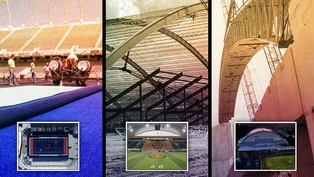
Preview of "Gridiron Innovations: The Kibbie Dome, The Minidome & the Blue"
Preview: S10 Ep1 | 30s | The origins of Idaho’s Kibbie Dome, the Blue Turf, and the Minidome. (30s)
Providing Support for PBS.org
Learn Moreabout PBS online sponsorship












Support for PBS provided by:
Idaho Experience is a local public television program presented by IdahoPTV
Major funding for Idaho Experience provided by the James and Barbara Cimino Foundation, Anne Voillequé and Louise Nelson, Judy and Steve Meyer. Additional funding by the J.A. and Kathryn Albertson...