
Lifting Legacies: Sculptor Benjamin Victor
Season 3 Episode 2 | 41m 20sVideo has Closed Captions
From clay to bronze, Idaho sculptor Benjamin Victor creates a statue of Christa McAuliffe.
Go behind the scenes with master sculptor Benjamin Victor as he creates a bronze statue of “Teacher in Space” Christa McAuliffe. Victor, who lives in Idaho, was commissioned by the state of New Hampshire to memorialize McAuliffe, who died in the explosion of the Space Shuttle Challenger in 1986. We watch the process from clay to bronze, and see the sculpture being installed.
Problems playing video? | Closed Captioning Feedback
Problems playing video? | Closed Captioning Feedback
createid is a local public television program presented by IdahoPTV
MAJOR FUNDING IS PROVIDED BY THE IDAHO PUBLIC TELEVISION ENDOWMENT AND THE CORPORATION FOR PUBLIC BROADCASTING.
Lifting Legacies: Sculptor Benjamin Victor
Season 3 Episode 2 | 41m 20sVideo has Closed Captions
Go behind the scenes with master sculptor Benjamin Victor as he creates a bronze statue of “Teacher in Space” Christa McAuliffe. Victor, who lives in Idaho, was commissioned by the state of New Hampshire to memorialize McAuliffe, who died in the explosion of the Space Shuttle Challenger in 1986. We watch the process from clay to bronze, and see the sculpture being installed.
Problems playing video? | Closed Captioning Feedback
How to Watch createid
createid is available to stream on pbs.org and the free PBS App, available on iPhone, Apple TV, Android TV, Android smartphones, Amazon Fire TV, Amazon Fire Tablet, Roku, Samsung Smart TV, and Vizio.

createid on YouTube
createid celebrates the unique talents of Idaho creators through lively video pieces. See exclusive content and join the community on Facebook, Instagram and YouTube. Subscribe now!Providing Support for PBS.org
Learn Moreabout PBS online sponsorship[Music] Benjamin Victor, Sculptor: Society enshrines in art what is important to it.
She was an American hero.
Announcer: Christa McAuliffe, Teacher in Space.
Victor: She had this special star power.
This teacher was made to be the public face of teachers everywhere.
And what material could be better than bronze?
I mean, bronze is forever.
Foundry worker: Come down a little.
Yeah.
Katie Jenkins, Jenkins Unlimited Studios: When he goes for a commission, it's because his heart is into it, and so that is poured into that clay.
NH State Sen.
Tim McGough, Christa McAuliffe State House Memorial Commission: It is unreal.
There's no one that creates the human form like this gentleman does.
Jeanne Gerulskis, Christa McAuliffe State House Memorial Commission: If you go to the New Hampshire State House now, you'll see a number of old white men.
Putting Christa there brings the state house into the current century.
Victor: It needs to be first rate, and I didn't want to sacrifice anything.
But we had to get it done really fast.
I wasn't nervous when I started, but then, man.
(Bubbling sound) Foundry worker: I don't know why it's doing that.
Victor: And I'm like, is this actually going to work out the way I thought it was?
Travis Fouts, Supervisor, Blue Mountain Arts: That's never happened before.
We had to figure out how we were going to fix this as quick as possible.
(Sound of wax ripping) Victor: It was really tough, and a total team effort.
Brian Jenkins, Jenkins Unlimited Studios: There's a lot more involved than just, you know, taking the clay and having it bronzed.
(Banging sound) This is grueling work; it's really hard on your mind and your body.
(Hammering, lighting flame, sound of grinding) Victor: That's it.
She's a beauty.
Barbara Morgan, Astronaut: Oh, my God.
Oh, man.
(Clapping) Victor: The greatest joy in life is when you can be part of something bigger than you.
Teacher: Do you see it?
Students: Yes!
Victor: It was just such a wonderful thing to think that perhaps I could use my gifts and talents to elevate her legacy.
(Music) ANNOUNCER: MAJOR FUNDING FOR CREATEID IS PROVIDED BY THE IDAHO PUBLIC TELEVISION ENDOWNMENT AND THE CORPORATION FOR PUBLIC BROADCASTING.
(Music) Victor: I think that anybody who's ever had a creative endeavor that they've taken part in, there's like this intrinsic spark in you that enjoys that sense of creating, and there's a media that matches you.
And that was sculpture and clay for me.
(Sound of hands in wet clay.)
Victor: It's very tactile, and to me it's very intuitive, like, finding the form of an object or person.
Beautiful.
Wow.
Look at that line.
And I've always had a fascination for the human body and how it works.
Back muscles are excellent.
This is a great pose.
I didn't start sculpture 'til college, and I just totally fell in love with the media and three-dimensional art in general.
And it was just so much fun that it felt like.
I love that.
Dancer: OK.
Victor: .well, I just wanted to do it the rest of my life.
And I have been ever since.
NARRATOR: INDEED, BENJAMIN VICTOR'S WORK IS IN SUCH DEMAND THAT HE COULD SCULPT ALL DAY, EVERY DAY.
AS HE WORKS IN HIS STUDIO IN BOISE, IDAHO, VICTOR IS SURROUNDED BY CLAY FIGURES FROM THE MORE THAN 60 MONUMENTAL STATUES HE'S CREATED.
.INCLUDING FOUR SCULPTURES IN THE COLLECTION OF THE NATIONAL STATUARY HALL.
One, two, three.
Woo!
(Clapping)NARRATOR: THAT MAKES HIM THE ONLY LIVING ARTIST WITH THAT MANY STATUES IN THE UNITED STATES CAPITOL.
Victor: It's very surreal.
They're all equally inspiring, and they're all equally sort of unsung heroes in their own way.
NARRATOR: FOR VICTOR, CAPTURING THOSE UNTOLD STORIES IS AS MUCH A PART OF HIS MISSION AS MAKING SURE HIS SUBJECTS LOOK AS REAL AS POSSIBLE.
Victor: If you just focus on, you know, the x's and o's of creating a sculpture that looks like them, that's good, I mean, that's half of it.
But it's only half the battle.
You know, what's the spirit of the sitter?
What's the spirit of the subject?
My grandmother was an art professor, and she always said that an artist has to have great empathy within them.
You have to be able to look at the plight of humanity, or the plight of your subject, so that the viewer comes to the piece and it pulls an emotion or a thought or a concept from them as well.
NARRATOR: THAT EMPATHY CAME TO THE FOREFRONT WHEN VICTOR SAW THAT THE STATE OF NEW HAMPSHIRE WAS LOOKING FOR A SCULPTOR TO CREATE A STATUE OF ONE OF ITS MOST FAMOUS CITIZENS: CHRISTA MCAULIFFE.
Vice President George H.W.
Bush: And the winner, the teacher who will be going into space, Christa McAuliffe.
Where is - is that you?
(Laughter and applause.)
NARRATOR: IN 1985, MCAULIFFE, A HIGH SCHOOL TEACHER, WAS CHOSEN TO BE THE FIRST PRIVATE CITIZEN TO GO INTO SPACE.
(Sound of laughing) THE NATION GREW CLOSE TO CHRISTA AS IT WATCHED HER TRAINING FOR THE FLIGHT.
ALWAYS JOYOUS, SHE EMPHASIZED THE LESSONS SHE'D BE TEACHING FROM SPACE.
Christa McAuliffe, Teacher in Space: So hopefully, while I'm up in the shuttle, and this is going to be live, I will be narrating what is being seen out the window.
Richard Covey, NASA: Challenger, go with throttle up.
Commander Dick Scobee: Roger, go with throttle up.
NARRATOR: BUT JUST SIX MONTHS LATER.
(Sound of explosion) .MCAULIFFE DIED, ALONG WITH THE REST OF THE CREW OF THE SPACE SHUTTLE CHALLENGER, WHEN IT EXPLODED SHORTLY AFTER TAKEOFF ON JANUARY 28TH, 1986.
Steve Nesbitt, NASA: Obviously, a major malfunction.
President Ronald Reagan: We remember Christa McAuliffe, who captured the imagination of the entire nation.
A teacher not just to her students, but to an entire people.
NARRATOR: WHILE THERE'VE BEEN SCHOOLS AND CENTERS NAMED AFTER MCAULIFFE, THIS WOULD BE THE FIRST STATUE OF HER, AND THE FIRST STATUE OF A WOMAN ON THE GROUNDS OF THE NEW HAMPSHIRE STATE HOUSE.
Cinde Warmington, NH Executive Councilor: It is high time that we have a statue of a woman on our State House grounds.
And I think to myself how important it is that we let little girls know that they can do whatever they want to do in their future.
Victor: The minute I saw that they were doing a Christa McAuliffe sculpture, I really wanted to do the piece.
It's like one of those moments in your life that you'll never forget, sadly, you know, the tragedy of the Challenger disaster.
It really hit home, especially with my mother being a teacher.
And it's such a beautiful thing that they pour their heart into it the way they do.
And I watched that with my mom growing up, and I know that that was the heart of who Christa really was.
NARRATOR: VICTOR SUBMITTED A PROPOSAL THAT REFLECTED THE FORTITUDE AND COMMITMENT OF TEACHERS LIKE MCCAULIFFE AND HIS MOTHER, WITH CHRISTA STRIDING CONFIDENTLY FORWARD.
Jeanne Gerulskis, Christa McAuliffe State House Memorial Commission: It's easy to have a sculpture of her just looking to the stars.
But that's not who she was or why she was selected, or what she planned to do after her flight.
Christa was a teacher.
She was an educator.
That was her vocation.
That's what she loved.
And he really captured the educator who was going into space, but with an eye toward the children of the future.
I mean, that was one of the things she said when asked about what she loved about teaching.
She said, "I touch the future.
I teach."
NARRATOR: THAT DEEP UNDERSTANDING APPEALED TO THE SEARCH COMMITTEE, WHICH UNANIMOUSLY PICKED VICTOR.
Jim Scully, Chair, Christa McAuliffe Memorial Commission: His interview, on top of his remarkable talent, was just unbelievable.
I mean, he really sang to the hearts of what this meant to him.
It wasn't just a job to get this done.
This was really about honoring Christa.
NARRATOR: UNLIKE MOST OF HIS COMMISSIONS, WHICH TAKE AT LEAST A YEAR TO COMPLETE, VICTOR WILL ONLY HAVE SEVEN MONTHS TO CREATE A NEARLY EIGHT-FOOT STATUE FROM CLAY TO BRONZE.
Victor: That was one of the biggest challenges, was just getting it done on time and done well on time.
NARRATOR: NO MATTER THE PRESSURE, THOUGH, HE STARTS AS HE ALWAYS DOES, WITH A MAQUETTE, A SMALL VERSION OF THE SCULPTURE.
Victor: I'm just making sure that everything's perfect before I jump right into the full-scale piece.
Because when you're going as large as I am, it's really, really important that you have everything worked out ahead of time.
This is oil-based clay, so it stays workable.
I like to get it nice and warm when I'm roughing out the piece.
I love how her hair is just blowing in the wind in these photos.
You have a lot of artistic license with hair.
It can become almost an abstract shape on some of my pieces.
I like the metaphor of wind, which can be a symbol for change, can be a symbol for action.
She definitely took action in her world by being so brave.
And an educator always stands for change, because an educator is helping change the world through the lives that they affect with their teachings.
(Sounds of metal clanking) NARRATOR: AFTER GETTING THE OVERALL LOOK THE WAY HE WANTS IT, VICTOR THEN WELDS TOGETHER A SUPPORT TRUCTURE, OVER WHICH HE'LL BUILD THE LARGE VERSION OF THE STATUE.
HE LINES IT UP WITH THE MAQUETTE TO MAKE SURE THE LEGS ARE AT JUST THE RIGHT ANGLE.
Victor: Wow, perfect.
Alright.
(Sound of lawnmower.)
Victor: It looks pretty good on this side.
NARRATOR: JUST TWO MONTHS LATER, VICTOR HAS MADE INCREDIBLE PROGRESS, WITH THE FULL SCULPTURE ALMOST DONE.
THE SCHEDULE IS SO TIGHT THAT HE'S BEEN WORKING IN A STUDIO NEXT TO HIS HOUSE SO HE CAN BE THERE DAY AND NIGHT.
Victor: Being working all around the clock, every single day.
Quite often I totally lose track of time.
You go into this zone where you don't really notice the outside world at all.
NARRATOR: THROUGHOUT THE PROCESS, HE'S BEEN ACCOMPANIED BY A VERY SPECIAL ITEM -- A NASA FLIGHT SUIT LENT TO HIM BY ASTRONAUT BARBARA MORGAN, WHO ALSO LIVES IN BOISE.
MORGAN, A TEACHER FROM IDAHO, WAS THE BACKUP TO CHRISTA MCAULIFFE AND TRAINED WITH HER.
THE TWO BECAME VERY CLOSE, AND WHEN MCAULIFFE DIED, MORGAN NEVER GAVE UP THEIR MUTUAL HOPE OF GOING INTO SPACE.
(Sound of splashing water) NARRATOR: SHE MOVED TO HOUSTON TO TRAIN AS A FULL-FLEDGED ASTRONAUT.
AND MORE THAN TWO DECADES AFTER THE CHALLENGER EXPLOSION.
Rob Navias, NASA: Zero and liftoff of Space Shuttle Endeavour, expanding the International Space Station, while creating a classroom in space.
NARRATOR: .MORGAN ACHIEVED HER GOAL, WHEN SHE SPENT 12 DAYS ON THE SHUTTLE ENDEAVOUR IN AUGUST, 2007.
Navias: Barbara Morgan seated down on the middeck -- Morgan racing towards space on the wings of a legacy.
NARRATOR: TO HAVE A COPY OF THE FLIGHT SUIT MCAULIFFE WORE HAS BEEN A HUGE HELP TO VICTOR.
Victor: There's just so many little things on it, like the little seams and buttons and patches, that it would have been really hard to get that from photos.
Like, I noticed all the zippers were kinda unique.
Like one would be halfway under, one's up and one's down.
One's hidden.
So I did that on the piece.
NARRATOR: ONE DETAIL HE ALSO WANTED TO GET RIGHT WAS MCAULIFFE'S WEDDING RING.
Victor: I know how important the ring was, because I know her family and her husband, those were just the center of her life.
I really like motion as well.
I really put that arm out to the side, and she's really striding with a strength.
That to me is part of capturing her character, not just her physical likeness, but the character of who she was.
NARRATOR: TWO WEEKS LATER, THE CLAY VERSION IS DONE, COMPLETE WITH A MESSAGE FROM THE SCULPTOR.
Victor: I signed my name and I put next to it a little heart and "teachers," because I wanted to give the teachers a little bit of extra love.
It's good to see this all come together.
It's a tight little deadline here, but she's looking great.
(Music.
Sound of tape ripping.)
NARRATOR: THE STATUE IS ABOUT TO BECOME ALMOST UNRECOGNIZABLE, AS THE MOLD-MAKING PROCESS BEGINS.
FIRST, IT'S COATED WITH A LIQUID RUBBER.
THEN CARDS ARE TAPED ONTO THE SCULPTURE TO MARK WHERE IT'LL BE CUT INTO PIECES.
THEN PLASTER IS APPLIED.
(Sound of plaster being applied) AFTER THE SHELL HARDENS, THE SCULPTURE IS CUT INTO MORE THAN 20 PIECES.
NARRATOR: THEN THE PAINSTAKING AND ANCIENT PROCESS OF POURING WAX BEGINS.
(Sound of wax pouring) Keith Silvas, Victor's assistant: This first layer is the most important, because this is where we capture all the details.
It's going to be the exact replica of what the clay was.
Victor: Wax can get incredible detail, like even down to a thumbprint or fingerprint.
Everything before it goes to the foundry has to be just right in wax, because that's what you're going to get in bronze.
And then when the waxes are all finished, they're sent to the foundry, where they dip 'em in ceramic shell and then they pass them through a high-temperature oven and the wax is melted out and that negative space where the wax was is refilled with molten bronze.
It's a great process for creating fine art bronze.
(Sound of wax pouring) Silvas: So we're going to get the wax layer about 3/16ths of an inch thick.
Because if it's thicker, it's going to create a really heavy sculpture, and bronze is not cheap.
It's going to be four coats.
I'd say we're pretty, pretty close with that.
Ben's one of my favorite artists.
So the opportunity to work on some of his pieces, it's just, "Wow, that's what I do for my job," you know.
It's awesome.
NARRATOR: AFTER THE WAX SETS, THE PLASTER AND RUBBER LAYERS ARE PEELED BACK TO REVEAL AN EXACT REPLICA OF THE PIECE.
James Turner, Benjamin Victor's Assistant: OK.
Alright, this is the hand, right hand.
Let's see.
(Sound of plaster being opened.)
Alright, our thickness looks pretty good.
You can see that there's some seam lines here that'll have to be chased.
NARRATOR: EACH PIECE IS THEN "CHASED," WITH ANY IMPERFECTIONS CAREFULLY SCRAPED OFF OR CORRECTED.
Turner: You could never tell there was a seam there.
It's really important that we echo the creative work.
When it leaves here, it has be exactly the same as it was when it first came in.
NARRATOR: MOST OF THE WORK IS DONE BY VICTOR'S TEAM MEMBERS.
BUT HE COMES BY TO CHECK OUT A VERY IMPORTANT PIECE.
Victor: Good pour.
It looks really good.
Everything from the windblown hair to her smile is looking good.
I'm getting excited to see it in bronze.
(Sound of plane overhead, car door closing and car starting.)
(Music) NARRATOR: THE PIECES ARE NOW DRIVEN 100 MILES WEST TO A FOUNDRY IN BAKER CITY, OREGON.
Travis Fouts, Supervisor, Blue Mountain Fine Art: In about 2003, my father founded this company, Blue Mountain Fine Art.
(Sound of oven starting) Fouts: You just want to be able to recreate exactly what the artist made and make it their vision into bronze.
(Sound of high flame) NARRATOR: ONE OF THE FIRST STEPS IS TO ATTACH WAX CHANNELS CALLED "SPRUES" TO EACH PIECE.
Christa Griffith, Blue Mountain Fine Art: The metal is going to be poured in here and the metal is going to run down in through all these sprues and run, run into the piece.
NARRATOR: FOR CHRISTA GRIFFITH, THIS ISN'T JUST A TASK.
SHE HAS A UNIQUE CONNECTION TO MCAULIFFE.
Griffith: Christa McCauliffe, I was actually named after her.
My mom was pregnant when that happened, and she heard the name and just thought it was beautiful.
It kind of feels a little bit like fate.
(Laughs) (Music) NARRATOR: AFTER THE SPRUES ARE ATTACHED, THE PIECES ARE REPEATEDLY DIPPED INTO A SLURRY MIXTURE AND THEN COATED WITH SAND TO BUILD UP A HARD SHELL.
Fouts: It takes a certain type of mind and eye to do what we do here.
(Sound of grinding) Attention to detail, and you definitely have to have the motivation to want to physically work hard.
You can be lifting over a hundred pounds, easy.
The metal pouring room is definitely one of the most physically demanding areas, because you can be working in extreme heat.
The ovens that pre-heat the ceramic shell, those are 1500 degrees.
You have to wear heat-protective gear.
(Sound of high flame) Chris Griffith: Blue Mountain Fine Art: Every five minutes it raises 50 degrees.
So in 15 minutes it will be 2050 and that's when we're going to pour it.
(Tense music) Alright.
You guys ready?
(Sound of machinery moving.)
(Music continues) NARRATOR: AS THE HEAD IS BEING POURED, THOUGH, THE TEAM HEARS SOMETHING UNUSUAL.
Griffith: Oh, that sounds weird.
(Sound of bubbling) Griffith: Never heard it do that before.
(Sound of bubbling) Griffith: Literally never heard it do that.
NARRATOR: BUT THEY HAVE TO KEEP GOING.
AFTER THE HEAD IS FILLED WITH BRONZE, IT'S COOLED DOWN.
(Hammering sound.
)NARRATOR: THEN, IN CONTRAST TO THE MONTHS OF DELICATE WORK ON THE CLAY, SHEER STRENGTH IS USED TO CRACK OPEN THE SHELL.
Griffith: That's bronze right there.
(Hammering noise.)
NARRATOR: AS THE FACE IS REVEALED, THOUGH, IT BECOMES APPARENT THAT THE EARLIER SOUND WAS A SIGN THAT SOMETHING ISN'T RIGHT.
Griffith: A little bad stuff on the face right there.
Fouts: That's never happened before.
It looks like there was moisture, and that got into the shell.
And then you pour hot metal in there and it's going to drive the moisture out.
It was one of the - one of the worst castings I've ever seen.
NARRATOR: HE MAKES THE DECISION TO HALT THE PROCESS.
Fouts: I knew Ben would want it to look exactly how he created it.
Ben: That was very upsetting, 'cause we were on a really tight deadline.
And so we were scared that it wasn't going to be done on time.
We couldn't afford another mistake at that point.
But the good thing about it is you have the mold.
NARRATOR: SO HIS TEAM IMMEDIATELY POURS A NEW WAX MOLD FOR THE HEAD.
THIS TIME IT'S IN TWO PIECES.
Fouts: It made it lighter to split it into two halves.
You have a way better chance of getting a good casting with smaller sections.
(Sound of ripping wax) Jimmy: OK, you got her?
Silvas: Yeah.
(Ripping noise) Jimmy: Oh that's good.
Silvas: Nice.
(Sound of flame) NARRATOR: FIVE DAYS LATER, IT'S TIME TO POUR AGAIN.
Griffith: Everything looked good when we poured it in, instead of last time it was bubbling.
And it's going to look good, yeah.
A lot better than the other one.
(Oven noise, hammering noise) Fouts: It looks great to me.
Definitely good news it turned out, and yeah, happy to see it.
(Machinery noise) NARRATOR: THE SPRUES ARE CUT OFF.
AND THEN THE HEAD GOES TO THE SANDBLASTING ROOM.
PIECE BY PIECE, CHRISTA IS REAPPEARING.
Fouts: We weighed up 550 pounds of metal today and 22 different castings.
When the artwork goes out into the world, maybe millions of people are going to get to appreciate that.
And it's a pretty, pretty good feeling to have that.
NARRATOR: IT WILL BE THE JOB OF THIS MAN, BRIAN JENKINS, TO PUT ALL THOSE PIECES BACK TOGETHER.
JENKINS' WIFE, KATIE, WHO IS ALSO HIS ASSISTANT, HAS COME DRESSED FOR THE JOB: Katie Jenkins: Jenkins Studios Unlimited: When we build a piece, and especially a special piece like this, we try to give it some honor.
Learn about the history.
And I'm a big NASA fan anyway, so it just seemed really fitting that pick-up day was a good day to wear it.
Fouts: You guys have a good trip.
(Sound of car door closing.)
(Music) NARRATOR: THE PIECES THEN TAKE THEIR NEXT TRIP - ANOTHER HUNDRED MILES TO JOSEPH, OREGON, KNOWN FOR ITS BRONZE ARTWORK AND FOUNDRIES.
(Sound of banging and grinding and welding metal) Brian Jenkins, Jenkins Studios Unlimited: I've had a lot of people throughout the years refer to the metal tooler as the "fixer."
If you've been in it long enough, you have seen every single problem that there could possibly be.
This one actually fit very well compared to more complex builds.
It's incredibly rewarding for me, because I remember the day, and because I feel like she was a fabulous teacher that loved what she did.
Ben's level of precision has always challenged me.
And that's something as a metal tooler that gives you a lot of drive, is being challenged.
It's not just curls, but it's curly hair that's in motion.
Victor: Your welder is very important.
When they're putting together the bronze sections, they have to each be welded together, and they've got to be structurally sound and strong.
But then that welder has to also know how to chase and fix the welds so that the textures are matched perfectly, so you don't see a seam line all along the piece.
(Metal buffing sound) Brian's one of the most talented metal workers that I've ever worked with.
(Metal grinding sound) Katie Jenkins: There's something about putting your hand on a sculpture of somebody.
It's something spiritual.
Especially children, they're going to want to touch it.
They're going to want to feel the way the fabric folds and everything.
So one of our jobs is to ensure that it is completely smooth.
(Metal grinding sound) Katie Jenkins: I feel incredibly proud to be touching a piece that means so much to so many people.
Brian Jenkins: You always have to make sure that you're putting it back together the right way.
And that's called the "attitude."
I tacked all the pieces together to make sure her hips were level.
And then I knew that once I got her hips level and then right above her feet, that I could confidently weld the whole thing up.
(Sound of chain moving.)
Brian Jenkins: There's certain points that have to line up.
Everything else I have to make work.
(Sound of arc welding.)
(Sound of chain, beep.)
Brian Jenkins: I've had a lot of people who think that the whole thing is done by the artist, where it's done in clay and dipped in bronze, and that's the bronze.
(Sound of metal buffing) Brian Jenkins: There's a lot more involved than just, you know, taking the clay and having it bronzed.
So when I pry here, that gap is wanting to close up, little by little.
(Sound of banging) Brian Jenkins: It's grueling work.
It's really hard on your mind and your body.
The whole thing's a challenge.
I love the fact that the Christa McAuliffe piece is going to be displayed long after I'm gone.
I take a great amount of pride in that.
Katie Jenkins: This is just a very powerful piece.
This is a symbol to the U.S.
So to bring some positivity to something that, that was a dark period feels really lovely.
(Sound of sculpture moving) NARRATOR: TWO MONTHS AFTER THE SCULPTURE LEFT IN PIECES, IT'S BACK AND COMPLETE.
IT'S THE FIRST TIME VICTOR HAS SEEN CHRISTA IN BRONZE.
Victor: Looks great.
I'm very happy with your, the form that you got and the attitude.
Two most important things.
Beautiful.
There's sometimes where the metal worker can't get the stance right, the lean.
So I'm really happy.
They just did a beautiful job.
(Sound of spraying) Victor: Then that brings us into the patina stage.
It's just two chemicals that we're using on the surface, liver of sulfur that blackens it, and then we wipe it back and it still hangs in the lows.
And so that creates kind of an antique effect.
This patina would be what I would often call a French Brown.
It's the safest patina you can do on bronze.
It's just going to look like what people think of as bronze.
I absolutely love doing patinas.
I wasn't getting what I wanted out of the material of bronze until I really knew how to do patinas on my own.
(Sound of water dripping) Oh, this is going to be pretty.
It's just going to look just perfect.
(Sound of torch lighting) Victor: And then we heat it and spray it with ferric nitrate.
And it's going to turn like a nice warm honey brown.
(Sound of torch blowing, spraying.)
Victor: That's a beautiful honey color.
(Sound of torch blowing.)
Each one is heated by hand, and each one is treated with chemicals by hand.
(Sound of torch blowing.)
But that's the art of it, is the beauty that they're all different and unique.
(Sound of torch blowing and spraying.)
You can go more on the hair.
Just like that.
Perfect.
You work on it and just react as you go.
And that's how the best pieces turn out.
(Sound of torch and grinding) There's a lot of pressure on commissions like this.
You're on a deadline; you have to get it right.
And it's high profile.
But I thought about the teachers in my life and how really for them it was always, "Do your absolute best."
And that's what I did all the way through.
I mean, I really put everything I could into the sculpture.
(Sound of slapping gloves) Victor: That's it.
She's a beauty.
That's perfect.
That's the patina I wanted on her.
I'm really happy with her.
I think this is just how she was meant to look.
And it couldn't have turned out better.
(Spraying sound.)
Wait until you see these colors come out with the lacquer on it.
It just deepens all that chemical.
It's really going to sing once that lacquer gets on it.
She's going to be beautiful.
NARRATOR: ONLY EIGHT DAYS BEFORE THE UNVEILING CEREMONY, THE STATUE IS BEING PREPARED FOR ITS FINAL JOURNEY -- MORE THAN 2500 MILES TO NEW HAMPSHIRE.
Victor: We made it by the skin of our teeth.
(Sound of drilling.)
Victor: It was really tough and a total team effort.
Driver: Forward!
Watch your fingers, watch your fingers.
Stop.
Stop, stop!
Forward!
Worker: Watch your hands.
Driver: Yep.
We're OK, We've got plenty of room on one side.
Victor: I felt total relief when we got the patina done and it got it on the van.
Driver: Alright, that's good.
Victor: I think I'm like a really hopeless optimist when it comes to the start of projects.
'Cause I'll get started and I think everything's going to go perfect.
And then I get my hands in the clay and get started and it's like, "Oh, everything's behind even from the start.
And I'm like, "This is terrible.
Why did I agree to this?
I'm staying up all night, you know, waking up early.
Its just - "I can't do this anymore."
And then I do it all again.
(Laughs.)
Barbara Morgan, Astronaut: Hey there!
Victor: Hey!
NARRATOR: ASTRONAUT BARBARA MORGAN, CHRISTA'S TRAINING PARTNER, CAN'T BE AT THE UNVEILING.
Victor: I can't wait to see what you think.
Morgan: Oh, I'm sure.oh, my gosh.
NARRATOR: BUT SINCE, LIKE VICTOR, SHE ALSO LIVES IN BOISE Morgan: Oh, man.
NARRATOR: SHE STOPS BY HIS STUDIO TO SEE THE CLAY VERSION OF THE SCULPTURE.
Morgan: Fantastic.
That is fantastic.
Where are her arms?
Victor: We had to take them off to do the molds.
Morgan: Yeah, yeah, yeah.
Yeah.
Oh my gosh.
You got the twinkle in her eyes, like we talked about.
I can't get over the details, too, you got on all the patches and everything.
It's amazing.
I'm glad the suit came in handy.
Victor: Oh, it did, because you can't see that level of detail in the photos.
Looks like I got a little clay on there for you, too.
Morgan: Good.
Perfect.
Perfect.
Victor: Gave her a little message here.
Morgan: Aw.
Oh, Benjamin.
I love how you signed it.
Oh, my gosh.
She would be really pleased.
She really would.
She'd be embarrassed, but she'd be really pleased.
(Music) Morgan: I love Christa.
And he just did such a beautiful, gorgeous job on a beautiful, gorgeous person.
And I know she would absolutely love Benjamin, too.
Victor: She just looks happy, positive, looking up and out.
Morgan: Yeah.
Victor: And I was thinking of the kids looking up at her.
Morgan: Yeah, for sure.
She'd be proud of you.
You'd love her.
(laughs) Victor: I wish I would've known her or met her.
Morgan: You do.
I mean, it's obvious.
You do know her.
And she knows you.
Victor: Thank you.
Morgan: Wow.
Scully: We are here today on what would've been Christa's 76th birthday.
Honoring someone who was such a remarkable woman was certainly no easy task.
We were incredibly lucky to have found Mr.
Benjamin Victor.
His ability to turn bronze into life is nothing short of remarkable.
Victor: Thank you.
What a day.
Man, what a turnout.
For the last seven months while I've worked on the sculpture, I've felt like I've really gotten to know her.
She was courageous, she really was.
She went up there into the unknown to do something special for the next generation.
Isn't that the real point of life, is to leave a legacy like this, like she did?
And so it's just beautiful.
You know, it's tragic, but there's a beauty in it.
So that's why when you see the sculpture unveiled, she's smiling and she's striding forward.
'Cause that's the whole point of that legacy, is that we need to carry the torch on.
Judge Steven J. McAuliffe, Christa McAuliffe's Husband: Christa would be so proud and humbled by this highest of honors conferred by her home state in her hometown.
I also know this.
She would want me to sternly stress that this statue must be seen and appreciated as she hoped to be seen and appreciated, as a classroom teacher representing her profession, as a stand-in for all teachers and all educators.
Benjamin worked tirelessly with great care and concern.
He wasn't satisfied to just make a statue.
Uh, he, he really, really dug deep.
Like you, I, we all can't wait to see Benjamin's work.
Thank you very much.
(Clapping) Scully: The time has come.
Man: 3,2,1, let 'er rip.
(Clapping) (Music) Morgan: I can't think of anything better than a beautiful sculpture of her, where you can walk all the way around and you're there with her in body and in spirit.
Paul Smith, Christa McAuliffe State House Memorial Commission: I really hope that future generations will say, "Hey, not only is this Christa McAuliffe, who is the first educator astronaut, but the guy that created her statue is this world-renowned sculptor."
Victor: The greatest joy in life is when you can be part of something bigger than you.
That artwork will last forever.
It'll be there long after I'm gone.
So just to be part a part of that legacy, that's what it's really about for me.
Guide: Today is a really special day.
You're going to be seeing the first woman on the State House grounds.
Is that pretty exciting?
Children: Yeah!
Guide: So ladies, do you think it was about time?
Girls: Yes!
Guide: After 205 years, oh, yeah.
Do you see it?
Is that pretty awesome?
And what do you think of the statue?
Student: It looks like it is actually, like, waving in the wind while she walks.
I really like that.
Student: I noticed she's wearing her ring.
Guide: The artist - he loves teachers.
And he put something special on the statue.
If you look up close, it says, "I heart teachers."
Do you think that's a cool thing?
Children: Yes!
Gerulskis: We're honoring the entire profession of teaching.
And that's often a profession that is not elevated.
Teachers are some of the most important people in the world.
Everybody has a teacher they remember that inspired them, that changed their lives.
Morgan: She wanted them to believe in themselves and be true to themselves.
And I think Benjamin captured that -- Christa believing in herself and being true to herself.
Victor: Christa McAuliffe stood for something great that we should all want to be like.
I hope that all of 'em look up at that sculpture and want to study about Christa's life.
(Music) Victor: I never would've thought I could even do this for a living.
So I hope that inspiration comes through to other students.
You can find a way to do what you love.
You may not become the most wealthy person in the world, but success is how we define it.
So that's where my life, I feel like a great success no matter what, 'cause I'm doing the thing I love.
(Music) ANNOUNCER: MAJOR FUNDING FOR CREATEID IS PROVIDED BY THE IDAHO PUBLIC TELEVISION ENDOWNMENT AND THE CORPORATION FOR PUBLIC BROADCASTING.
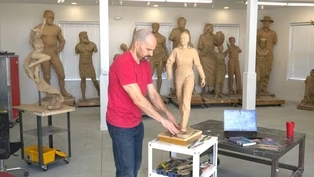
Preview of "Lifting Legacies: Sculptor Benjamin Victor"
Preview: S3 Ep2 | 29s | From clay to bronze, Idaho sculptor Benjamin Victor creates a statue of Christa McAuliffe. (29s)
Providing Support for PBS.org
Learn Moreabout PBS online sponsorship














Support for PBS provided by:
createid is a local public television program presented by IdahoPTV
MAJOR FUNDING IS PROVIDED BY THE IDAHO PUBLIC TELEVISION ENDOWMENT AND THE CORPORATION FOR PUBLIC BROADCASTING.