
Preserving Our American Memories
Season 9 Episode 5 | 26m 47sVideo has Closed Captions
Idaho Experience explores what makes an object an artifact through exhibits like the Merci Train.
As we celebrate America 250, Idaho Experience takes a look at some of our touchstones with American history, like the 1949 Merci Train. We also explore what makes an object an artifact and how decisions are made on what to preserve.
Problems playing video? | Closed Captioning Feedback
Problems playing video? | Closed Captioning Feedback
Idaho Experience is a local public television program presented by IdahoPTV
Idaho Experience is made possible with funding from the James and Barbara Cimino Foundation, Anne Voillequé and Louise Nelson, Judy and Steve Meyer, with additional support from the Corporation for...
Preserving Our American Memories
Season 9 Episode 5 | 26m 47sVideo has Closed Captions
As we celebrate America 250, Idaho Experience takes a look at some of our touchstones with American history, like the 1949 Merci Train. We also explore what makes an object an artifact and how decisions are made on what to preserve.
Problems playing video? | Closed Captioning Feedback
Where to Watch Idaho Experience
Idaho Experience is available to stream on pbs.org and the PBS app.
Providing Support for PBS.org
Learn Moreabout PBS online sponsorshipNarrator: Major funding for Idaho Experience is provided by the estate of Darrell Arthur Kammer, in support of independent media that connects communities and expands understanding.
Additional funding was provided by the James and Barbara Cimino Foundation, Anne Voilleque and Louise Nelson, Judy and Steve Meyer, and from the Corporation for Public Broadcasting, and contributions to the Friends of Idaho Public Television.
And viewers like you.
Thank you.
Voice of David Amott: Memory takes effort.
Narrator: For every artifact that gets saved, what else gets cast aside?
For all the preserved historic buildings in our communities, what else was torn down or left to deteriorate?
Amott: People always come up to me and say, "Well, we can't save everything."
I reassure them when I hear that we are in no danger of saving everything.
In fact, we're too much in danger of saving nothing.
Narrator: Idaho Experience explores how artifacts tell the stories of Idahoans’ place in American history, and how preservation decisions are made.
The Merci Train and the fate of the hundreds of objects that once sat inside, is one of Idaho's best examples of the sometimes subjective natu of preservation, and the need for dedicated individuals who care about Idaho's past.
And its story started with the Friendship Train, a gesture of kindness from the people of America to Europe.
[News bulletin trumpet music] Newsreel Narrator: October 1947.
The end of World War II did not end the suffering for the people of Europe.
The hunger and destruction of war was compounded by cold floods and drought that killed crops and left citizens desperate for food.
Popular newspaper columnist, Drew Pearson, urged ordinary Americans to help feed the hungry and to demonstrate the power of U.S.-style democracy.
Voice of Drew Pearson: For a drought starved Western Europe, food is more powerful than tanks or guns, more constructive than atom bombs.
It can build friends where weapons make enemies.
Newsreel Narrator: The logistics but the idea was simple a train would collect donated food across the continent, adding boxcar after boxcar.
On November 7th, with a Hollywood sendoff, the Friendship Train left California for New York City.
Voice of Ava Gardner: This is Ava Gardner.
The Friendship Train is waiting for our gift of food right now.
I think it's a wonderful idea to help keep the light of hope and liberty burning with food for friendship.
Newsreel Narrator: It quickly gathered steam.
Enthusiastic Americans donated their food, and US railroad companies donated their trains and tracks.
Voice of Steve North: It started out with about 12 cars in LA.
By the time it made across the country it had 700 boxcars.
Newsreel Narrator: The Friendship Train was greeted by celebrations, parades, and live radio broadcasts as it traveled.
Idaho citizens sent two boxcars to join at Ogden, Utah.
Voice of Drew Pearson: I don't know whether you've ever heard of the town of Burley, Idaho.
I never had before, but the Elks Lodge in Burley, Idaho gave us one carload of wheat.
Newsreel Narrator: 700 boxcars worth of food rolled into New York City and was loaded onto the Friend Ship, the equivalent of a six mile long train.
On December 7th, 1947, nearly 4,000 tons of food left New York on a ship bound for France and Italy, where it went mostly to children and schools.
Voice of Steve North: I guess the most interesting thing would be how the people of France responded.
What the people did to do that, to repay the United States back, just kind of boggles the mind for some of the stuff that they sent.
Narrator: How did they say thank you?
By filling antique boxcars with gifts from the French people.
It became known as the Merci Train, organized by French veterans and railroaders.
The gifts represented French industry, art and culture.
The gifts were fancy and artistic, and humble and homely.
Many of them straight from the hearts of people grateful for American support during and after two world wars.
Voice of Nicole Inghilterra: This hand-carved stool tells us the craftsman was an 83 year old blind man.
Voice of North: The president made up a list of what could be sent.
It had to show something about what France is, how France was built.
Handmade toys, clothing, dolls, quilts, you name it.
It was all, all done by hand.
Narrator: The boxcars themselves were cherished antiques familiar to American GI's who'd seen them haul World War One troops and prisoners.
Built beginning in the 1870s, the cars were known as "40 and Eight" because they could hold 40 men, or eight horses.
Each U.S.
state got one boxcar full of gifts.
In Idaho, the boxcar was trucked to downtown Boise, and displayed outside the Capitol.
Nicole Inghilterra: There was excitement for weeks prior to the boxer coming to Idaho.
There was a big parade that was hosted to welcome the train.
Narrator: But what happened to the gifts after the boxcar went on display?
North: Some of the stuff went to the museums.
Some of the stuff went to private donors.
Some of the stuff got stolen.
Some of the stuff got... it went everywhere.
Narrator: So, surely treasures remain hidden today in Idaho dressers or closets, waiting to be rediscovered and shared.
We do know that the Idaho State Historical Society has 300 of the artifacts in its possession.
Inghilterra: In the collection, we have things like vases that were made from mortar shells.
And I love the things that we still use today.
Like, you know, it's a salt cellar.
It's a salt box.
It's a fun one.
I have to say that Winged Victory is my favorite.
She is just so striking.
The Winged Victory of Samothrace has been displayed in the capital since roughly 1949.
She's a plaster cast of the original that's held at the Louvre.
She feels so emblematic to the French people, so I'm quite proud that she's part of our collection.
Narrator: The biggest artifact of all is the 40 and Eight boxcar, which has a tale of its own.
North: It was at the Capitol building for a while, and then some general or admiral or officer had it in his yard, his property, for a while.
And then it went over to Boise State for a couple of years.
Inghilterra: At one point it's recorded as being used as a horse trough, and had kind of fallen into different functional capacities at, like, the National Guard, for instance.
And then the American Legion then says, "We're going to give it to the state Historical Society."
To which we said, "Absolutely."
Narrator: In the late 70's, the boxcar moved to the Old Penitentiary in Boise.
But even then, the boxcar sat outside exposed to the elements That didn't sit right with World War One veteran Larry Evans, who began to raise money to hire a crane to lift the boxcar over the gate of the Old Pen, telling the Idaho Statesman he wanted to complete the task before he kicked the bucket.
In 1980, the boxcar was lifted over the gate.
Then came the challenge of restoring the boxcar, which had been subject to graffiti, vandalism, and harsh Idaho weather for three decades.
Inghilterra: It becomes a labor of love for multiple people.
Stewards of the story, the 40 and Eight and Tom Brown in particular.
Tom Brown was a long time volunteer at the Historical Society and specifically had a passion for World War Two history.
So in 1984, he starts volunteering, especially with the goal of restoring the boxcar.
Tom becomes a bit of a legendary figure for a lot of people who love these pieces, and who want to make sure that their story isn't forgotten.
Narrator: Today, Idaho's restored boxcar is protected inside the Shirt Factory building at the Old Pen.
Without Tom Brown and Larry Evans, Idaho's boxcar and many of its stories may have been lost to time.
The individual decisions and actions that drive preservation priorities take place all the time, in every corner of the state.
Bob MacLeod is the president of the Blaine County Historical Society.
Bob MacLeod: The Blaine County Historical Museum was formed in 1962, by a group of people that had a lot of items they had collected over the years, and they wanted to preserve them.
We have a 1929 Ford Model A. We have a mock up of early American mine.
The original cash register from the Friedman's Store from 1915.
Narrator: There are also a number of everyday items like dish sets, a classroom set up, and a recreation of a local drugstore.
MacLeod: Well, it just shows how people lived in what they used and how they use things.
Narrator: Six decades later, the museum continues to accept donations, but with a discerning eye.
MacLeod: Generally speaking, it's got to be at least 50 years old for us.
And it has to be from this area.
It had to be given to us by a family that used it.
We've had some wonderful things trying to be gifted to the museum, but it just didn't fit into our bailiwick.
An artifact has a story behind it.
That's what's important.
It might be an old rusty gun, but if you knew who owned the gun and how it was used, that makes it an artifact.
Narrator: And as the collection grows, the museum needs to be mindful of its space constraints.
MacLeod: We are in the process of moving along and trying to expand the museum, because we have storehouse with a lot of stuff and we'd like to display, but we just don't have room.
In fact, my garage has quite a few things in it too, that I'm trying to move back to... They've just kind of ended up there by default more than anything.
Narrator: Nine hours north, space is also a limiting factor for the Post Falls Historical Society and Museum.
Voice of Kristine King: I always think when something is given to me, there's something in here that will really enrich our museum.
Narrator: President Kristine King tries to keep as many donated artifacts as she can.
King: I take that seriously.
I think there's a spiritual element of it and something to be learned.
And so I try to find that.
Narrator: Many of the donated items come directly from the founding families of Post Falls.
King: I grew up Catholic, and some of the beautiful Bible verses we talk about is turning the hearts of the children to their fathers.
And in doing family research, that's the one thing I noticed clearly, that when people know where they come from, they feel inspired to do better.
Narrator: Preservation sometimes requires money and trained professionals, but sometimes it takes little more than an individual with drive and a passion for history.
Voice of Susan Hawkes: Elliot Butterworth was a man of vision.
Narrator: An immigrant from England, Elliot worked on the Utah Northern Railroad before settling in Franklin, Idaho, where he ran a hardware store.
Hawkes: He could see through the next 20 or 30 years that all the original settlers were starting to pass away, and he wanted to retain their important stories.
Narrator: As the pictures and other small artifacts began to line the walls of his hardware store, Elliot was called back to England on a mission for The Church of Jesus Christ of Latter day Saints.
Hawkes: He went to all the museums he could find there, and he knew without a doubt, on his way back, he was going to go collect rare and unique artifacts.
So he came home and started his museum in the little ZCMI Co-op Building.
Narrator: His collection told the story of Franklin's origins, with artifacts from town founders and models of buildings from the area, including some he built himself.
The museum also has items with regional importance, like an ox skull in memory of handcart pioneers, and a steam engine once owned by Brigham Young.
Butterworth also picked up objects that he felt told the story of American history.
Over the years, the collection grew.
Hawkes: The store was getting way too small to hold all the artifacts he had collected.
Narrator: With labor from the Civilian Conservation Corps.
He built the Franklin Relic Hall for the artifacts.
Hawkes: Some people could have claimed he was a hoarder, but he knew his artifacts.
Narrator: Individuals with a passion for preserving Idaho history have long helped tell Idaho stories to future generations, with efforts small and large.
Starting in the late 1800s, one and two room schoolhouses started popping up across the state.
By 1913, Idaho was dotted with more than 1600 small schools In Camas County in the 40s.
Those tiny schools consolidated into the Fairfield district, leaving the schoolhouses vacant.
Some buildings were converted, like the Corral School, which became a mechanic shop, and is now dormant.
Others were left to time and decay.
Before the Menard school was demolished, Jack Frostenson and his dad saved the bell they said could be heard for miles.
Voice of Jack Frostenson: It put your ears out if you're standing by it when they rang it.
Narrator: Jack preserved the bell in a monument he designed as a class project.
Frostenson: It was my second year at the University of Idaho in a degree in architecture.
And my dad had this little piece of corner of a field, and I talked him into building a monument that would remember this for a long time.
And it has, by golly, quite a while.
Narrator: As an added touch.
He installed a plaque with every teacher's name, including his own mother's.
Frostenson: Right at the end.
She taught two years there.
Narrator: Jack and his wife, Linda, now live on the property where they can hear visitors ring the bell.
Many of those who've stopped by had personal connections to the school.
These days, the bell doesn't toll as often.
Frostenson: Yeah, there's not many of us left.
Narrator: But for now, the bell still rings, [bell ringing] celebrating the history of the prairie and the role that the schoolhouses played in everyday life.
Frostenson: Well, by golly, that's enough.
Narrator: Elsewhere in the state other historic structures have met varied fates.
Thanks to preservation, one of the oldest buildings in Idaho still stands.
The Pierce Courthouse was built in 1862.
John Bradbury: It was the first courthouse in Idaho and the first governing body in Idaho.
Mining was just going huckledy-buck, millions of dollars being taken out of here.
So they decided they need some county government.
You see the bars up there and that window, that's where the jail was.
And they brought kegs and nails in and put them into the wall so the prisoners couldn't cut their way out of the log jail.
And then the second floor was where the county commissioners met.
Narrator: The building served as the courthouse until 1885, when the county seat moved to Murray.
Today, it still serves as a logging museum.
A building significance doesn't always determine its fate.
Instead, resources are often the deciding factor.
On the other side of the Idaho Territory, the US government ordered a courthouse for Bear Lake County.
Voice of David Amott: The county courthouse was built between 1884 and 1885.
Right at the height of persecution that the people in southern Idaho, Mormons really all over the state, were facing due to their unusual practice of polygamy.
In a bit of a, as you would say today, "flex" by the government, they required that this building be constructed, this courthouse, right in the middle of Paris.
Narrator: The building served as an active courthouse for more than 120 years, and was listed on the National Register of Historic Places in the 70s.
While the building was picturesque, it wasn't compliant with the Americans with Disabilities Act, and it was expensive to maintain.
In 2018, the Bear Lake County Commissioners received the go-ahead to build a new courthouse.
That left the question of what to do with the old courthouse.
Laurie Rich: Somebody said it was going to be torn down, and I said, well, can't do that.
We just couldn't do it.
There was all there was to it.
We just couldn't tear it down.
Narrator: Bear Lake County resident Laurie Rich and David Amott of Preservation Utah led a coalition to preserve and repurpose the original building.
Rex Payne was one of the Bear Lake County Commissioners tasked with deciding the fate of the structure.
Rex Payne: Well, certainly the old building was, you know, a landmark and had some historic significance to all of us.
But on the other hand, when it comes to the safety of our public, we have to make some decisions.
Narrator: Before the new courthouse opened, two citizens fell down the stairs of the old one.
And the danger was present even for those outside of the building, with several metal sheets flying off the roof during a storm.
Payne: If that would have struck someone, then they possibly could have been injured or killed.
Narrator: Though advocates had started to raise money to save the building, the commissioners decided the original courthouse needed to come down.
Rich: What I remember is this cold night and little flakes of snow came falling down from heaven.
Like tears from heaven.
And then all of a sudden they took that machine and just, put a big hole in it.
And I thought, well, this is the end.
There's no way we can save it now.
Amott: And that was crushing.
I remember I... What does one do in that situation?
You know, you feel like you've lost a friend.
Payne: Again, we have to look at the safety of the public and the use of the public and what is most beneficial to the ones that we serve.
Amott: I know it's expensive.
It requires money, but it also requires priority and values.
And you can always tell a community that prioritizes that because they just feel like places, as opposed to just another space that is easily passed through and easily forgotten.
Narrator: Resources for preservation are often strained.
Back in Post Falls, the Historical Society is in an ongoing conversation with the City Council about its future and financial solvency.
Since 2009, the city has allowed the historical society to use a century-old building in exchange for performing routine maintenance.
But a recent building inspection showed the need for expensive repairs.
While the Historical Society has addressed some of those issues, in 2026, the council asked for proposals on how the building and historical society could be financially self-sufficient.
Nathan Ziegler: I do agree with the statement that the decisions that we make do show our priorities, and one of the priorities that I feel responsible for is sitting on this council, responsible for not only the money that I spend in this city, but for many of your moneys also that we collect.
Randy Westlund: We've been working on how we're going to pay for health insurance and pay our police officers and dispatch and fill potholes in the streets.
The idea of being displaced continues to worry Kristine.
King: We're right here where history is.
I was telling you that, like Corbin Ditch is down the street.
This is where they lived.
If we got sent somewhere else, where would we go?
Narrator: Not every preservation effort is at the mercy of public funds.
Back in Camas County, as the years go on, maintenance on the aging Manard School Memorial has become more difficult for Jack and his wife Linda to maintain.
Frostenson: We have to watch it and shovel snow off of it.
And a lot of times a hard wind will blow shingles out of the roof.
Narrator: There may be a day when the Manard school bell no longer rings to remind visitors of Idaho's tiny schoolhouses of the past, but the next generation will have their own preservation decisions to make.
Amott: We say in preservation that if you tear down a building, it's gone forever.
But if you save a building, you've saved it for 30 years.
Each generation has to decide what is important to them, what is essential to save, and what can be jettisoned.
And so saving a building is actually not something you do just once.
Weather and time and other forces take their toll.
It pains me to think that we in the here and now, then decide for everyone else, no, you don't get this.
This doesn't belong to you.
Preservation requires true effort, and that's not available for every building.
But gosh, when you can save something, even if you think it's beyond hope... I do like seeing, even if it's lost, somebody tried.
Somebody recognized that this this might be valuable for us in the present, but also everyone in the future.
Major funding for Idaho Experience is provided by the estate of Darryl Arthur Hammer, in support of independent media that connects communities and expands understanding.
Additional funding was provided by the James and Barbara Seminole Foundation and Volker and Louise Nelson, Judy and Steve Meyer, and from the Corporation for Public Broadcasting and contributions to the Friends of Idaho Public Television and viewers like you, you.
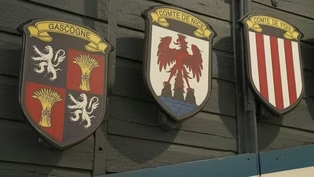
Preview of "Preserving Our American Memories"
Preview: S9 Ep5 | 1m 30s | Idaho Experience explores what makes an object an artifact through exhibits like the Merci Train. (1m 30s)
Providing Support for PBS.org
Learn Moreabout PBS online sponsorship










Support for PBS provided by:
Idaho Experience is a local public television program presented by IdahoPTV
Idaho Experience is made possible with funding from the James and Barbara Cimino Foundation, Anne Voillequé and Louise Nelson, Judy and Steve Meyer, with additional support from the Corporation for...