
Idaho's Sacred Places
Season 9 Episode 3 | 40m 3sVideo has Closed Captions
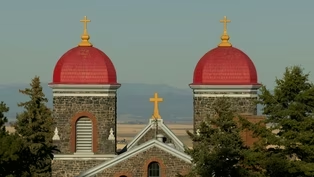
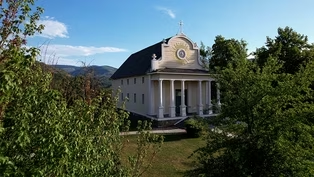
In this episode we explore Idaho’s deep faith through three houses of worship.
Idaho, with its strong faith, rich history and natural beauty, has many sites deserving of veneration. In this Idaho Experience, we explore Idaho’s faith through three places of worship that represent a small fraction of “Idaho’s Sacred Places”, the historic Cataldo Mission, the Center for Benedictine Life at The Monastery of St. Gertrude and the synagogue of Congregation Ahavath Beth Israel.
Problems playing video? | Closed Captioning Feedback
Problems playing video? | Closed Captioning Feedback
Idaho Experience is a local public television program presented by IdahoPTV
Major funding for Idaho Experience provided by the James and Barbara Cimino Foundation, Anne Voillequé and Louise Nelson, Judy and Steve Meyer. Additional funding by the J.A. and Kathryn Albertson...
Idaho's Sacred Places
Season 9 Episode 3 | 40m 3sVideo has Closed Captions
Idaho, with its strong faith, rich history and natural beauty, has many sites deserving of veneration. In this Idaho Experience, we explore Idaho’s faith through three places of worship that represent a small fraction of “Idaho’s Sacred Places”, the historic Cataldo Mission, the Center for Benedictine Life at The Monastery of St. Gertrude and the synagogue of Congregation Ahavath Beth Israel.
Problems playing video? | Closed Captioning Feedback
How to Watch Idaho Experience
Idaho Experience is available to stream on pbs.org and the free PBS App, available on iPhone, Apple TV, Android TV, Android smartphones, Amazon Fire TV, Amazon Fire Tablet, Roku, Samsung Smart TV, and Vizio.
Providing Support for PBS.org
Learn Moreabout PBS online sponsorship[Music] Announcer: Idaho Experience is made possible with funding from The James & Barbara Cimino Foundation, Anne Voillequé and Louise Nelson Judy and Steve Meyer with additional support from The Corporation for Public Broadcasting and contributions to the Friends of Idaho Public Television.
And viewers like you.
Thank you.
[Music] Narrator: Idaho, with its strong faith, rich history, and natural beauty, has many sites deserving of veneration.
Sacred places known for their spiritual connection.
Rabbi Dan Fink: When I walk into this space, it puts me in a different place.
There's just a kind of warmth to this building that is very beautiful to me.
Narrator: Places that celebrate the natural world as a sanctuary for our souls.
Sr.
Barbara Jean Glodowski: I always like to see nature as a carrier.
Every leaf, every blade of grass has a spark of divine.
Narrator: Places that are made sacred by the community who gather there to worship.
Sr.
Teresa Jackson: We have Eucharist five days a week.
That's where we enter into the totality of the Christian mystery.
Rabbi Johanna Hershenson: There is a sacred quality to having the community together.
And definitely my heart soars when the pews are full.
Narrator: A place that celebrates the contributions that enrich a community.
Carla Wilkins: You know, we're such a small town, but we’ve always had great services thanks to the sisters.
Narrator: A place that provided refuge for pioneers and natives alike.
Ernie Stensgar: We're very proud of this place, of course.
With the very hand of our people, this place in the wilderness was built and become a beacon.
Narrator: In this episode of Idaho Experience, we explore three houses of worship, The historic Cataldo Mission, The Center for Benedictine Life at the Monastery of Saint Gertrude, and the Ahavath Beth Israel Synagogue.
A few of Idaho's sacred places that deliver hope and promise for Idaho's faith communities.
[Music] Narrator: It's the oldest standing building in Idaho, listed on the National Register of Historic Places, and the centerpiece of an 18 acre Idaho state park.
It was built on faith, vision and cross-cultural respect.
It's a sanctuary worthy of its monikers.
Will Niska: The Mission of the Sacred Heart, Cataldo’s Mission.
Old Mission.
There's a bunch of names that this building goes by.
It was constructed in 1850 and completed in 1853 by the Jesuit missionaries and the Coeur d’ Alene Tribe.
Narrator: Decades before Circling Raven, a tribal leader and visionary, foresaw the arrival of the Black Robes, or Holy Men, who would introduce the Coeur d’ Alene to a new religion and a new way of life.
Ernie Stensgar: According to our stories, he had a vision of meeting these Black Robes with a cross.
So we foretold that, that one day they would come amongst us, and it happened.
And he told his people to be welcoming of these people when they came.
[Speaking Coeur d’ Alene] Narrator: Father Peter Byrne is a Jesuit Pastor at the Coeur d'Alene Indian Reservation.
Father Byrne: We glorify you.
How did he ever even have that sense or image of Black Robes?
They feel that French trappers and Iroquois trappers came down into Montana and spoke about Black Robes, because they were already way up in French Canada.
So they went searching for Black Robes.
And they went to Saint Louis and met Father Peter De Smet.
And he came into Stevensville, Montana and was welcomed by the Salish people of that area.
Narrator: Father De Smet was a renowned peacemaker and mediator.
He dispatched a small group of Jesuits to establish a Mission among the Coeur d'Alene, first along the Saint Joe River.
But persistent flooding prompted them to relocate it onto a hill overlooking the Coeur d'Alene River.
Years later, Father Antonio Rivalli designed a permanent church, and as many as 300 Coeur d'Alene built it alongside the Jesuit Brothers.
Their tools consisted of little more than a broad axe, auger and pen knife.
Will: There were no nails used in the original construction of this building.
It was all mortis and tenon jointed together.
They used a wattle and daub technique to create the walls.
It's an Adobe like method where they would take river grass and braid it and weave it.
And then they would take river mud and pack it back into the walls as well.
So the walls are approximately a foot thick each.
In the back sanctuary, you can see some of the original fingerprints from the Coeur d’ Alene Tribe as they were packing the mud in the corners, and as they're spreading it out on the walls.
The Coeur d’ Alene Tribe and the Jesuit missionaries were very creative and very resourceful with their means.
In order to fashion their candle holders and their chandeliers they were taking their goods that they had and recycling them.
Father Ravalli carved all the candle holders out of tin cans.
Fr.
Byrne: The church at Cataldo mimics the front part of the main Jesuit church in Rome called the Jesu, which is Italian for Jesus.
Even me if I have any denominational care.
Just the way it was built and all that.
I think that's a pretty amazing building.
And then there's history there.
There was an encounter.
And there still is an encounter.
And like any encounter, you know, there's tension in the encounter and there's forgiveness and then there's hurt and then there's love.
Drink from it.
The Jesuits had a sense of an invisible world, a sacramental world that everything is images, the unseen presence of the Creator.
And that resonated, I think with the Native people.
[Music] Ernie: With the bare hands of our people this place in the wilderness was built and become a beacon not only to Native people, but also to the pioneers and, and trappers, soldiers that came through the area.
[Drumming] Narrator: But as more miners, loggers and military poured into the area tensions between whites and Native Americans rose.
The Coeur d'Alene War of 1858 erupted between an alliance of Native American tribes, primarily the Coeur d'Alene, and the U.S.
Army, led by Colonel Edward Steptoe, and later Colonel George Wright.
Ernie: They fought all through the Spokane Plain, through the Palouse Country, and soldiers were pushing them back.
My t’upye’, my great-great grandmother was Halea, and she was there, she was a young girl at that, at that battle.
But they rode back to, here to Cataldo I guess, as a as a place of safety.
Actually, this place was where they signed the Treaty of Peace with the United States government.
Narrator: With a treaty in place Cataldo Mission would go on to serve several critical roles.
Will: Captain John Mullan spent some time here when he was putting in the Mullan Roadlla.
from Fort Benton to Walla Walla.
Father Cataldo, he was the Archbishop of the Rocky Mountain West.
He had his headquarters here for quite some time.
He was actually the one that founded Gonzaga University.
The Mission landing was where the steamboats would come up from Lake Coeur d’ Alene and travel the Coeur d’ Alene River.
It was as high up as they could navigate.
There were rail lines that would meet the steamboats and take people back to Lake Coeur d’ Alene, take ore, and take logs down the river as well.
Narrator: In the 1870s, Pres.
Ulysses S. Grant signed a series of executive orders redrawing Native American reservation boundaries.
The Coeur d'Alene reservation order excluded the Mission.
So the Jesuits and the Tribe moved to De Smet, Idaho.
A cornerstone for a new Gothic style church was laid in De Smet in 1881.
But tragically it burned down in 1939.
After Cataldo was abandoned it fell into disrepair, prompting the Boise Diocese to take it over in the 1920s to restore it.
The Mission had more work done in the 1950s, but it declined again.
Will: The last major restoration was done in 1974 in preparation for the bicentennial of the United States.
The building was left uninhabited and unmaintained for some period of time, so a lot of vandalism did occur.
People were starting fires in the middle of the floor in the main sanctuary here.
All of the main floor has been reproduced.
The flooring underneath the altar is still what is original in this building.
If you look closely, you can see all the hand-hewn marks from the broad axe strokes as they were flattening those boards out.
Narrator: The State of Idaho turned the property into a state park in 1975.
The Boise Diocese deeded it back to the Coeur d'Alene in 2001.
Today, it's managed in partnership with the Tribe and the Idaho Department of Parks and Recreation.
The park includes a museum housing a Sacred Encounters exhibit.
Ernie: It was a happy treaty, if you will, with the state of Idaho to have the State Parks take care of it.
And they’re doing a heck of a bang up job.
This place is ours.
But it belongs to all of us, I think.
Not only in the Coeur d’ Alene Tribe’s heritage, but a lot of the people around here too.
Narrator: The relationship between the Coeur d'Alene and the Jesuits has endured the test of time.
But as Father Byrne sees it, it might be best described in one word.
Fr.
Byrne: Complicated.
Complicated.
Even though we came at the invitation of the people, which is a helps a lot.
I mean, we didn’t just kind of show up, and said, hello, we're here.
No.
They wanted us here.
And the Coeur d'Alene all became Catholic for the most part.
[Music] You know, the Catholic experience in those days could be pretty strict.
So a lot of them felt they couldn't still be Native and be Catholic.
I mean, so that's where the complication comes in.
The Lord be with you, and with your spirit.
There's a lot of respect for us.
I mean, I’d always heard this before, that we're not seen exactly as white people.
One thing my uncle said, and he says, you know, I don't want to be Indian.
I want them to be Indian so we can have a real encounter, a real relationship.
Narrator: His uncle was Father Cornelius Byrne, who served as pastor for the Coeur d'Alene for decades.
Fr.
Byrne: He came here to De Smet in the early 30s.
The Native people gave him a name, he who is great in the heart, in Salish.
And then he became the first white person, And the first Jesuit, but first white person, to be buried in the cemetery.
And he was the first honorary member of the Coeur d'Alene Tribe.
non-Native, He encouraged the Tribe to make a pilgrimage back to the church at Cataldo to capture again the coming of the Jesuits and the meeting with the Coeur d’ Alene people, and together how they built that church.
Narrator: The pilgrimage coincides with the Feast of Assumption on August 15th, a special day in the Christian faith.
It grew so popular in North Idaho that it became problematic to the Coeur d'Alene people.
Fr.
Byrne: If you get a certain proportion of non-Native people coming to any event, the Native people just they withdraw.
It became such a tourist thing, again, the Natives just kind of withdrew, and said, We've lost that too.
Narrator: The Feast of Assumption pilgrimage may be smaller today, but it remains important for those who attend.
Fr.
Byrne: Holy God, our Creator, we pray .
.
.
One of the Jesuits has worked with Native people for 50 years, kind of gets this feeling from them, we're rising, we're finding our voice.
[Speaking Coeur d’ Alene] We're not just to be pitied.
No.
There's a future.
The body and the blood of Christ.
[Music] Ernie: I told my grandson, I brought him in here for the first time today.
His name is Tahkisa, and we walked in here, and I told him, I said, “Your great-great grandparents built this.” You know, and he said, “They did?” I said, “Yeah.” I said, “They did.
They did a good job.” He said, “Yeah, they did.” He said, he said, “This is awesome.” You know, he's going to remember this.
And he's going to keep coming.
And when he comes in, he's going to have a profound sense of who he is.
[Music] If you sit up here in the night you can hear the voices of our people, or you can hear the animals talking, or you can hear the whispers through the trees.
We fought hard to get the land back into the ownership of the Tribe.
Our ancestors are buried here.
If there was ever a site in the Coeur d’ Alene country, this is one of the places that would be a sacred site.
[Music] [Singing in Hebrew] Narrator: On a crisp fall morning in Boise, Idaho, 13-year-old Tenzen is going through one of the most important rites of passage in the Jewish faith, a Bat Mitzvah.
Rabbi Johanna Hershenson: The word “Bat Mitzvah” means “Daughter of the Commandments,” and suggests that at this point in a person's life, they're responsible for their own Jewish identity.
Tenzen Maye Rasmus: [Reading the Torah in Hebrew] Rabbi Hershenson: And one of those responsibilities is reading from the Torah, is leading a worship service.
[Tenzen reading the Torah] [Tenzen reading the Torah] Narrator: For Tenzen, it's the culmination of a year of studying, as she learned to read part of the Book of Genesis in Hebrew.
Tenzen: It's kind of hard to read because it's made so long ago.
There are no spaces between the words.
And there's also no accent marks under the characters.
Narrator: But all the work has been worth it.
Tenzen: I really wanted to come closer to the Jewish community, and I think it's a really cool experience and, you know, just feel more connected with my religion that way.
Rabbi Hershenson: It is a privilege to enter into such a sacred space as this.
Narrator: The important event is taking place at Ahavath Beth Israel, a historic synagogue that's been in use for nearly 130 years.
It's believed to be the longest continually-operating synagogue west of the Mississippi.
Originally called Congregation Beth Israel, it was built in 1895 by a group of German American Jews who had settled in Boise in the mid-1800s.
The building sat prominently in downtown Boise, a few blocks from the state Capitol.
At the time, there were only about 50 Jewish families in Boise, but they played important roles in the community.
The synagogue's founders, for instance, included Moses Alexander, who owned a popular chain of men's clothing stores.
Alexander served as the mayor of Boise for two terms and was also Idaho's governor from 1915 to 1919.
He was the first practicing Jew in the United States to be elected governor.
Other founders of the congregation, the Falks, also owned a store.
Rabbi Dan Fink: Typical story in the West, Jews tended to come with mining booms.
The Jews set up shop selling clothing, dry goods, food, furniture, etc.
as, as towns developed.
Narrator: The synagogue was designed with a blend of architectural styles that hearken back to areas of Europe where Jews had lived.
Rabbi Fink: The outside, the wood shingle, is very typical of parts of Eastern Europe.
When you come in, by contrast, it's really Moorish.
The shape of the arches Is kind of a Moorish revival, which was popular in the late 19th, early 20th centuries.
I think for synagogues because it recollects what was seen as a golden age for Jews in Spain.
Narrator: In 1895, the local newspaper heralded the construction of the synagogue, saying, “When completed, it'll be one of the finest church edifices in the state.” “A noted rabbi will be here to dedicate the synagogue, and the congregation will engage the services of a rabbi to locate here permanently.” It would take some time for that prediction to come true, though.
It wasn't until 1994 that the congregation finally decided it needed a professional leader.
It chose Dan Fink, a 12th generation, harmonica-playing rabbi with a penchant for dry humor.
Rabbi Fink: It took 99 years, you know, but in Jewish time of thousands of years, I guess 99 years is soon-ish.
Narrator: Fink would become the very first permanent rabbi in the entire state of Idaho, a fact noted by national news media.
And from the beginning, the history and intimacy of the synagogue attracted him.
Rabbi Fink: I just thought it was like a kind of a little jewel.
There's just a kind of warmth to this building that is very beautiful to me.
Through my rabbinate I would sometimes just come in here and sit, you know, and it was always meditative for me.
Narrator: He sometimes needed that quiet .
.
.
[Harmonica Music] to figure out how to manage a growing congregation that was also the result of a merger in 1986 between two very different groups.
One was the original Beth Israel Congregation, which operated in the Reform tradition of Judaism.
The other was Ahavath Israel, a Conservative congregation formed in 1946 by Polish Jewish immigrants and their families.
It followed more traditional customs, including using a different prayer book.
Ultimately, the rabbi settled on a Reform prayer book for Friday night services, and a Conservative book for Saturday morning services.
Rabbi Fink: To see a community that's built by two communities coming together, I think is significant.
I think there's something beautiful in that.
And it's part of what attracted me, honestly, to the job in the first place.
Narrator: After the merger, the larger congregation needed more space for its Hebrew school and events.
And the synagogue’s historic sit was rapidly being encroached upon by an increasingly commercialized Boise.
Rabbi Fink: People often referred to the synagogue as “Congregation House of Subway,” because the Subway sandwich shop had their sign, you know, on what was basically our shared lawn.
Narrator: So in 2003, the congregation decided to move the synagogue to a five-acre plot of land about two miles away, where a new school and social hall were being built.
Moving a building that was more than a century old took some chutzpah.
Rabbi Fink: When they lifted it off the foundations and you heard that “eee,” you know, it was a little nerve-racking.
Once we got past that initial creak as they lifted it off the blocks, pretty confident.
[Hebrew Chanting] [Sound of a Shofar] [A Ram’s Horn] Rabbi Fink: We go forward!
To move a building like that, they have to do it in the middle of the night.
Because they're constantly lowering traffic lights and power lines.
And there was a kind of whole choreography to it.
You know, they, the building would wheel, and then it would get to the next intersection, and the building would stop, they’d lower the lines.
[Cheering] Building crawls through, lines go back up, on to the next one.
It was a real celebration.
You know, we had people carry the Torah scrolls.
And, you know, hundreds of people walked behind that synagogue, you know, many, many, who were not Jewish.
It was amazing.
It was one of the memorable, really, one of the memorable nights of my life.
The idea of journey is so deeply embedded in Jewish DNA, right?
I mean, the Torah is essentially the story of a wandering people, of going out of Egypt.
And then so much of Jewish history is a kind of journey from one country to another.
You know, it was a kind of little microcosm of something that is really at the heart of the Jewish experience.
[Singing in Hebrew] Narrator: More than 20 years later, the education building teems with activity.
Lena August: And ready for Shabbat!
Shabbat shalom.
Children: Hey!
Lena: Shabbat shalom.
Children: Hey!
Lena: Shabbat, Shabbat.
Shabbat, Shabbat, shalom.
Children: Hey!
Narrator: Children at summer camp are learning Jewish songs and other cultural traditions, like how to braid challah bread, which is eaten every Friday night by observant Jews.
Joanna Jost: All right, so I'm going to teach you two different ways you can braid.
Which is pinching them together at one end and then braiding, just like you would if you're braiding hair.
Traditions are important.
We say in Judaism, “L’dor v’dor,” “From generation to generation.” So it's important that we pass down not just the religious teachings, but the things that connect us with our ancestors.
Rabbi Hershenson: Let's just do a little recap.
We are taking a look now at Martin Buber, “I and Thou.” Narrator: Adult education is in full swing as well.
And the classes are being taught by a brand-new rabbi hired after Rabbi Fink retired.
Rabbi Hershenson: So there is no “I” without either an “It” or a “Thou.” Narrator: Johanna Hershenson is one of the more than 1200 female rabbis who've been ordained in the United States since 1972.
Rabbi Hershenson: I think what drew me to becoming a rabbi is the opportunity to teach.
And not only the opportunity to teach, but to teach Torah, to make ancient traditions relevant today, here and now.
Torah is technically the first five books of the Hebrew Bible.
Pulling the Torah out of the ark, every time I do it is really a special moment, right?
I'm taking out these scrolls that the Jewish people have been engaged with for thousands of years.
One of my teachers says that Torah study is the longest running book club ever.
And I think about that every time I pull those scrolls out.
I look and sound very different than a rabbi from 1300, and yet I'm engaged in the same conversation.
[Reading the Torah in Hebrew] Lena: Baruch atah Adonai.
Children: Baruch atah Adonai.
Lena: Eloheinu melech ha-olam.
Narrator: That ancient conversation continues in sacred spaces outside of the synagogue as well.
Lena: So this is called a a sukkah.
And we put it up as a celebration of the harvest to remind us of the time when we as Israelites camped in the desert under temporary structures.
And throughout the whole week, we eat in them, we sleep in them, and we have our kids decorate them to make them joyous.
So they're scissors to cut some string.
You can use pipe cleaners.
Get creative, okay.
Rabbi Hershenson: The sukkah is temporary space, but it is still sacred space.
A space is made sacred by what we do in it, by how we relate to it.
Which is relationship, which is supporting community and gathering, holding space for people.
[Music and Singing in Hebrew] Narrator: As Tenzen receives the Torah and marks her transition to adulthood, the Jewish community, her family and her friends are all there to hold space for her.
Rabbi Hershenson: I view it as such a privilege to hand the responsibility over to this young person.
Tenzen: It's really magical.
I feel like I'm on top of the world and I don't know, it's just so special to touch the sacred scroll.
Narrator: There's also something special about this ceremony happening in this sacred space, which has been a refuge for Jews for so long.
Rabbi Hershenson: I feel the presence not only of the people who show up, but of Jews who came before us in this town.
And to me, that is just really, energizing.
It gives me a sense of rootedness, but also a sense of confidence as we find our way forward.
[Singing in Hebrew] [Church Bells Ringing] Sr.
Barbara Jean Glodowski: One One of my favorite verses is from Romans eight.
“The earth is standing on tiptoe a waiting for humankind to wake up.” The earth needs us to wake up.
And so we just we live with the land, we live with the earth, and we respect it.
because this is a very, very sacred ground.
Narrator: For more than a century, the Sisters of The Center for Benedictine Life at the Monastery of Saint Gertrude have lived a life that enriches a deeper faith.
Sr.
Teresa Jackson: There's a tremendous hunger for deeper spirituality, for God, for meaning that traditional institutions don't seem to be able to satisfy the way they once did.
That Benedictine life is something that is so needed in today's world.
Narrator: The Monastery of Saint Gertrude is Idaho's only women's monastery.
Built over 100 years ago, its Romanesque features have provided sanctuary for an order of Benedictine nuns since their early days of settling on the Camas Prairie.
Sr.
Teresa: We are founded from the San Andreas cloister in Switzerland.
And in 1882 there was all kinds of unrest in Switzerland.
Carla Wilkins: So they decided to send three sisters to America to establish a safe refuge.
chosen to lead them with Sister Johanna Zumstein.
She spoke four languages, but not English.
But they needed her brains and her facility for languages.
Sr.
Teresa: So they came by ship, they came by train.
Ended up over in western Oregon, originally.
Carla: They buy a beat up butcher shop.
The roof leaks.
They’re sleeping on the floor, suffering from typhoid fever.
And two years go by.
They go to Uniontown, WA.
They build a convent there.
There's a school on the main floor.
They're living on the next two floors.
More girls are joining, and in ten years it's too full.
So they move three miles away to Colton, Washington, build Saint Scholastica’s Academy.
In ten years it's too full.
Sr.
Teresa: And apparently a Catholic farmer offered the sisters land in Cottonwood, Idaho, if they would come and teach in local schools.
Carla: The real hook was that John and Gertrude Uhlenkott realized that the sisters provide the infrastructure of a place, the free labor, the free teaching.
So they said, you know, “If you come to Cottonwood, we'll give you 85 free acres.” Sr.
Teresa: So they did that.
They came over here in 1907.
And initially it was white, kind of, you know, frame wood house.
Carla: And then Mother Johanna dies.
So they sell the Colton convent and they all come to Saint Gertrude's.
Which makes this too small.
They meanwhile built the monastery that's here today, starting in 1919 and finishing it in 1924.
Sr.
Teresa: And it was actually quarried from blue porphyry rock from up on our hill.
Sr.
Barbara Jean: And it's pre-Jurassic in age.
We realized that we have this vein that came out of Africa that popped up on our hill.
And you're not going to find that anywhere else in the United States, which makes it even more unique here.
Carla: There wasn't much of it, which is why the fourth floor of the monastery is sided.
Sr.
Teresa: And it's a very, this is a good German, Swiss thing.
It's very stable and very well built.
And it will last forever.
Narrator: The monastery is named for Saint Gertrude the Great, a 13th century German mystic.
She's known for her deep spiritual insights and theological revelations.
Like Saint Gertrude, the Sisters at the monastery are followers of the Order of Saint Benedict.
Sr.
Teresa: The sense that there must be a deeper relationship with God.
You know, that's exactly what Benedict was about when he started.
And I think that's exactly what he's about today.
Narrator: In the fifth century, Benedict had been a hermit who was born of a Roman nobleman.
For three years he lived in a cave or “Holy Grotto” in the mountains of Subiaco.
There, people who were drawn to his sanctity, sought his guidance.
He wrote “The Rule of Benedict,” a book describing a way of life that practices common sense, moderation, prayer, work hospitality, and community life.
And it's through their commitment to community that the Sisters have made their greatest contribution to our state.
Sr.
Teresa: We staffed grade schools all over Idaho, Washington.
The high school that's now the public high school next door was our academy.
Carla: They try to teach about tolerance, how immigrants have really changed this landscape.
Sr.
Lillian Englert: I liked teaching Junior English because it was American literature.
and it gave me a chance to develop writing skills with the students.
I loved seeing the lights come on!
When somebody got it.
Also, the relationship.
that's kind of the fun part of still being in Idaho.
And being accessible to former students, that they stop in and say, “Hi.” And, you know, it's just fun to connect with ‘em.
Sr.
Barbara Jean: Education is very important here.
Most of us have master's degrees plus.
Because to be qualified to do what we're doing is extremely important.
Carla: There isn’t a hospital between Lewiston and Boise.
It's a 300 mile health care desert.
So they opened the hospital here at Cottonwood.
And, you know, we're such a small town, but we've always had great services thanks to the Sisters.
Narrator: In reverence to the past, The Center for Benedictine Life is also home to a history museum, which was founded by Sister Alfreda as a result of providing an education to her students.
Narrator: Sister Alfreda was a biology teacher.
And she starts collecting things things to teach her students.
She's picking up roadkill and doing taxidermy with her students.
Collecting bugs and insects, and then just any artifacts.
And in 1931, she has a pretty great museum in the attic of the first convent.
And we've made a reproduction of that attic here with the things she collected in 1931.
And my favorite is this gramophone.
[Gramophone Playing] [Singing] During that time .
.
.
Carla: This museum is the oldest museum in Idaho, and we are telling stories rather than just showing artifacts.
We have Ladd Arnoti, who the Sisters sponsored.
He was born in Hungary.
He came from war torn Germany with his family.
He and his mother crossed Russian lines to escape Hungary as Russian troops advanced.
And everything they owned is in the trunk we have on exhibit in the museum.
In thanksgiving, he painted a picture of the Virgin Mary that hangs in our chapel balcony.
He becomes a photographer in Cottonwood for 40 years.
And then he becomes our mayor.
It’s just nice to see who the personalities are and how much immigrants shaped this area.
Narrator: To help maintain the c of running the museum, visitors can purchase sustainable goods made by the sisters.
Man: Oh yeah, that's the one.
Carla: Here in the gift shop, Sister Carlotta, she is an herbalist.
She makes soaps and salves, lip balms, teas.
It's just such a joint effort here.
Sr.
Carlotta Maria Fontes: I do enjoy doing it.
And when I'm doing it, I think about the people who are going to be using this soap and depending on which soap they say they love, when I'm making that particular soap, I think of those people.
It feels good to make it.
I had this, this feeling that I wanted to help people, but I wanted to do it natural.
And, you know, when I came up here, this one Sister, I was talking with her, and she was talking me about the herbs, and who knew that a dandelion in your lawn is medicinal?
it just amazed me that I could walk up the hill, or I can walk around, and see something and it's like, okay, “That, that's an herb.
That, that heals.” You know, most of the time we're trying to kill it, but it heals.
That's when I decided to join this community because they were a lot about the earth.
And I love the earth.
I love nature.
Sr.
Barbara Jean: I always like to see nature as a carrier.
Every, every leaf, every, every blade of grass has a spark of divine.
And if people could just get outside and be more in touch with nature and ourselves.
Because I think we forget the fact that we are made out of dust and to dust we shall return.
Sisters Singing: Peace is flowing like a river.
Flowing out to you and me.
Narrator: As Benedictines have done for centuries, the Sisters evoke their faith through prayer, a daily practice that enlightens their experience of the Christian mystery.
Sr.
Barbara Jean: Prayer is extremely important to us.
And we pray for nation.
We pray for the people.
We pray for the world.
And every single day you can hear our petitions along with our prayer.
Sr.
Teresa: We come together three times a day.
And it's a time to start over to say, “This is what we're here for.” Sr.
Lillian: Benedict calls this way of life, “The school of the Lord's service.” We never have it all together.
We're still learning.
So I think living with a bunch of people is a constant learning process.
It's not just, you know, dance down primrose path, you know.
No, it's plain hard work, like marriage is.
Sr.
Teresa: And you know, you do what community needs.
so it's kind of a slow way of chipping away for all of us at, you know, our self-centeredness, our egocentricity.
And so the challenge is to be awake to that, to be aware.
And the daily monastic life is an ongoing opportunity to do that.
And that's, that's an incredible gift.
Sr.
Barbara Jean: My motto every day is, I, I wake up and I look for love.
And if I look for love, I'm going to find God.
And I can find God in every human being, every blade of grass, every leaf I can find God.
[Sisters Singing Ends] [Music] Narrator: In celebration of that which is sacred, The Center for Benedictine Life on occasion hosts concerts in the chapel of the monastery.
Laurie Karel: The Sisters, they nurture the whole human spirit.
They love to, you know, have things that build joy in your soul And as Mozart said, “Music is for the glory of God.” [Music] [Music] Announcer: Idaho Experience is made possible with funding from The James & Barbara Cimino Foundation, Anne Voillequé and Louise Nelson Judy and Steve Meyer with additional support from The Corporation for Public Broadcasting and contributions to the Friends of Idaho Public Television.
And viewers like you.
Thank you.
[Music]
Introduction to "Idaho's Sacred Places"
Preview: S9 Ep3 | 1m | In this episode we explore Idaho’s deep faith through three houses of worship. (1m)
Preview of "Idaho's Sacred Places"
Preview: S9 Ep3 | 30s | In this episode we explore Idaho’s deep faith through three houses of worship. (30s)
Providing Support for PBS.org
Learn Moreabout PBS online sponsorship












Support for PBS provided by:
Idaho Experience is a local public television program presented by IdahoPTV
Major funding for Idaho Experience provided by the James and Barbara Cimino Foundation, Anne Voillequé and Louise Nelson, Judy and Steve Meyer. Additional funding by the J.A. and Kathryn Albertson...