Oregon Field Guide
Oregon’s Gray Whales
Clip: Season 37 Episode 10 | 6m 23sVideo has Closed Captions
Why a population of gray whales summers off the Oregon Coast instead of migrating
Why do gray whales perform gymnastic headstands and rolls in the shallow waters off the Oregon Coast all summer long instead of traveling to Alaska? And what do whales and kelp have to do with each other? We meet researchers who’re trying to understand this unique population of whales they see as risk-takers.
Problems playing video? | Closed Captioning Feedback
Problems playing video? | Closed Captioning Feedback
Oregon Field Guide is a local public television program presented by OPB
Oregon Field Guide
Oregon’s Gray Whales
Clip: Season 37 Episode 10 | 6m 23sVideo has Closed Captions
Why do gray whales perform gymnastic headstands and rolls in the shallow waters off the Oregon Coast all summer long instead of traveling to Alaska? And what do whales and kelp have to do with each other? We meet researchers who’re trying to understand this unique population of whales they see as risk-takers.
Problems playing video? | Closed Captioning Feedback
Where to Watch Oregon Field Guide
Oregon Field Guide is available to stream on pbs.org and the PBS app.
Providing Support for PBS.org
Learn Moreabout PBS online sponsorship(sea birds squawking) (whale whooshing) - [Narrator] You might think of gray whales as feeding out in the open ocean, but on the Oregon coast, there's this unexpected population that feeds right along the shore.
- Gray whales on the Oregon coast, they are fascinating.
They live in a super shallow environment, feeding and swimming in water that's half as deep as they are long.
- [Narrator] The gray whales are about 40 feet long.
That's about as long as a school bus.
(whale blowing) So, this means they have to do all sorts of gymnastics as they forage.
- They swim upside down and do rolls, and they're often doing headstands, where they're literally head down, fluke up, and trying to hold position and feed on what they can.
- [Narrator] No one knew why these particular gray whales stuck around to feed on the coast of Oregon while most other gray whales migrated north to Alaska for the summer.
So, 10 years ago, Leigh Torres and her team set out to find out why.
- Every day, we get up at 6:30.
Half the team goes on the kayak.
Half the team is off on a cliff, like, observing for hours on end.
(waves lapping) - [Narrator] The kayak team collects data at 12 different sites spread across the wide bay at Port Orford, including six at Mill Rocks and six in Tichenor Cove, often in rough waters.
- And here's me (laughs) hanging onto the kelp to keep us in place at this station because it's a little bit choppy, one might say.
So, the kelp is our friend here.
- [Narrator] When they reach the site, they lower a number of instruments to collect a range of data, including water temp, clarity, and dissolved oxygen.
- Okay, we are at station MR18.
Secchi disk depth was 4 1/2 meters.
Time of day is 8:10, 47, 48, 49, 50.
Dropping.
- [Narrator] There is also a GoPro that takes video, so they can record how much zooplankton is in the water.
- Awesome.
- (gasps) Look.
Right there.
Wow!
- [Narrator] A whale spouts right behind us.
- Oh shoot.
I have to get a photo.
- That was crazy.
- [Narrator] And then another.
- [Sophia] Blows behind the jetty.
- [Narrator] The researchers think it might be a mother and her calf.
- Another blow.
- [Narrator] Gray whales, like other baleen whales, they eat tiny animals called zooplankton.
- [Celest] And I'm gonna let it drift naturally.
- [Narrator] So to get a sample of that, Celest does the final piece of their data collection, and she drops in this small plankton net.
- And we pull up really fast because we wanna capture as much prey as possible in the water column.
These are all the little ones that we just pulled up.
They're all swimming up in there.
- [Narrator] For the kayak team, whale blows are a bonus.
For the field crew stationed on the clifftop, it's their main focus.
- Sometimes, like, we spot a whale right away, and other times it's like, "Well, no whales today."
- Let's just keep looking around.
- We integrate a graduate student, undergraduate students, as well as high school students all working together as part of this team to collect the data on the whales and the zooplankton.
- This involves a lot of, "Is it a wave, or is it a whale?"
- [Eden] Yeah.
(laughs) - [Narrator] They use a device called a theodolite to precisely map whale spouts from the cliff.
- And then inside here there's like a crosshair, and we try to put the whale blow or like where it just was exactly in there.
And then (theodolite beeps) it'll give us coordinates on the screen.
- [Narrator] Doing this day after day, year after year, shows where the whales are traveling and foraging.
- I'm downloading the data from the RBR that we got out on the water.
So, then we end up getting this big datasheet with the readings from every half second.
- [Narrator] Back at the lab, the researchers start processing the data.
This is the GoPro descending through the water column.
- 9:15.
- [Narrator] They log the zooplankton visible in the footage and compare that to the zooplankton collected in the net.
- The first time I pulled up a sample myself, it was like absolutely full of zooplankton, and pretty much since then, I was really excited about learning to identify them.
This species of zooplankton, I have to look at their tail to identify them.
It's common for us to have different species in a sample.
It's like a zoop soup.
(laughs) - [Narrator] Taken all together, these measurements have started to paint a picture about why these whales stick around through the summer.
For one, whales love this zoop soup, and the zoop soup is thickest near the kelp forests.
- Kelp is a centerpiece to our coastal ecosystems.
They provide habitat for so much of our rocky reefs.
- [Narrator] But Oregon has lost almost 2/3 of its kelp forests in recent years.
- There is reason to be concerned about losing kelp.
When that kelp declines, the zooplankton availability and abundance also declines, which is the prey resource of whales.
- [Narrator] These gray whales, who researchers have dubbed the Pacific Coast Feeding Group, are full of surprises.
- They feed on different prey than the rest of the gray whales that go all the way to the Arctic.
They are feeding all summer and fall long, right in the very near-shore environment.
Literally what we're looking at here.
But we've also found that these gray whales are actually shorter than the other gray whales.
Maybe they need to be shorter to live and feed in such shallow environments.
We also have learned (whale blowing) that the animals will shift foraging strategies as they age.
So, when they're younger, they feed more in a forward-moving strategy, but as they get older, they feed more stationary like in a head-standing strategy.
I see them as risk-takers.
They're willing to try something new and see if it works.
And I think that really will help them out as we move forward into climate change, where so much is changing and animals need to adapt to survive.
 New
NewVideo has Closed Captions
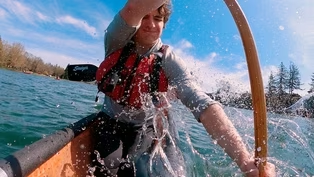
Clip: S37 Ep10 | 10m 24s | Oregon State University engineering students build and race concrete canoes. (10m 24s)
 New
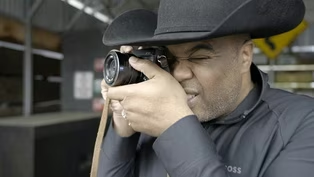
NewPhotographer and Rodeo Wrangler Ivan McClellan (originally aired on “Oregon Art Beat”)
Video has Closed Captions
Clip: S37 Ep10 | 10m 2s | How photographer Ivan McClellan’s vision brought a Black rodeo boom to Portland. (10m 2s)
Providing Support for PBS.org
Learn Moreabout PBS online sponsorship














Support for PBS provided by:
Oregon Field Guide is a local public television program presented by OPB