Oregon Field Guide
Concrete Canoe Races, Rodeo Photographer, Oregon’s Gray Whales
Season 37 Episode 10 | 29m 29sVideo has Closed Captions
Students race concrete canoes. Documenting Black rodeos. The whales that call Oregon home.
College students across the NW compete to make boats out of concrete and race them. How photographer Ivan McClellan’s vision brought a Black rodeo boom to Portland. Why a special population of gray whales lives off the Oregon Coast year round instead of migrating.
Problems playing video? | Closed Captioning Feedback
Problems playing video? | Closed Captioning Feedback
Oregon Field Guide is a local public television program presented by OPB
Oregon Field Guide
Concrete Canoe Races, Rodeo Photographer, Oregon’s Gray Whales
Season 37 Episode 10 | 29m 29sVideo has Closed Captions
College students across the NW compete to make boats out of concrete and race them. How photographer Ivan McClellan’s vision brought a Black rodeo boom to Portland. Why a special population of gray whales lives off the Oregon Coast year round instead of migrating.
Problems playing video? | Closed Captioning Feedback
Where to Watch Oregon Field Guide
Oregon Field Guide is available to stream on pbs.org and the PBS app.
Providing Support for PBS.org
Learn Moreabout PBS online sponsorshipMajor support for Oregon Field Guide is provided by... [ ♪♪♪ ] WOMAN: Come on!
There he is, there he is, there he is.
[ exclaims ] Get him out of there, buddy!
Good boy!
[ laughing ] WOMAN: Whoo, high five!
Yeah!
AARON: Tonight on Oregon Field Guide: [ camera shutter clicking ] We follow one artist's journey from photographing cowboys to organizing a trailblazing rodeo.
MAN: Everybody in Portland and outside of Portland thought we had lost our minds.
[ gasps ] Look!
Right there!
Wow!
Then, we meet a unique group of gray whales that call Oregon home.
WOMAN: They swim upside-down and do rolls, and they're often doing headstands where they're trying to feed on what they can.
But first... This is a chunk of concrete, and as we all know, it doesn't float.
So why would you ever want to make a canoe out of it?
[ marching band playing fanfare ] IAN: On a college campus known for sports like baseball, basketball, and football, most folks don't know about the team you can find in the old engineering workshop... the Concrete Canoe team.
It’s exactly what it sounds like.
We’re making a canoe out of concrete.
It seems crazy, but it’s true.
A lot of people, they just can't really grasp their head around it, but that’s kind of the fun part about it.
MAN: Forty years ago, a bunch of civil engineers got together and said, " Hey, we need civil engineering, but sports!"
And so they came up with Concrete Canoe.
It’s a wild tradition.
Every year, on college campuses across the country, civil engineering students take on an extracurricular challenge: building canoes out of concrete that float and racing them against other schools.
We make concrete canoes because it is difficult.
Concrete, like what you see in sidewalks and driveways, is basically a mix of cement with tiny rocks called aggregate.
These rocks add strength, but also weight.
[ beeping ] 4.3754 pounds.
That’s a little on the heavy side.
A canoe, by its nature, is meant to float.
And concrete, as we all know, sinks like a stone.
So making the concrete strong but also light is the first challenge for the students.
And this is where things get granular, literally.
The stuff we make our concrete out of is not like you would find in any retail store.
It's all designed by us for our very niche and unique purpose.
So to make concrete that floats, the students add buoyant aggregates like ground-up cork, tiny glass beads, and even feather-like flakes of fiberglass.
As the mix crew mixes, the construction crew finalizes the shape of the canoe, the foam form to be used as the mold.
The thickness of the concrete is critical.
Too thick, and that's extra weight, which will slow the canoe on race day.
But too thin, and the walls of the canoe become brittle, like ceramics, risking cracks and even sinking.
That’s the most quarter-inch of a quarter-inch I’ve ever seen.
Yeah!
[ whirring ] Each year is a chance for a new design, testing new concepts to make a better concrete canoe.
And any new idea is always an experiment that might not actually work.
[ sighs ] Will it break if we drop it or if we sit in it the wrong way?
I hope to never find out.
Oh, yeah.
That's getting better.
After the mix is ready, it’s time for pour day.
The concrete isn’t exactly poured, per se.
More, it's smooshed and then smoothed, one handful at a time.
Pour day is definitely the most important, because if anything goes wrong, there’s no take-backs and redos.
WOMAN: We only have so much time to work with it before it starts curing, and then once it starts curing, we can't really overwork it at that point, so we’ll go batch by batch.
After the concrete is all poured, it needs to cure, and this will take at least a month.
And to keep the concrete from cracking as it dries, the students designed a DIY sprinkler system.
As the competition canoe is left to cure, the team heads to a local lake.
One, two, three.
Everyone ready?
This is their first attempt at a concrete canoe, a prototype started in the fall term and is now ready to try out.
Lower the canoe.
Okay, slow.
It weighs a couple hundred pounds, and getting it into the water is where engineering theory and a fair amount of guesswork get put to the real-world test.
ALEC: A concrete canoe does not handle like your typical canoe.
I was not prepared to get in a concrete canoe, but then again, who is?
The designs and calculations have tried to strike a balance.
To be fast in the water for the race, the hull should be long and slender, but that makes it unstable... I’m trying.
...and risks capsizing.
ALEC: It's very hard to describe beyond it’s very tippy and balancing is very challenging.
See, it’s just not going to go... Oh, [ bleep ]!
[ gasps ] [ man laughs ] With their tight term schedule and a full class load, the students only get a weekend or two to practice paddling.
There’s not too much that goes along with the technique.
It’s more of just practicing the techniques.
You know, making sure you know how to stay in a straight line, making sure you know how to, like, turn.
There you guys go, you’re going good.
I'd say about 30% of the teams can go in a straight line, so we’re doing pretty good if we’re there.
ALEC: Water is slowly but steadily coming into the canoe.
That’s not a great sign, but this is the practice canoe.
So we won’t be bringing this to the competition.
Nice!
Yeah!
After allowing the competition canoe to cure for a month, it’s the big moment of truth: pulling it off the form.
Has it dried completely?
Has it cracked?
All right... If something has gone wrong, there’s not enough time to make another canoe.
Three, two, one, lift.
All right, we’re going to rotate it towards my right.
Oh, that’s pretty-- All right.
Heck yeah.
All right.
All right, let’s get to patching.
RACHEL: I really liked how it looks on the inside.
It's super smooth and the colors look pretty good and it doesn't need too much patching, so this is a good thing.
They seal up the porous concrete to make it watertight, or as watertight as concrete can get.
And with this last step, it’s time to head to the races.
A different school hosts each year, and this year is Portland State University’s turn.
Teams have come from across the Pacific Northwest, and students get their first chance to size up their competition.
And some of the canoes have already been patched with duct tape.
From fall to spring, the students have invested more than a thousand hours to get to this point.
And for this extracurricular challenge, race day is the final exam.
[ people applauding, cheering ] STUDENT: Let’s go!
[ overlapping chatter ] Good luck, Beavers!
They line up for the first of many races.
ANNOUNCER: Ready, go!
RACHEL: Row!
And they’re off.
Row!
[ crowd cheering ] MAN: Paddle, Barbara and Carol!
You didn’t expect these races to be fast, did you?
WOMAN: Yeah, you got it!
Hard to tell if the Ducks are in the race, and if they’re winning.
And one canoe seems to have a significant list to one side.
One team's canoe breaks apart and they cross the finish line with a swim.
But the spirit is high.
CROWD [ chanting ]: O-S-U!
OSU celebrates the first races of the day... [ cheering ] ...but already, the canoe is taking on water.
WOMAN: There’s a leak in it already?
When the water's bailed out, the source of the leak is identified.
It doesn’t look good, but it’s a slow leak.
Let’s go, Beavers!
The races go all day-- all day-- and everyone gets a chance to paddle.
And each race adds up to points toward the total school score.
CROWD: Let’s go, Beavers!
But the real test of the canoes-- and teamwork-- comes at the end of the day with a four-person coed race.
ANNOUNCER: Everyone, paddles up.
The schools square off at the starting line.
Get ready.
Go!
[ crowd whistling, cheering ] OSU starts strong... and rounds the buoy back to the starting line... followed closely by the canoe called Cementitious Maximus, paddled by wizards... followed by the canoe that seems precariously on the brink of capsizing.
[ cheering ] Bring it in, come on!
CROWD: Let’s go, Beavers!
It’s about as neck-and-neck as a concrete canoe race comes.
OSU is coming in fast to the finish line, but stalls.
Ah, the thrill of victory and the agony of defeat.
I got a little flustered seeing the other teams ahead of us, and I focused a little bit too much on trying to get us to go faster and not enough on getting us going straight.
So not quite what I wanted to see in the last race, but really good for today.
Okay, one, two, three!
No glory of first place.
And they don’t even get a grade.
But getting to this moment calls for a victory celebration.
At the end, it’s a club.
It's for fun.
Three, two, one!
[ all cheering ] ALEC: The competition to me is a celebration of engineering, a celebration of all of our efforts to make something that shouldn’t work.
And now it’s time to load up the canoe.
PHILIP: You know, the whole time that we're working on this, there's so many people working really hard to make everything happen, and it won’t work if you have just a few people.
But when you're moving the canoe, you get the physical manifestation of that, because you all physically have your hands lifting the same object up together, doing something that’s really hard... Up and over.
...and I think that’s quite beautiful.
[ crowd cheering, applauding ] Congratulations, everybody!
[ ♪♪♪ ] This next one comes to us from our friends at Oregon Art Beat.
It's about the photographer Ivan McClellan, who managed to wrangle up a rodeo where no one thought possible.
[ ♪♪♪ ] The cowboy hat... the boots... the horse... the flag is a powerful symbol for us as Americans.
I've taken in a single photo and put all of those elements together on a Black woman.
[ ♪♪♪ ] And it's undeniable, the power of those pieces coming together in one frame.
Taking that icon and merging it with a Black man or a Black woman means something deep.
It takes a lot of the stereotypes and the prejudices that we have about a Black person, and we merge them with our most noble ideas.
And it makes you think.
Or, if you're a Black person, it gives you, you know, a sense of pride.
No, not at all.
I don't stress.
[ laughs ] No?
That's not part of my... part of my deal.
Well, it looks good in here.
I get sleepy.
When the pressure gets high, I go, like, "Whoo, I'm tired."
[ chuckles ] It looks good.
So, yeah, we're good.
Thank you.
You guys did a lot.
Thank you.
I had had the idea to do my own rodeo for about two years, and I had been talking to other cowboys and other rodeo producers about it.
A friend of mine, he's like, "You do the stuff with Black cowboys.
Why don't we bring out some Black cowboys for Juneteenth?"
Everybody in Portland and outside of Portland thought we had lost our minds.
You know, we heard people like, "Why would you do it there?"
Or, "There's no Western culture there."
I absolutely love rodeo.
I'm a tie-down calf roper and a team roper, but my passion is designing clothes.
And my company, we have a Western wear line, me being a cowboy, and then Mr.
Ivan reached out to me and told me he was about to make history, and I was like, "Oh, I'm gonna go see about that.
I gotta be there."
So I have to bring the South out here to the Pacific Northwest and let y'all see what we do.
So I've been a cowboy since I was about 6, 5 years old.
I was riding horses in the backyard with my uncles and my cousins.
With bull riding, you just gotta roll with the punches.
I mean, tomorrow, the rodeo's gonna be a sold-out crowd, so sold out from back door to front door, so it's going to be good energy, live, and I can't wait.
We've hauled in truckloads and truckloads of dirt, we've got the best audio guy in the Northwest working for us, and we've got the best lighting guy in the Northwest as well.
The idea was that we would do an inclusive rodeo and we would bring out folks that just hadn't felt comfortable going to an old-fashioned rodeo, but they could come to our rodeo.
[ woman singing over PA ] I just thought, these Black cowboys here in Portland will mean so much to the people here, and it will literally change lives.
[ laughing ] The tickets sold out in a few days.
It just sort of caught fire and everything went.
People treat me like I'm the rancher.
I'm not that guy.
I don't know anything about rodeo or cowboying beyond what I've captured, and I'm definitely not a cowboy myself.
I'm an artist and I do art.
[ ♪♪♪ ] I grew up in Kansas City.
We grew up in a really interesting place, because it was urban in front of our house, but behind our house was five acres of land.
There were people back there raising cows, and it was just like sort of growing up in two worlds at the same time.
We'd watch old Westerns on TV like "Gunsmoke" and "Bonanza" and we'd watch "The Beverly Hillbillies."
For a long time, a cowboy has kind of been one thing, and that's John Wayne.
This sort of independent white man in a cowboy hat permeated American culture in a really powerful way and became this icon, this untouchable icon.
It's not true.
And when I found out that there were Black cowboys, it kind of shattered a lot of those images that I had seen in films, and it was like, "Wow, this culture that I love is related to this culture that I'm from" was so exciting and so compelling to see that I kept going back, because it was like living out a real Western in real life.
Black cowboy culture really is a lot like that rural/urban divide.
You'll see urban culture and country culture just smashing together: guys riding horses with no shirt and a gold chain and basketball shorts and Jordans.
Women with, you know, long acrylic nails and braids grooming horses or barrel racing.
You know, the fashion really merges with what you see in the city.
You know, people are, in cowboy culture, a little bit scrappy.
Not a little bit scrappy, they're scrappy as hell.
[ ♪♪♪ ] These are people you don't want to get in a fight with.
There's a lot of volatility in a lot of these folks' lives.
I don't take these people out of their element.
We're in people's backyards.
These are their horses, their land.
Their connections with these animals are just unreal.
I took a picture of a cowgirl named Kortnee Solomon, she said, "Hey, Mr.
Ivan, just to let you know, it's going to rain in six minutes."
And I said, "Okay.
I'm gonna lay on the ground like this and I want you to run your horse right by me."
She's 11, and she said, "No problem."
And she comes galloping on her horse, she gets right above me, I take a picture of her.
She's, you know, looking straight forward, her braids are blowing back in the wind, there's dramatic clouds going, and right after that, it started raining torrentially.
I just sort of shoot and I can feel when things are right.
And then something goes up your arm and goes up your spine and tickles your brain.
[ ♪♪♪ ] I'll shoot and then look at everything.
I don't trust the camera.
I think the important part for me is to revisit.
So every year or so, I go through everything that I've ever taken.
I go through terabytes and terabytes of images.
I see different things.
Maybe I think I discarded it because it was blurry, but now, in this space that I'm in, I really love this photo.
And then I'll pull it back out and put it out in the world.
Truth is a very difficult thing to nail down.
I've seen people go into this rodeo space and have a completely different truth than me.
Some people might go in and focus on poverty.
Somebody might focus on fashion or athleticism or something like that.
The way that I capture rodeo, the way that I capture Black cowboys is based on my experience.
I don't think anybody knows why someone gets on a bull or a bronco.
It's definitely not money.
It might be how they grew up, it might be that it just sort of simplifies things.
At least for eight seconds, like, the only thing in the world is holding on.
[ ♪♪♪ ] [ announcer speaks indistinctly over PA ] [ crowd cheering ] People were really, really excited to be there.
I've heard people say that it was a spiritual experience.
I've heard people say that it was the best live event that they've ever been to.
For Portland, there were a ton of Black people there.
There were a ton of white allies there that wanted to do something for Juneteenth.
And just sort of seeing all of these folks in a moment of absolute joy and expressing that joy in unexpected and uncontrolled ways... I just love seeing people, like, have that experience and have that moment.
The athletes said it was the best event that they'd ever been to as well.
They keep calling me and they're like, "Is next year's event on?
I want to start planning to come up there."
Because they got that gift of energy from the crowd as well.
For it to be a place of community and to give that community a moment of joy is so satisfying and so rich.
[ ♪♪♪ ] Gray whales that live along the coast of Oregon, you often find them near kelp.
You might wonder what the connection is between gray whales and kelp.
In this story, we're going to find out why.
[ gull caws ] STEPHANI: You might think of gray whales as feeding out in the open ocean, but on the Oregon coast, there's this unexpected population that feeds right along the shore.
Gray whales on the Oregon coast, they are fascinating!
They live in a super shallow environment, feeding and swimming in water that’s half as deep as they are long.
The gray whales are about 40 feet long.
That's about as long as a school bus.
So this means they have to do all sorts of gymnastics as they forage.
They swim upside-down and do rolls.
And they're often doing headstands where they're literally head down, fluke up and trying to hold position and feed on what they can.
No one knew why these particular gray whales stuck around to feed on the coast of Oregon while most other gray whales migrated north to Alaska for the summer.
So 10 years ago, Leigh Torres and her team set out to find out why.
Every day we get up at 6:30, half the team goes on the kayak, half the team is off on a cliff, like, observing for hours on end.
The kayak team collects data at 12 different sites spread across the wide bay at Port Orford, including six at Mill Rocks and six in Tichenor Cove, often in rough waters.
And here’s me hanging on to the kelp to keep us in place at this station because it’s a little choppy... one might say.
So the kelp is our friend here.
When they reach the site, they lower a number of instruments to collect a range of data, including water temp, clarity, and dissolved oxygen.
Okay, we are at station MR18, secchi disc depth was 4.5 meters.
Time of day is 8:10.47, 48, 49, 50.
Dropping.
There is also a GoPro that takes video so they can record how much zooplankton is in the water.
[ gasps ] Look!
Right there!
Wow!
A whale spouts right behind us... Oh, shoot!
I have to get a photo.
That was crazy.
...and then another.
Blow is behind the jetty.
The researchers think it might be a mother and her calf.
[ chatter over radio ] Another blow.
Gray whales, like other baleen whales, they eat tiny animals called zooplankton.
I'm going to let it drift naturally.
So to get a sample of that, Celest does the final piece of their data collection and she drops in this small plankton net.
And we pull it up really fast because we want to capture as much prey as possible in the water column.
These are all the little... that we just pulled up.
They're all swimming up in there.
For the kayak team, whale blows are a bonus.
For the field crew stationed on the cliff top, it’s their main focus.
Sometimes we spot a whale right away, and other times it's like, "Well, no whales today."
"Just keep looking around."
We integrate a graduate student, undergraduate students, as well as high school students, all working together as part of this team to collect the data on the whales and the zooplankton.
This involves a lot of, "Is it a wave or is it a whale?"
[ Eden laughs ] They use a device called a theodolite to precisely map whale spouts from the cliff.
And then inside here there's like a crosshair, and we try to put the whale blow or, like, where it just was exactly in there.
And then... [ beeps ] it'll give us coordinates on the screen.
Doing this day after day, year after year, shows where the whales are traveling and foraging.
I'm downloading the data from the RBR that we got out on the water.
So then we end up getting this big datasheet with the readings from every half second.
Back at the lab, the researchers start processing the data.
This is the GoPro descending through the water column.
9:15.
They log the zooplankton visible in the footage and compare that to the zooplankton collected in the net.
The first time I pulled up a sample myself, it was absolutely full of zooplankton.
And pretty much since then I was really excited about learning to identify them.
This species of zooplankton, I have to look at their tail to identify them.
It’s common for us to have different species in a sample.
It’s like a zoop soup.
Taken all together, these measurements have started to paint a picture about why these whales stick around through the summer.
For one, whales love this zoop soup, and the zoop soup is thickest near the kelp forests.
Kelp is a centerpiece to our coastal ecosystems.
They provide habitat for so much of our rocky reefs.
But Oregon has lost almost two-thirds of its kelp forests in recent years.
There is reason to be concerned about losing kelp.
When that kelp declines, the zooplankton availability and abundance also declines, which is the prey resource of whales.
These gray whales, who researchers have dubbed the Pacific Coast Feeding Group, are full of surprises.
They feed on different prey than the rest of the gray whales that go all the way to the Arctic.
They are feeding all summer and fall long, right in the very near shore environment, literally what we’re looking at here.
But we've also found that these gray whales are actually shorter than the other gray whales.
Maybe they need to be shorter to live and feed in such shallow environments.
We also have learned that the animals will shift foraging strategies as they age.
So when they're younger, they feed more in a forward-moving strategy.
But as they get older, they feed more stationary, like in a headstanding strategy.
I see them as risk takers.
They’re willing to try something new and see if it works.
And I think that really will help them out as we move forward into climate change where so much is changing and animals need to adapt to survive.
[ ♪♪♪ ] You can now find more Oregon Field Guide stories and episodes online.
And to be part of the conversation about the outdoors and environment here in the Northwest, join us on Facebook, Instagram, and YouTube.
[ yelps softly ] [ indistinct chatter ] [ electronic music playing over speakers ] Major support for Oregon Field Guide is provided by... Additional support provided by... and the following... and contributing members of OPB and viewers like you.
 New
NewVideo has Closed Captions
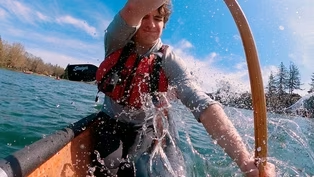
Clip: S37 Ep10 | 10m 24s | Oregon State University engineering students build and race concrete canoes. (10m 24s)
 New
NewVideo has Closed Captions
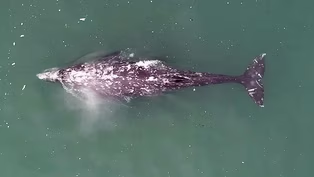
Clip: S37 Ep10 | 6m 23s | Why a population of gray whales summers off the Oregon Coast instead of migrating (6m 23s)
 New
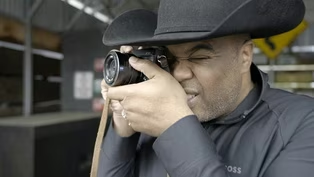
NewPhotographer and Rodeo Wrangler Ivan McClellan (originally aired on “Oregon Art Beat”)
Video has Closed Captions
Clip: S37 Ep10 | 10m 2s | How photographer Ivan McClellan’s vision brought a Black rodeo boom to Portland. (10m 2s)
Providing Support for PBS.org
Learn Moreabout PBS online sponsorship













Support for PBS provided by:
Oregon Field Guide is a local public television program presented by OPB